|
Congratulations on closing out FY23 and the start of FY24. We know it was a lot of hard work to get the invoices in and we really appreciate all your hard work. Thank you and enjoy the rest of your summer!
Our next office hours are set for Aug. 17 from 3-4 p.m. We will be focusing on updates to the Monthly Enrollment and Quarterly Progress Reports you will see in the PSRS. Join here.
As part of our MIECHV funding, we are required to report back on several measures, and unfortunately missing data remains an issue for our state. We ask all sites to help us to ensure that their data is as complete as possible. We hope that you find articles like this helpful and please remember we have a variety of resources available on the website or you can reach out to DOH directly at HomeVisiting@doh.wa.gov. We will continue to provide articles like this to support the field, please let us know if you have any suggestions for future topics or areas of focus.
Tobacco Use and Tobacco Cessation Referrals
Tobacco use is the leading cause of death and disease in the United States. In Washington State, cigarettes are the most common type of tobacco used among adults. Those exposed to secondhand smoke, including babies of mothers who smoked during pregnancy, are also at risk for serious health impacts. In 2017, approximately 14% of Washington residents aged 18 and older smoked cigarettes. In 2020, an estimated 10% of pregnant women smoked cigarettes during the three months before pregnancy, 4% smoked during the last three months of pregnancy, and 5% smoked during the postpartum period.
Smoking during pregnancy can lead to preterm delivery, low birth weight, and other serious problems for the baby. Babies whose mothers smoke while pregnant and babies who are exposed to secondhand smoke after birth are more at risk for sudden infant death syndrome (SIDS) than babies who are not exposed to cigarette smoke. For infants and young children, secondhand smoke exposure causes respiratory infections, leads to more frequent and severe asthma attacks (among children who already have asthma), and increases risk for ear infections.
Other tobacco products, including electronic vapor products (EVPs), also cause significant risks to pregnant women and babies. Nicotine can affect fetal brain and lung development, and some flavors in EVPs have been associated with negative health effects for developing babies. The use of EVPs is of particular concern for teens in Washington State. In 2017, an estimated 21% of Washington 10th graders used vapor products, while 5% smoked cigarettes. Among pregnant women in Washington State, in 2020, 5.5% used e-cigarettes during the three months before pregnancy and 1.9 % used e-cigarettes during the last three months of pregnancy.
High rates of tobacco use disproportionately affect marginalized communities in Washington. Among racial groups, 27% of American Indian and Alaska Native adults smoke, followed by 16% of African Americans, and 16% of Native Hawaiian and Pacific Islanders. In addition to those groups, those with lower income, lower level of education, and poor mental health are also at higher risk for tobacco use.
Measuring Tobacco Use in Home Visiting Families
Home visiting programs that receive MIECHV funding are required to measure tobacco use among primary caregivers at enrollment. If a caregiver reports current tobacco use at enrollment (i.e., smoking, vaping, chewing) the home visitor is asked to make a referral for tobacco cessation counselling services. Referrals must be made within three months of enrollment.
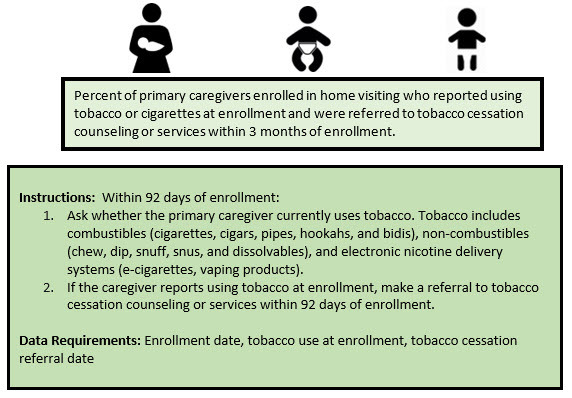 While all primary caregivers should be assessed for tobacco use, only those who report tobacco use at enrollment are included in the measure. Those who reported using tobacco but were already receiving tobacco cessation services at enrollment are excluded from the measure. The Tobacco Cessation Referrals MIECHV Measure Definitions PDF on the DCYF Data Collection and Reporting Page can be reviewed to learn more about how this measure’s performance is calculated.
How are we doing?
 |
|
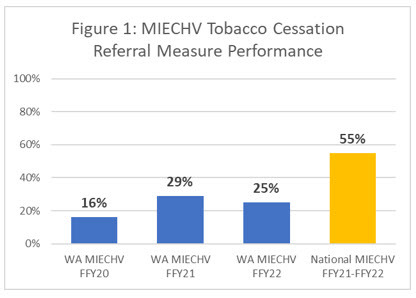
In FFY 2022, 525 MIECHV-funded primary caregivers were eligible for this measure, of which 40 (7%) reported using tobacco at enrollment. Among those 40 caregivers, 25% received a tobacco cessation referral within three months of enrollment. Figure 1 displays performance among Washington MIECHV-funded families in Federal Fiscal Years (FFY) 2020 to 2022. There was a 13-percentage point increase in tobacco cessation referrals made within three months of enrollment from FFY 2020 to FFY 2021. |
In FFY 2022, there was a slight decrease in primary caregivers that reported tobacco use at enrollment and received a tobacco cessation referral within three months of enrollment. Nationally the mean performance among all MIECHV programs was 55% in FFY 2021 and FFY 2022.
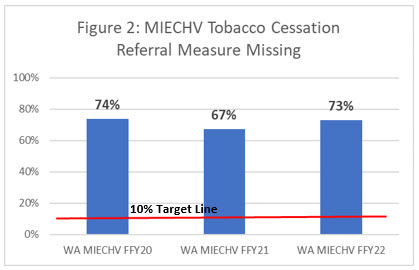
Figure 2 looks at the percent of missing data from FFY 2020 to FFY 2022. For this measure, the percent of missing data is extremely high and has increased from 67% to 73% in FFY 2022. Contributions to high missing data includes inaccurate data entry for tobacco screenings and primary caregivers not having a tobacco screening documented within 92 days of enrollment. |
|
 |
Please review the screening tools and visit protocols to identify how to help close this gap in missing information for your MIECHV Home visiting families
How to enter data?
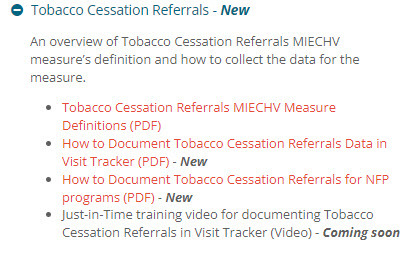
Instructions to enter data is now available for programs on the website. Please refer to the MIECHV Performance Measures section on the Data Collection & Reporting page for instructions on how to document Tobacco Cessation Referrals on Visit Tracker and Flo.
SFY23 Closeout
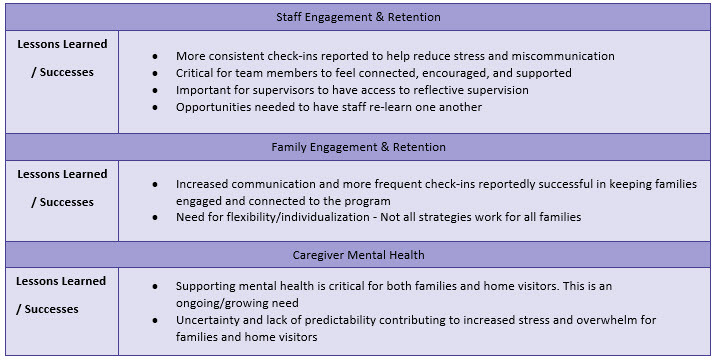
Thank you for your feedback and contribution throughout this last fiscal year! We completed three webinar series on Staff Engagement & Retention, Family Engagement & Retention, and Caregiver Mental Health. In each series participants identified root causes, strengths and strategies as well as sharing real-time examples through LIA spotlights, breakout rooms and full group discussions on sustaining gains.
LIAs contributed to lessons learned from previous experience and current PDSA cycles being implemented throughout the year. Below is a summary of key highlights, for a full view visit Basecamp along with webinar slides and recordings.
 SFY24 HVSA CQI Contract Requirements
CQI Structure
- Focus CQI activities on one of the following topics:
- Staff Engagement and Retention (Team Support and Well-Being)
- Family Engagement and Retention
- Caregiver Mental Health
- Other topic areas approved by DCYF
- Establish an internal CQI staff team to oversee support and implement CQI activities to assess program processes and outcomes; the CQI Team members are expected to participate in regular CQI team meetings, CQI webinars, and CQI project activities.
CQI Activities
- Participate in monthly CQI calls/webinars
- Conduct and track data in ongoing rapid cycle PDSAs and reflect on the data
- Report on Activities and Reflections through Monthly and Quarterly progress reports
- As part of ongoing quarterly reports, the contractor will share details of ongoing PDSA testing, data, reflections, and adaptations
- Contractors experiencing Minimum Active Enrollment Caseload below 85% of the Maximum Service Capacity, as defined in Section 6 (c) of this statement of work, will report monthly via the Monthly Enrollment Report on CQI activities, including PDSA tests, data and reflections, to address understanding and improving their Active Enrollment Caseload
- Create a plan for sustaining gains made through CQI activities
For questions regarding contract requirements, please contact your DCYF Program Specialist.
Each month, DCYF ESIT Tribal Program Consultant Brian Frisina will provide a key topic to help support us all in getting to know our Tribal Nations partners better.
This month’s topic is:
Northwest Indian Fisheries Commission (NWIFC)
The Northwest Indian Fisheries Commission (NWIFC) is a natural resources management support service organization for 20 treaty Indian tribes in western Washington. Headquartered in Olympia, the NWIFC employs approximately 65 people with satellite offices in Burlington and Forks.
NWIFC member tribes are: Lummi, Nooksack, Swinomish, Upper Skagit, Sauk-Suiattle, Stillaguamish, Tulalip, Muckleshoot, Puyallup, Nisqually, Squaxin Island, Skokomish, Suquamish, Port Gamble S’Klallam, Jamestown S’Klallam, Lower Elwha Klallam, Makah, Quileute, Quinault, and Hoh.
The NWIFC was created following the 1974 U.S. v. Washington ruling (Boldt Decision) that re-affirmed the tribes’ treaty-reserved fishing rights. The ruling recognized the tribes as natural resources co-managers with the State of Washington with an equal share of the harvestable number of salmon returning annually.
The commission is composed of representatives from each member tribe who elect a chair, vice chair and treasurer. Commissioners provide direction to the NWIFC executive director, who in turn implements that direction.
The role of the NWIFC is to assist member tribes in their role as natural resources co-managers. The commission provides direct services to tribes in areas such as biometrics, fish health and salmon management to achieve an economy of scale that makes more efficient use of limited federal funding. The NWIFC also provides a forum for tribes to address shared natural resources management issues and enables the tribes to speak with a unified voice in Washington, D.C.
Back To The River
From our collection of extensive interviews with the people involved in the Fishing Wars plus added interviews, we compiled an hour-long video called “Back to the River.” It is designated as a companion video to “As Long as the Rivers Run” to help today’s viewers understand the struggle for recognition of tribal treaty fishing rights and to share the experience through their eyes. The film bridges the gap of misunderstanding by educating the public about this vital time period that shaped Pacific Northwest history and helped open doors to many tribes throughout the United States.
February 1, 2013 marked the release of “Back to the River” which premiered at the Seattle Aquarium. Guests received copies of “Back to the River” and “As Long as the Rivers Run.” From there we have continued a touring roll-out of “Back to the River” at different reservations.
Back to the River tells the story of the treaty rights struggle from the pre-Boldt era to tribal and state co-management. The movie includes the voices and personal accounts of tribal fishers, leaders and others active in the treaty fishing rights struggle.
View “Back to the River” in its entirety online (watch time 38:11):
Sources
The Northwest Indian Fisheries Commission (NWIFC) | Serving the Treaty Tribes in Western Washington, © 2016.
Back to the River - Salmon Defense. Salmon Defense is a 501(c)(3) tax-exempt charitable organization.
What is Health Equity? Episode 2 of "That's Public Health"
July national minority mental health awareness month. Health equity is a public health approach that tackles health differences that are avoidable, unnecessary and unjust, and works to improve everyone’s health. Learn how in this second episode of the "That's Public Health" web series from American Public Health Association and Complexly (watch time 3:53):
Learn More
Read more about the current water inequity public health crisis within the Navajo Nation:
|
Ethnicity and Mental Health Review on the Universities of Bristol, Glasgow and Keele
Why do people from ethnic minority communities continue to have poorer access, experiences and outcomes in mental health care, despite 40 years of evidence highlighting inequalities? Researchers from the Universities of Bristol, Glasgow and Keele reviewed all the published and unpublished evidence on experiences of communities, service users and mental health professionals. This video explains the findings (watch time 4:32):
Webinar recording and slides now available
On June 29, the MIECHV TARC and the National Center on Early Childhood Quality Assurance hosted the webinar, Home Visiting and Early Care & Education: Opportunities for Collaboration. If you missed the event, want to go back and review the content, or want to share the recording with colleagues, the closed-captioned webinar recording is now available on the TARC’s YouTube channel. The slides are also available.
|
|
News
WA is taking a new approach to caring for newborns exposed to drugs, The Columbian
Treehouse Expands Programs for Youth in Foster Care Throughout Washington, San Juan Islander
Expert appointed to oversee Oregon agency that has been housing foster kids in hotels, The Seattle Times
|