|
DCYF has open funding opportunities at the moment, check them out and see if you qualify for any!
DCYF Early Childhood Equity Grant: The Fair Start for Kids Act, passed by the Washington State Legislature in 2021, directs DCYF to distribute funds to support inclusive and culturally and linguistically specific early learning and early childhood and parent support programs across the state. The funds are distributed through the Early Childhood Equity Grant program. The Early Childhood Equity Grant helps support culturally responsive programming so that children have access to diverse care that meets their needs. The Early Childhood Equity Grant Application is now open! The application will remain open until June 30, 2023 at 5:00pm. Learn more and apply here.
Tribal Focused Organizations RFA: The Washington State Department of Children, Youth, and Families is excited to announce a funding opportunity for Federally Recognized Tribes, Recognized American Indian Organizations (RAIOs), and other Native Serving Organizations. Through this funding opportunity, DCYF will contract with Tribal Governments, RAIOs, and Native Serving Organizations to pilot culturally responsive and specific prevention services to reduce entries into out-of-home care among Native children. This pilot will help DCYF and its pilot partners learn what it takes to achieve that goal in advance of an anticipated expansion in these kinds of services in the coming years.
The application will be live from May 10, 2023 and due by July 7, 2023, by 5 p.m. The agency anticipates awarding 3-6 contracts, valued at approximately $100,000-$200,000 for one year, with a possibility of further extension dependent on available funding and pilot success. The initial contract will run from October 2023, through September 2024.
All Washington Federally Recognized Tribes, Recognized American Indian Organizations (RAIOs) and other Native Serving Organizations are encouraged to apply for this opportunity. Information about this opportunity including the Request for Applications (RFA) form, is available at Washington’s Electronic Business Solution, WEBS Website: https://fortress.wa.gov/ga/webs/
Please contact Rachel Denny at Rachel.Denney@dcyf.wa.gov for any questions.
Reminder: there will be no office hours in July. If you missed the June office hours, or any others, you can find the PowerPoints here; of note are the June slides which include a summary of the minor updates to the DCYF Statement of Work in your upcoming contract We will see you in August!
DCYF Parent Advisory Group Recruitment: Applications Due June 30. DCYF is excited to announce the recruitment of parents and guardians for the Department of Children, Youth, and Families’ Parent Advisory Group (PAG)! At DCYF, we believe parents are their children’s first and most important teachers. PAG is a sounding board for decisions, ideas and questions that shape the future of DCYF. Parental involvement in decision-making is the key to having policies and programs that support families’ strengths and needs. The PAG is made up of parents and family caregivers of children, from prenatal through 17 years old.
To apply, visit the DCYF Parent Advisory Committee page or call Community Engagement Manager, Emily Morgan at 360-999-0009. Applications must be submitted by June 30. If you know someone who might be interested, feel free to share! We look forward to partnering with you and bettering the lives of children, youth, and families.
Check Out this New Resource!
Pause – Reset – Nourish (PRN) to Promote Wellbeing is a new 2-page resource, chockful of practices and links to other resources is available on the National Child Traumatic Stress Network website here: https://www.nctsn.org/sites/default/files/resources/fact-sheet/pause_reset_nourish_to_promote_wellbeing_use_as_needed_to_care_for_your_wellness.pdf
Great LIA Resources on Infant and Early Childhood Mental Health (IECMH) Consultation
You don’t need to be funded by MIECHV to take advantage of HRSA resources available from the MIECHV Technical Assistance Resource Center. The two documents linked below can help LIA’s thinking about embedding IECMH services in their home visiting programs and offers tips on how to find an IECMH consultant, which can help programs considering outside support for Reflective Supervision Consultation.
https://mchb.hrsa.gov/sites/default/files/mchb/programs-impact/finding-an-IECMH-consultant.pdf
https://mchb.hrsa.gov/sites/default/files/mchb/programs-impact/iecmhc-roadmap.pdf
Data Best Practices: Protecting the Data of HVSA Families
Data that you collect from home visiting families is used to produce reports that go to programs, advocates, policy makers, and the general public, and to report back to funders. The data tells stories of families, and the impact home visiting is making on the families and communities. The data is also used for advocacy work by partners so that home visiting continues to grow in our state. Linked below are some of the products that have been published about Washington families. Reports like this are possible because of the data you collect from the families you serve.
To protect the privacy and confidentiality of HVSA families, Home Visiting staff and IT staff at DOH follow strict security practices and safeguards to manage families’ data.
- DOH acquires data either through access to the programs’ national data systems or directly from your program. The data is stored in a secure drive at DOH that is accessible only to authorized DOH staff directly related with home visiting work.
- Data is never used to identify individuals. Personal identifying information or PII (e.g., first and last names, home address) for families that consented to share PII, is used only to understand what proportions of families were referred to Child Protective Services (CPS). Once we have this information, it is used only to establish a percentage of families who were referred to CPS for the state as a whole to demonstrate that home visiting is likely preventing child abuse and neglect for many families in our state.
- When publishing reports, DOH follows a small numbers policy that prohibits us from reporting out counts below 10. We do not report data when any counts are below 10 to protect against someone using the results to potentially identify a family.
DOH uses MFT (Managed File Transfer) for sharing data and reports securely with LIAs. This is a new system that replaces the SFT or Secure File Transfer system. Use of MFT to transfer files between LIAs and DOH is particularly important when we are sharing client-level data to protect the privacy of clients and families, especially in regard to small numbers that could be identifiable (e.g., when there are less than 10 teenage clients). For this reason, DOH utilizes MFT and not email when transferring client or program files (e.g., Dashboards). Regular email is not secure since the messages are generally not encrypted.
At least one person from your agency should have access to your MFT account. When we post dashboards or other reports, please remember to download them within two weeks since they will be deleted after 14 days. The best practice is not to share the username and password of MFT. DOH recommends having two people on MFT account per LIA so that two people will be able to download the data.
Please contact DOH’s Home Visiting Unit Team at homevisiting@doh.wa.gov if you encounter issues accessing your MFT account or if you would like to add another person from your agency to MFT account. Instructions for setting up an MFT account can be found here on the Data Collection & Reporting page, under “Sharing Data with the Washington State Department of Health (DOH).
Protecting the privacy and confidentiality of HVSA families is our top priority at DOH. Please contact the Home Visiting Unit team at DOH (homevisiting@doh.wa.gov) if you have any questions or concerns.
Welcome David Kelly to the DOH team
The Home Visiting team is thrilled to welcome Kelly David as the new Data Trainer at the Department of Health (DOH)! Kelly joined our team in Mid-May, so some of you may have had the pleasure of meeting him already but I wanted to make a formal introduction.
Kelly joins the Trio with a breadth of experience in training and supporting through technical assistance in a variety of industries. Kelly has been with the Department of Health for more than ten years, serving in a Lead support role in the HSQA Office of Customer Service Call Center. As a Lead, Kelly was the primary call center trainer, technical support, call center support, an Online Services Subject Matter Expert, and a business applications tester working with HTS, Online Licensing, and Telecom. Prior to working for DOH, Kelly was in the electrical industry in a support role for six years, started two churches, and served in various pastoral services roles for more than twenty years.
Kelly enjoys serving others and providing support in any way that he can. We are excited to see his strengths applied in the home visiting work, training on our data systems and use of data.
Kelly is originally from Oklahoma, by way of the mid-west. He and his wife have lived in Washington in the Lacey area for twenty years.
Please join us in welcoming Kelly to the HVSA Team!
Start Early Home Visitor Peer Connection
Home Visitor Peer Connections provide a space for home visitors across Washington to connect with each other, share questions, strategies, and reflections on working with families. As we plan for the new fiscal year we encourage anyone that has participated in peer connections to share feedback using the survey below.
Home Visitor Peer Connection Survey
Sustaining Gains
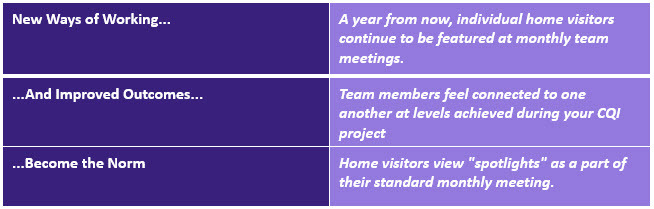
Sustainability occurs when new ways of working and improved outcomes become the norm. The following example demonstrates how to sustain gains as it relates to staff retention and engagement:
 May Webinar Summary – Caregiver Mental Health: Part 3
Caregiver Mental Health Part 3: In the last part of this series participants reflected on strategies and change ideas using key driver diagrams along with hearing about what sustaining gains have looked like through LIA share outs. This including reflections on the following questions:
- What strategy jumps out to you that you have not pursued before?
- How would you plan to implement this strategy?
- Are there any strategies that you would like to learn more about?
A very special thank you to everyone who attended and participated in this lively discussion!
Resources (found in Basecamp CQI Project Folders)
Looking ahead
Thank you again for your participation in this new webinar format! We would appreciate your feedback on this new approach for our CQI webinars. Please take a moment to complete our survey so that we can continue to improve upon this new practice:
CQI Monthly Webinar Survey
Upcoming Dates - June 28th & July 26th
CQI Monthly Webinars will continue to be held every 3rd Wednesday of the month from 1:30-2:30pm. The new webinar series for Fiscal Year 2024 has been shared out, if you or someone on your CQI team needs to be added to this invitation series please reach out.
For questions, support, or to be added to CQI listservs, please contact Camille Carlson: ccarlson@startearly.org
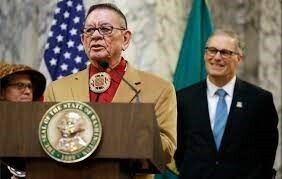 Former Sen. John McCoy, D-Tulalip, left, speaks Wednesday, Feb. 22, 2017, as Washington Gov. Jay Inslee, right, looks on at the Capitol in Olympia, Washington.
Each month, DCYF ESIT Tribal Program Consultant Brian Frisina will provide a key topic to help support us all in getting to know our Tribal Nations partners better.
This month’s topic is:
WASHINGTON, D.C. – Today, at a U.S. Senate Committee on Indian Affairs hearing, U.S. Senator Maria Cantwell (D-WA), made this statement about the passing of Tulalip tribal leader and former Washington state Senator John McCoy. “And if I could just take a moment to recognize the passing of one of our tribal leaders, John McCoy from the Tulalip Reservation,” said Sen. Cantwell. “Not only was he a 20-year member of the United States Air Force and a tribal leader at Tulalip, but he served our state legislature both as a representative and a senator, and we will miss him dearly.” Sen. Cantwell’s comments came moments before the committee passed S. 1723, the Truth and Healing Commission on Indian Boarding School Policies in the United States Act, addressing an issue of personal importance to Sen. McCoy. Sen. McCoy’s father was fluent in the Tulalip Tribe’s language but refused to teach it, saying “they beat it out of me” at boarding school. In 2005, as a member of the state House of Representatives, he helped win passage of a bill that encourages school districts to teach Native history and culture and to consult Tribes in developing that curriculum. Sen. McCoy continued to work on the issue in the State Senate, and was instrumental in passage of 2015 legislation to expand what is today the innovative “Since Time Immemorial: Tribal Sovereignty in Washington State” curriculum. The legislation passed out of committee today is consistent with Sen. McCoy’s view that “we must teach history – the good, the bad, the ugly – so that everybody understands how Indians were treated.” Sen. McCoy served the State of Washington’s 38th district for nearly two decades -- in the Washington House of Representatives from 2003-2013, and in the State Senate from 2013 until his retirement in 2020.
Sources
Image: Affiliated Tribes of Northwest Indians, shared on Facebook, June 8, 2023. Photo taken at Capitol in Olympia, Washington, Feb. 22, 2017, AP Photo/Ted S. Warren.
Cantwell Statement on the Passing of Former Washington State Senator and Tulalip Tribal Leader John McCoy, Press Releases, News, U.S. Senator Maria Cantwell of Washington, June 7, 2023.
Honoring and Celebrating Juneteenth
Juneteenth, also known as “Freedom Day”, “Emancipation Day” and “Jubilee Day,” is the oldest known holiday that commemorates the end of slavery in the United States. The enslavement of African American people did not end once the Emancipation Proclamation was signed by President Abraham Lincoln in 1863. It would take two additional years, and more than 2,000 federal troops to enforce freedom for 250,000 slaves in Galveston Bay, Texas. Despite slavery, Jim crow laws, voter suppression, segregation, economic inequality, police brutality, racial profiling, judicial injustice, individual injustice, housing discrimination, bias, and mass incarceration, African Americans have made great contributions to this country, beginning with hundreds of years of free slave labor that amassed great wealth outside of their community.
Congress passed The Juneteenth National Independence Day Act in June 2021 and President Biden signed the bill into law on June 17 – two days before Juneteenth. The federal government followed the lead of 47 states that already recognized Juneteenth. African Americans consider Juneteenth a celebration and time of empowerment. The Juneteenth flag represents the history, and the freedom of African American slaves and their descendants. The five-point star, a bursting star, and an arc signify a new freedom, a new people and a new star. The colors of red, white and blue communicate that the African slaves, and their descendants are all Americans. The colors also represent the blood, soil and prosperity of Africa and its people. Juneteenth is a reminder of the past and encourages continuous improvement by utilizing platforms to elevate black voices and their allies, with the goal of advancing racial equity, social justice, wealth-building, belonging, and access for present and future generations.
DCYF recognizes that underlying systems, policies and practices are driving disparate outcomes and experiences for our African American children, youth, and families. DCYF's strategic priorities are to eliminate racial disproportionality and advance racial equity. In 2020, the Office of Racial Equity and Social Justice (ORESJ) was established and is taking the intersectional approach, leading with race, to provide the vision, expertise, and accountability mechanisms necessary to make progress on DCYF’s commitment to advance racial equity and eliminate racial and ethnic disproportionality and disparities. The ORESJ is now at the Leadership Table, continuing to embed racial equity and social justice into the way we do our work and communicate with the community that we serve.
Let’s use this year’s Juneteenth holiday to seek out the plethora of celebrations in our local communities. Happy Juneteenth!
Pride Explained for Kids
Why do we celebrate Pride? Where does it come from? Watch Pop'n'Olly Learn and discover what happened on June 28th 1969. Learn about the Stonewall Inn and the event which helped pave the way for LGBT+ Liberation (watch time 3:34):
Pride Explained for Kids
14 Best Picture Books to Celebrate Pride Month with Kids
June is Pride month, a time to celebrate the LGBTQ+ community in all its wonderful uniqueness. It’s an opportunity for queer families and children to be seen and to share. Here are a few of the most joyful books with LGBTQ+ characters and stories for you to share with your child this month. Be prepared for giggles, touching conversations, and tons of rainbow color!
Article by Chrysta Naron, May 13, 2021, mayasmart.com.
News
WA tribes celebrate as Supreme Court upholds Native child welfare law, The Seattle Times
Expansion of access to Working Connections Child Care will help Washington families, The Cascadia Advocate
|