|
The Coronavirus State and Local Fiscal Recovery Funds (SLFRF) program, a part of the American Rescue Plan Act (ARPA) provided DCYF with funding to provide financial support to low-income families. Specifically, by means of unrestricted $250 cash grants per child to Washington State residents who were, and continue to be, impacted by COVID-19.
DCYF contracted with Scholar Fund as the Program Administrator in order to create and implement a plan and an application system to get the funds out to Washington State families.
Applications open on February 21, 2023 for eligible families. Applicants must:
- Have Washington State residency
- Have a child/children under the age of 18
- Have a household income that is under 200% of the 2022 Federal Poverty Limit
Applications will close on March 31, 2023.
For more information about this grant, including frequently asked questions and contact information for technical assistance, please visit the Washington Family Relief Fund Webpage.
HVSA Office Hours will be taking place March 16 from 3-4 p.m.
Join Zoom Meeting
https://dcyf.zoom.us/j/83183457961?pwd=UHZyRC90ZnhuU2RMNmRNQlFzTk5uQT09
Meeting ID: 831 8345 7961
Passcode: 644977
One tap mobile
+12532158782,,83183457961#,,,,*644977# US (Tacoma)
+12133388477,,83183457961#,,,,*644977# US (Los Angeles)
A Guide for DV survivors talking about their experiences of abuse and the child welfare system
WSCADV is offering a new resource for survivors of domestic violence to share their lived experiences in a way that can create meaningful change.
This new guide for survivors who want to share their stories, and the advocates supporting them provides inspiration and guidance on what to think about before, during and after speaking publicly about experiences with DV and the child welfare system.
Also, they will review best practices for DV advocates around mandatory reporting and supporting survivors.
Tuesday March 7, 2023 | 10 a.m. to noon.
Administration for Children and Families (ACF) is now soliciting applications for the Fiscal Year 2023 Tribal Maternal, Infant, and Early Childhood Home Visiting Grant Program: Development and Implementation Grants!
Funds will support 63-month cooperative agreements between ACF and federally-recognized Indian tribes (or a consortium of Indian tribes), tribal organizations, or urban Indian organizations to support the following: conduct community needs and readiness assessments; develop the infrastructure needed for planning and implementation of evidence-based maternal, infant, and early childhood home visiting programs; provide high-quality, evidence-based home visiting services to pregnant women and families with young children aged birth to kindergarten entry; implement performance measurement and CQI activities; and engage in activities to strengthen early childhood systems of support for families with young children.
This funding is intended for tribal entities that do not have prior experience with implementing evidence-based home visiting programs and are not currently implementing a program. A separate NOFO (Tribal MIECHV Grant Program: Implementation and Expansion Grants, HHS-2023-ACF-ECD-TH-0241) will be available soon for entities with such prior experience (including current Tribal MIECHV grantees).
Applications are due May 1, 2023. More information is available in the NOFO: https://www.grants.gov/web/grants/view-opportunity.html?oppId=345994
SFY23 Quarterly Dashboards
Thank you all for your feedback on the quarterly data dashboards. DOH has been working on modifications in response to your feedback. Some work is still underway, but we wanted to at a minimum provide information on enrollment, families served and retention now. Q2 dashboards will be posted to the MFT by the end of February. An updated guidance will also be posted to the MFT and will be available soon on the HVSA’s Data Collection and Reporting page in the DOH Data Products section under “Quarterly Data Dashboard Reports.”
New Visit Tracker HVSA Measures Tracking Tool
In January, Visit Tracker released an exciting new data quality feature to assist home visitors in tracking data related to the HVSA aligned measures and MIECHV performance measures.
For each family, there is now a “WA Measures Tracking” page that provides:
- An upcoming data collection schedule for each of the HVSA Aligned and MIECHV performance measures, and
- A summary of each primary caregiver’s and child’s data related to the Aligned and MIECHV measures.
 |
|
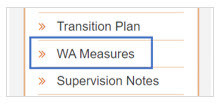
Home visitors can access this page by clicking on the “WA Measures” link in the left-hand menu of Visit Tracker.
More detailed information on this tool will soon be available on the HVSA Data Collection and Reporting page under “Quality Assurance Reports” in the “DOH Data Products” section.
|
Feel free to e-mail homevisiting@doh.wa.gov with any questions about the WA Measures Tracking tool.
Start Early Community of Practice
Start Early is launching another Communities of Practice (CoP’s) this Winter. This CoP is focused on home visiting supervisors. This CoP will be eight 90-minute sessions beginning February to April. A staff member of Start Early HUB supports this COP with facilitation and resources.
For more information and registration: Connecting with Peers-Supervisor Community of Practice
For questions, please reach out to Alex Patricelli - Start Early Technical Assistance and Training Specialist at apatricelli@startearly.org.
Start Early Home Visitor Peer Connections
February– Fun in our work!
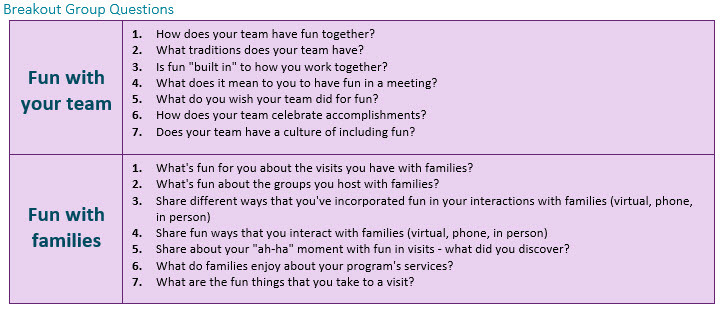
In February home visitors shared how their teams create fun and meaningful connections through group meetings and collaboration. Breakout rooms shared different styles of team meetings held virtually and in-person. In a second small group, home visitors also discussed how they have integrated play in home visits using hands on activities and interactive material. Reflecting on past visits, home visitors shared moments they felt successful in building a connection and strong engagement with families.
At the end of the peer connection the group shared their main takeaways from the time together. Home visitors found it helpful to hear how others experience similar challenges in engaging with families as well as connecting over the joy they feel in partnering with families.
 Resources
Upcoming Dates – Wednesday, May 10th (10-11AM)
We encourage any Home Visitor interested to sign-up using the link below:
Register for Home Visiting Peer Connections
For questions, please contact HVStartEarlyWA@startearly.org
Root Cause Analysis Tool: The Five Whys
The Five Whys is a problem-solving technique that helps to get to the root of a problem quickly. The strategy involves looking at any problem and drilling down by asking "Why?" or "What caused this problem?
While you want clear and concise answers, you want to avoid answers that are too simple and overlook important details. Typically, the answer to the first "why" should prompt another "why" and the second "why" will prompt another and so on.
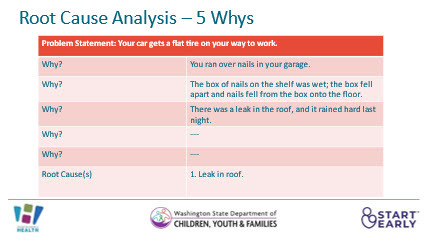 Conducting a five whys root cause analysis:
- Develop the problem statement. Be clear and specific.
- The team facilitator asks why the problem happened and records the team response. To determine if the response is the root cause of the problem, the facilitator asks the team to consider “If the most recent response were corrected, is it likely the problem would recur?” If the answer is yes, it is likely this is a contributing factor, not a root cause.
- If the answer provided is a contributing factor to the problem, the team keeps asking “Why?” until there is agreement from the team that the root cause has been identified.
- It often takes three to five whys, but it can take more than five! Keep going until the team agrees the root cause has been identified.
- To validate root causes, ask the following: if you removed this root cause, would this event or problem have been prevented?
January Webinar Summary – Family Engagement and Retention: Part 1
In the first webinar of the family engagement and retention series, participants identified root causes of family turnover and family engagement by building fishbone diagrams in small group breakouts. You can visit basecamp to view the full fishbone diagram created and other resources.
Resources (found in Basecamp CQI Project Folders)
Looking ahead
In part two of this series, participants will build upon the previous webinar and identify strengths and strategies that may lead to change ideas to test through PDSA cycles.
Upcoming Dates
Wednesday, February 22nd (1:30 – 2:30)
Family Engagement and Retention: Part 2
For questions, support, or to be added to CQI listservs:
Camille Carlson: ccarlson@startearly.org
Each month, DCYF ESIT Tribal Program Consultant Brian Frisina will provide a key topic to help support us all in getting to know our Tribal Nations partners better.
This week’s topic is:
Separation of Powers: State-Tribal Relations
Native American tribal governments are sovereign, self-governing entities. Much like state governments, tribal governments are responsible for the health, safety and welfare of their citizens and their communities. Tribal sovereignty pre-dates the formation of the United States and is recognized through the U.S. Constitution and numerous federal statutes and court cases. Tribal governments are on equal footing with state government and have a government-to-government relationship with federal government. The sovereignty of each entity necessitates a government-to-government relationship at the state and tribal levels as well.
States and tribes have adjacent jurisdictions, with some tribes crossing into the boundaries of more than one state. These bordering jurisdictions are a key reason why state-tribal relationships are necessary. In addition, services are now provided by tribal government to members and non-members who reside on or near the reservations. This makes coordination between state and tribal agencies and service providers essential. There also is an increasing desire to ensure that services provided to tribal members through state programs are culturally-competent in order to increase effectiveness. Finally, tribal citizens are also citizens of the state in which they reside. State legislators have a responsibility to provide for the well-being of all state citizens, tribal and non-tribal alike. The health and well-being of tribal citizens and tribal communities enhance the overall health of a state. In short, strong tribes contribute to strong states.
Sources
Image: What is Tribal Governance and How They Work, published July 29, 2022, © 2023 Southeastern Oklahoma State University.
Separation of Powers: State-Tribal Relations and Interstate Compacts. © 2023 by National Conference of State Legislatures.
Below are resources and opportunities to engage:
-
Can Kids Change The World?
Did you know that the fight for civil rights didn’t just include adults? Kids, like 7-year-old Ayanna Najuma, braved harsh consequences to make their communities more inclusive. Learn more about and be inspired by their uplifting bravery (watch time 6:55):
Can Kids Change The World?
-
Here Are 9 Ways to Celebrate Black History Month in 2023
Find ways you can honor and celebrate Black history this February by supporting Black businesses, educating yourself on Black history and more. Read full CNET article by Peter Butler (7 minute read):
Here Are 9 Ways to Celebrate Black History Month in 2023
-
We Gon' Be Alright: Notes on Race and Resegregation, book by Jeff Chang: "..an incisive and wide-ranging look at the recent tragedies and widespread protests that have shaken the country... links #BlackLivesMatter to #OscarsSoWhite, Ferguson to Washington D.C., the Great Migration to resurgent nativism. Chang explores the rise and fall of the idea of “diversity,” the roots of student protest, changing ideas about Asian Americanness, and the impact of a century of racial separation in housing."
As part of DCYF’s commitment to providing therapeutic and trauma-informed environments for youth in the agency’s care, Juvenile Rehabilitation (JR) has launched exciting collaborations and partnerships to bring creativity, resilience, and healing to young people at Echo Glen Children’s Center. For the 2022-23 school year, DCYF is partnering with Pongo Poetry Project, First Sight Productions (FSP), and Echo Glen School to provide therapeutic poetry writing workshops and filmmaking to students at Echo Glen.
One young person’s poetry has been transformed into a short film, titled Walk One Mile. The video invites viewers into the lives of Echo Glen residents, asking them to try on different shoes and experience life from their unique perspective.
“I want you to walk one mile, just one, in my shoes,” says the reader. “Do they fit? If not, then maybe you can understand why I am the way I am.”
This touching video was filmed by Echo Glen students with voiceovers from students at Mount Si High School. Providing our youth with an opportunity to write about and visually tell their lived experiences is both therapeutic and rewarding. It strengthens writing, organizational, and technical skills while helping youth claim their stories, fostering personal growth.
Home Visiting Playbooks for Strengthening Family Outcomes
The Home Visiting Collaborative Improvement and Innovation Network has released a series of interactive "playbooks" spanning seven topic areas. The resources feature change ideas, plan-do-study-act (PDSA) cycles, and key insights from teams working to improve outcomes among home visiting participants.
News
Educators want end to special education funding cap, Seattle's Child
Bridle Trails State Park: Kid-friendly trails on the Eastside, Seattle's Child
|