|
|
Adobe Stock image
DCYF employees who choose to provide verification of their up-to-date COVID-19 vaccination booster may be eligible for a one-time $1,000 lump sum payment contingent on legislative approval during the 2023 Legislative session. Obtaining a COVID vaccination booster is voluntary. While the initial COVID vaccination dosage is a requirement for employment (unless approved for an accommodation for religious or medical reasons), receiving a vaccination booster is not required.
Effective now through December 31, 2023, employees may submit verification of their up-to-date COVID-19 booster status. See additional details related to the booster incentive including how to submit your verification here.
How can an employee submit verification?
Employees may submit a copy of the front and back of their COVID-19 Vaccination Record card to the appropriate email address below.
Review the list below to find the correct email address.
The standard for COVID-19 booster verification is met when the employee provides proof they received the most recent up-to-date COVID-19 booster dose recommended by the CDC. An employee’s underlying medical condition will not be considered in determining whether an employee is up-to-date with their COVID-19 booster for purposes of receiving the incentive.
An eligible employee must meet all the conditions in order to receive the payment. For example, booster(s) have been verified, the employee is in a position eligible for the incentive, and they have remained employed on July 1, 2023, when eligibility for the payment has been met.
For information on current Center for Disease Control guidance on COVID vaccinations, including boosters, click here.
|
|
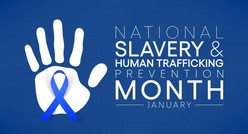
Wear blue on Wednesday, Jan. 11 to show support for National Human Trafficking Awareness Day.
January is National Human Trafficking Prevention Month and Wednesday, Jan. 11 is Human Trafficking Awareness Day. This month is dedicated to raising awareness about the different forms of human trafficking, ways to support trafficking victims and survivors, and educating the community about the issue of human trafficking. The more people that are aware of and equipped to identify potential trafficking situations, the quicker they can notify their local law enforcement. Join community members across the nation to raise awareness and show support by wearing the color blue on this day – the color for human trafficking prevention.
Human trafficking is a largely hidden crime involving one or more person exploiting another for labor services or commercial sex. Traffickers will often target young people, people who are or have been involved with child welfare or have been incarcerated, people experiencing poverty, homelessness, and discrimination, particularly those who identify as BIPOC and/or LGBTQ2IA+. The traffickers will sometimes use force, fraud, or coercion, but often when the victim is under 18, they will offer false promises of love or family and acceptance.
DCYF’s Commercially Sexually Exploited Children Regional Leads and Missing and Exploited Youth (MEY) Program assist Child Protective Services in supporting victims of trafficking in minors and the many youth in Child Welfare and Juvenile Rehabilitation facilities who are survivors of abuse and trafficking. On behalf of these young people and individuals worldwide, we encourage you to educate and increase awareness of exploitation and trafficking in your communities and improve systems that provide services for youth at risk.
Learn more about human trafficking by reviewing the following resources:
Check out some of the in-person events listed in our Events Section.
|

January is National Mentoring Month – a month dedicated to celebrating mentors and their positive influence on young people, as well as an opportunity to raise public awareness of the importance of mentoring.
To celebrate, Gov. Jay Inslee proclaimed January as Mentoring Month in Washington State. See the Governor's Proclamation.
Youth who have mentors experience many benefits. They are more likely to enroll in college and less likely to drink or do drugs. They participate in more sports and extracurricular activities, have better school attendance, and show an overall improvement in social well-being.
Thousands of students across Washington need a caring adult in their lives. Folks interested in becoming a mentor should reach out to Big Brothers Big Sisters of Washington, Communities In Schools of Washington, Friends of the Children, Boys and Girls Clubs of Washington state, OurGEMS, or Mentor Washington, which are all ready to help volunteers get connected with students to mentor.
To learn more about mentoring programs and opportunities, contact tom.pennella@dcyf.wa.gov.
|

In an effort to increase accessibility to high-quality child care for children and youth in foster care and increase placement capacity throughout the state, the Department of Children, Youth, and Families (DCYF) began offering multi-licensing to caregivers and child care providers.
Previously, individuals were restricted from simultaneously offering child care in their homes while fostering. Starting Jan. 1 this new multi-licensing provides a streamlined process that supports individuals to become licensed in both foster care and child care.
“Fostering and child care provide a much-needed service and support to families across the state,” says DCYF Secretary Ross Hunter. “Multi-licensing allows foster care providers to run child care businesses and vice-versa, without excessive red tape. Both services are critically needed in many communities in Washington.”
Current foster parents and child care providers interested in multi-licensing can contact their licensor to learn more about the process and if additional background checks or training are required. Foster parents who pursue multi-licensing, must have at least one community child present to be able to claim child care payment for their foster child.
To qualify, individuals must:
- Be licensed (foster care or family home child care) for a minimum of one year
- Be 21 years or older
Caseworkers who receive questions from their clients about multi-licensing should direct caregivers to their foster care licensors.
|

With the arrival of the new year, many of us will make New Year’s Resolutions. This has become a tradition as endings and beginnings are a good time to recalibrate our priorities and make improvements. Past experience shows that most of these resolutions are broken quickly due to not having a specific action plan to achieve them. Instead of making resolutions, have you thought about developing specific goals for the New Year? While you are deciding which goals to prioritize, consider putting your mental wellbeing first this year.
Setting goals not only motivates us, but can also improve our mental health and our level of personal and professional success. Setting goals helps trigger new behaviors, helps guides our focus, energizes behavior, gives direction, provides a challenge and sustains our momentum in life. This is true in both our personal life as well as our professional life.
Goal setting is as easy as writing down your goals. If you don’t write down your goals you will forget them. Utilized your planner or calendar as a reminder of what you promised to do for your well-being.
Break down your goal into a small action step that can be achievable and measured. Try to be realistic, for instance, if you want to take a lunch break every day but noon is rarely a good time, take this into consideration. Look at your calendar in the morning and schedule your lunch break for when it works best in your calendar.
Find an individual or group that is committed to working on their own wellbeing. They will help you stay motivated, and you can do the same for them.
Review your goals at the end of each week and celebrate what you achieved and identified what you want to do better the next week.
Please note a correction to one of the Peer Support meetings:
The CPS/FAR/FVS/FRS (field staff) Peer Support meeting should include Intake staff. These meetings are:
Remember, you can request a 1:1 session at any time and the Peer Support unit is able to set up a group session/workshop to discuss stressors or focus on wellbeing, please email dcyf.peersupport@dcyf.wa.gov.
|

The WA Cares Fund is a new program that gives working Washingtonians access to long-term care coverage when they need it. WA Cares is self-funded by worker contributions and investment earnings on those contributions. Working Washingtonians pay a 0.58% premium during their working years to be able to access a $36,500 benefit (adjusted annually for inflation) that can help pay for long-term care services when they need them.
You will only contribute to WA Cares Fund while you’re working. Once you retire or if you leave the workforce temporarily, contributions stop. Workers begin contributing to WA Cares on July 1, 2023. You can find a calculator to estimate your contribution on the WA Cares website.
Private Insurance Exemptions
Workers who had private, long-term care insurance on or before Nov. 1, 2021 were able to apply to ESD for an exemption from the WA Cares Fund until Dec. 31, 2022.
Under current law, these exemptions are permanent and if you have received an approved exemption, you will not be able to re-enroll in the program. If you previously applied for a private insurance exemption and received an approval letter from ESD, your exemption is still valid. You do not need to reapply, but you should make sure your employer has your exemption letter on file.
If you can’t find your exemption letter, you can download a copy from the Secure Access Washington account you used to apply for the exemption.
New exemption categories Beginning Jan. 1, 2023, you can apply for an exemption from WA Cares if any of the following applies:
- You live outside of Washington.
- You are the spouse or registered domestic partner of an active-duty service member of the U.S. armed forces.
- You have a non-immigrant work visa.
- You are a veteran with a 70% service-connected disability rating or higher.
These exemptions will be available on an ongoing basis. You will qualify for these exemptions only as long as these circumstances apply. If you no longer qualify for your exemption, you will be required to notify ESD and your employer within 90 days.
Additional Resources
You can find more information on the program’s website:
To stay up to date on WA Cares news and events, subscribe to the program’s mailing list.
|
|
|
|
Currently, there are 64 positions open at DCYF, listed here. Some of these positions are highlighted below. The following positions are open to all, so please share with anyone who may be interested:
If you have any questions or want the Recruitment Team to highlight your job posting, please contact dcyf.jobs@dcyf.wa.gov.
|
|
|
Thursday, Jan. 5, 2023 | 2023 Governor’s Budget Webinar for Staff | 10 – 11 a.m. | Join Here
Monday, Jan. 9 | Learn More about Human Trafficking | In-person event: Richland Library |6 – 7 p.m.
Wednesday, Jan. 11 | 2023 Human Trafficking Awareness Month Reception | In-Person Event: Spokane Public Library | 4:30 – 6:00 p.m. | Facebook event
Thursday, Jan. 12 | Afterhours Peer Support Meeting | 8 – 10 p.m. | Register
Tuesday, Jan. 17 | CPS FAR FVS FRS Peer Support Meeting| 3 – 5 p.m. | Register
Thursday, Jan. 19 | Support Staff Peer Support Meeting | 9 – 11 a.m. | Register
Thursday, Jan. 19 | Shine the Light on Human Trafficking | In-person event: Columbia Basin College Gjerde Center | 5:30 – 7:30 p.m.
Friday, Jan. 20 | CFWS & Adoptions Peer Support Meeting | 8 – 10 a.m. | Register
|
|
|
|
|