 |
|
|
|
|
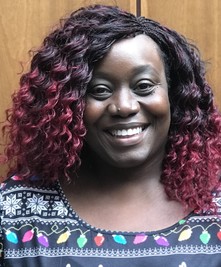
We are thrilled to share news that we welcomed our new Home Visiting Manager of Policy and Systems, Nelly Mbajah on Dec. 12. In this role, she will be leading and engaging ongoing growth and development of home visiting system and the associated policy. Nelly brings incredible depth, experience and commitment to advancing racial equity and supporting high quality programs in Washington. Nelly started her career engaging and supporting families in home visiting and ECLIPSE programs in communities. More recently, Nelly has been working with the Pierce County Human Services Division supporting Community Action Programs, Puget Sound Educational Service District (PSESD) Director of Program Services, and extensive experience with Children’s Administration. Welcome Nelly, we are so excited for you to join us!
|
|
|
Between July 2021 and June 2022, the Home Visiting Services Account (HVSA) served 2,774 families and 2,724 children across Washington State. HVSA programs are tasked with collecting and reporting data for these program participants, which allows us to tell a story about the successes of home visiting and to identify opportunities for improvement.
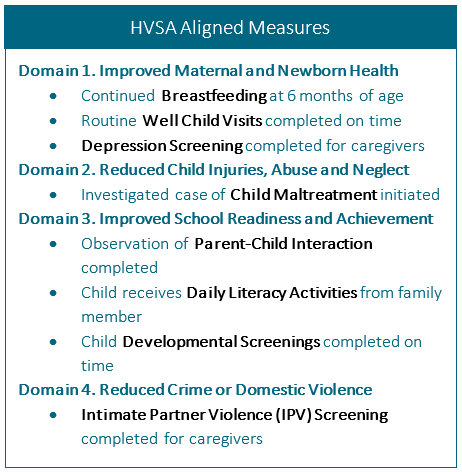
Each program reports data on 8 HVSA aligned measures. These measures cover four domains that encompass the health, well-being, and development of participating caregivers and children (see box to the right).
|
|
 |
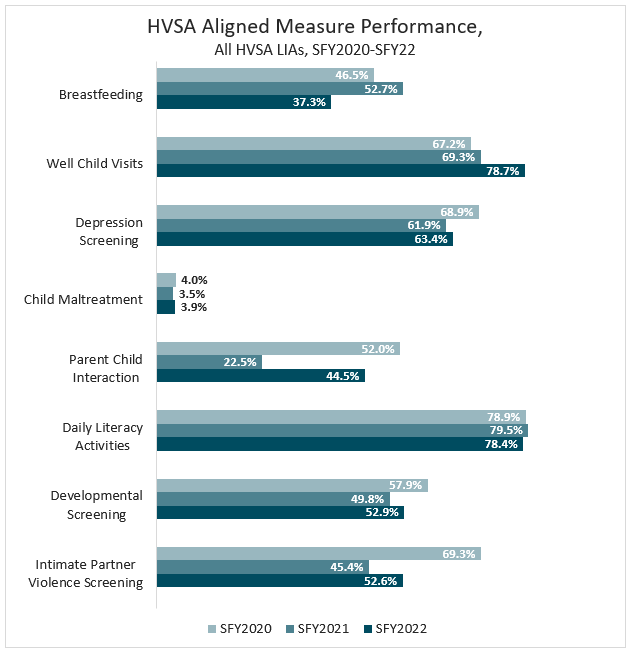 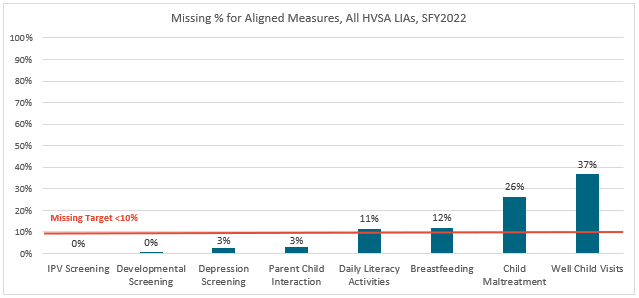 In the previous year (SFY 2021), we saw some challenges in meeting the performance measures due to the COVID-19 pandemic. In SFY 2022, we saw great improvements in many of the measures (as shown in Figure 1) despite the fact families, home visitors, and supervisors were still navigating the ongoing challenges from the pandemic. Many of the screening rates are now approaching the pre-pandemic levels. We are proud of the work that home visitors and supervisors are doing to engage families. This is evident in the high levels of daily literacy activities occurring among HVSA families: Almost 80% of caregivers were either reading, singing, or telling a story to their child, every day (in a typical week), throughout the pandemic. Thank you for all the work you do.
The DCYF Home Visiting team encourages each of you to pause for a moment and reflect on the tremendous amount of work and dedication you delivered to the families in your programs during the 2022 calendar year. We are sharing home visiting participant quotes with you highlighting and recognizing the amazing work you deliver to the families in your communities across Washington State These were collected as part of survey responses to our PAT programs in 2021, and we wanted to share them, knowing that there are many, many more examples of your impacts than we can offer here.
A lot of spacing here (as well as after the quotes)
This program has helped me a lot, not only as a mother, but also personally in overcoming my fear of failure as an individual. I feel more self-confident.
I absolutely LOVE this program, I think it’s one of the best things our community offers for all families!
[This] program is amazing and best people I've ever worked with.
We have been very fortunate to have such a great program impact our lives
Without your support, we would be very stressed, and I don't know how we would be doing. Thank you for your support and dedication to the most vulnerable.
I’m honestly a better mom because of …this program. Thank you 😊
[You] really helped me feel like the best mom I can be for my baby especially as a first time mother also going through a pandemic.
I'm really glad I became about of this program because it widen my view as a parent and helped me so much through my trials as a beginner parent.
I love the program because I not only learn better for my son but also to improve family dynamics.
I wish all parents out there could share it and see how much they could learn from it.
I love that I have somebody who is able to help me grow as a parent and help me find new creative ways to be a parent.
I love the program because I can learn something new with each visit and assess my baby's development. Overall, I recommend this program and especially the staff's charisma. I have a great time when we have parents' night, and it helps me a lot because I learn from other parents and more new techniques.
We hope you enjoy these reflections, soak them up, and carry them with you as you enter the holiday season. Thank you for all you do to support children and families!
HVSA Office Hours will be taking place Jan. 19 from 3-4 p.m.
Join Zoom Meeting
https://dcyf.zoom.us/j/83183457961?pwd=UHZyRC90ZnhuU2RMNmRNQlFzTk5uQT09
Meeting ID: 831 8345 7961
Passcode: 644977
One tap mobile
+12532158782,,83183457961#,,,,*644977# US (Tacoma)
+12133388477,,83183457961#,,,,*644977# US (Los Angeles)
There are still spots available for this upcoming training, which is provided free for HVSA-funded home visiting programs:
HVSA Introduction to Reflective Supervision for Supervisors
with Martha Stebbins-Aguiniga, MA, LMHC, IMH-E
Online, January 30 and February 1, 6, and 8
Mondays and Wednesdays
9:00am - 12:30pm
This training is offered free to program managers and supervisors of HVSA-funded home visiting programs. To apply or for more information email Nina Evers at nina.evers@dcyf.wa.gov
The U.S. Department of Health and Human Services (HHS) Centers for Disease Control and Prevention (CDC)and the HHS Office of Minority Health (OMH) are announcing a new Hear Her campaign segment that focuses on improving maternal health outcomes for American Indian and Alaska Native (AI/AN) women.
Launched in 2020, the campaign seeks to prevent pregnancy-related deaths by sharing potentially life-saving messages about urgent warning signs.
Disparities are noticeably high for AI/AN women, who are twice as likely to die of complications related to pregnancy. These adverse maternal health outcomes are because AI/AN women are more likely than white women to experience high levels of poverty, live in hazardous conditions, experience food insecurity, and lack access to health insurance.
“Through the CDC and OMH partnership, we have expanded the existing Hear Her campaign to create culturally appropriate resources that amplify the experiences of American Indian and Alaska Native women, while giving them tools to advocate for their health and well-being during and after pregnancy,” said Rear Admiral Felicia Collins, M.D., HHS Deputy Assistant Secretary for Minority Health and OMH Director. “The campaign also emphasizes the importance and role of health care providers in providing respectful care.”
This new Hear Her campaign segment builds on the work that the CDC and OMH have been doing to reach tribal communities and provide health care providers and AI/AN people with critical health resources.
Read the full press release on the OMH website. Visit the CDC’s Hear Her AI/AN Resources page for more information on this targeted effort to improve AI/AN maternal health.
We recognize that as we move forward on our home visiting journey together, that sometimes the ask on local programs carries weight that doesn’t translate directly to supporting families. This fall, we asked all our MIECHV funded programs to complete the MIECHV Home Visiting Budget Assistance Tool (HV-BAT), which was a combination of fiscal and programmatic information – an additional administrative lift to meet funding requirements. We truly appreciate your partnership in taking this on. Midcourse, HRSA chose to pause the requirement for a year. Despite this, several programs continued forward and turned in their HV-BAT. THANK YOU to those programs that stayed the course – the information will be used to build a greater understanding of the costs of delivering home visiting. And we appreciate those programs that opted out, honoring their own capacities during times of uncertainty. We will continue to share with you our learnings about the financial realities of delivering services (and most certainly with our funders as well) and will be reaching out over the next couple of months to those LIAs that submitted to complete the quality review process.
DOH changed the training date for the “MIECHV data collection and reporting orientation” from Jan 12th to Feb 16th: 9 am – 11 am.
MIECHV Data Collection and Reporting Orientation
Join on your computer, mobile app or room device
Click here to join the meeting
Meeting ID: 214 434 467 715 Passcode: ERMWMP
Download Teams | Join on the web
Or call in (audio only)
+1 564-999-2000,,534118117# United States, Olympia
(833) 322-1218,,534118117# United States (Toll-free)
Phone Conference ID: 534 118 117#
Find a local number | Reset PIN
Learn More | Meeting options
Start Early is Hiring!
Start Early Washington is building a state home visiting professional development system that promotes high-quality home visiting in alignment with the Washington State Home Visiting Core Competencies. In partnership with the HVSA, local programs, and Start Early’s national home visiting teams, this position will oversee the strategic development of this system as well as develop and provide trainings to home visitors and supervisors. Click here to learn more: https://startearly.hrmdirect.com/employment/job-opening.php?req=2309744&&&nohd#job
Start Early Community of Practice
Start Early is launching another Communities of Practice (CoP’s) this Winter. This CoP is focused on home visiting supervisors. This CoP will be eight 90-minute sessions beginning February to April. A staff member of Start Early HUB supports this COP with facilitation and resources.
For more information and registration: Connecting with Peers-Supervisor Community of Practice
For questions, please reach out to Alex Patricelli - Start Early Technical Assistance and Training Specialist at apatricelli@startearly.org.
Start Early Home Visitor Peer Connections
The Start Early Washington team is excited to be offering home visitor peer connection opportunities, which will provide a space for home visitors across Washington to connect with each other, share questions, strategies, and reflections on working with families. These will be held quarterly and facilitated by a Start Early Washington Technical Assistance Provider.
Upcoming: Wednesday, February 8th (10-11AM)
Home Visitor Peer Connections Registration
November Webinar Summary – Drop-In Office Hours
At our last webinar of the year, we discussed the upcoming MIECHV CQI Practicum as well as potential interest for Communities of Practice in 2023. For newer staff, we reviewed several resources including Project Charters and PDSA templates.
Resources (found in Basecamp CQI Project Folders)
CQI Project Charter
PDSA Templates
Staff Engagement and Retention Webinar Series Recordings and Webinar Resources
Upcoming Dates
January 25: Family Engagement and Retention Series – Part 1
For questions, support, or to be added to CQI listservs, please contact Camille Carlson: ccarlson@startearly.org
Each month, DCYF ESIT Tribal Program Consultant Brian Frisina will provide a key topic to help support us all in getting to know our Tribal Nations partners better.
This week’s topic is:
The Indian Child Welfare Act (ICWA)
|
The Indian Child Welfare Act (ICWA) was enacted in 1978 in response to a crisis affecting American Indian and Alaska Native children, families, and tribes. Studies revealed that large numbers of Native children were being separated from their parents, extended families, and communities by state child welfare and private adoption agencies. In fact, research found that 25%–35% of all Native children were being removed; of these, 85% were placed outside of their families and communities—even when fit and willing relatives were available.
Congressional testimony documented the devastating impact this was having upon Native children, families, and tribes. The intent of Congress under ICWA was to “protect the best interests of Indian children and to promote the stability and security of Indian tribes and families”
|
What States Need to Understand About ICWA
Fawn Sharp, President of the Quinault Indian Nation, discusses why it is vital for Native children to be raised in Native families and communities, immersed in their Native language and culture (watch time 1:20):
Learn More: Haaland V Brackeen
Haaland v. Brackeen is a case argued before the Supreme Court of the United States on November 9, 2022, during the court's October 2022-2023 term. It was consolidated with Cherokee Nation v. Brackeen, Texas v. Haaland, and Brackeen v. Haaland. Read the case highlights and questions. Download and listen to the Supreme Court's audio recording and transcripts, here.
Listen to the full audio (3:17:03) of the Supreme Court Hearing on the Brackeen v Haaland case that challenges the constitutionality of ICWA. The outcome of the case will determine whether the Indian Child Welfare Act (ICWA) is constitutional.
Resources
Sources
Fawn Sharp: Why Enforcing the Indian Child Welfare Act Matters. Uploaded to YouTube March 2016 by National Congress of Amercian Indians.
Image: What does Indigenous Peoples’ Day have to do with foster youth? | FosterClub. Posted Oct. 10, 2022, by APETITE1.
About ICWA >> NICWA. ©2022 All rights reserved, National Indian Child Welfare Association - Protecting our Children. Preserving our Culture.
Fawn Sharp: What States Need to Understand About ICWA. Uploaded to YouTube in 2016 by National Congress of Amercian Indians.
Haaland v. Brackeen. Ballotpedia digital encyclopedia of American politics, and the nation’s premier resource for unbiased information on elections, politics and policy.
Oral Arguments in Haaland v. Brackeen. Uploaded to YouTube by Mvskoke Media Nov. 9, 2022.
Oral Arguments - Audio: Haaland v. Brackeen, Nov. 9, 2022. Supreme Court of the United States.
Why Enforcing the Indian Child Welfare Act Matters: My Personal Story
Fawn Sharp, president of the Quinault Indian Nation, shares her personal experience with the Indian Child Welfare Act and how state non-compliance with ICWA took a heavy toll both on her and the children she was working to adopt (watch time 13:10).
Health Benefit Exchange’s section 1332 immigration status waiver application approved by the federal government
Starting in 2024, Washington residents will be able to purchase health and dental plans on the Exchange regardless of immigration status. Folks will also have access to state subsidies available through Cascade Care Savings. Most customers who are eligible for Cascade Care Savings can find a high-quality Cascade Care plan for less than $10 a month.
You can find more information about the section 1332 waiver and Cascade Care Savings below, as well as on the Health Benefit Exchange website.
News
A Green Hill Graduation: First Cohort of Centralia College Students Celebrate New Degrees, Centralia Chronicle
What is the Indian Child Welfare Act and why is it in jeopardy? Crosscut
|