|
|
|
Today marks the one-year anniversary of the launch of the Juvenile Rehabilitation (JR) Newsletter! We’re so grateful to celebrate this milestone with you and to continue sharing news about our programs, progress, goals, and the young people at the center of it all.
In this issue, you’ll hear from recent college graduates at Green Hill School and learn what Capitol Classroom youth participants have planned for the 2023 Legislative Session. We also highlight safety as a cornerstone in our facilities, how we’re using data to drive our decisions, and much more.
Thank you for your readership and continued support of our work and the young people we serve. Wishing you a happy, healthy new year!
 |
|
Felice Upton
Assistant Secretary, Juvenile Rehabilitation
|
|
|
|
|
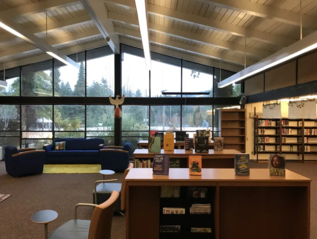
The first state library for incarcerated youth has opened at Echo Glen Children's Center thanks to a partnership between the Department of Children, Youth, and Families (DCYF), the Secretary of State’s Office, and Washington State Library, Institutional Library Services (ILS).
Echo Glen is transitioning its on-campus library, previously managed by the Issaquah School District, to a full-fledged ILS branch.
“I am so excited for the young people at Echo to have access to a librarian, to discover their love of reading and learning, and for them to benefit from all of the activities that come with a full-time librarian, increased resources, and a thoughtfully curated collection,” said Felice Upton, Assistant Secretary of JR.
The change will mean a better selection of resources to support youth residents’ information, education, recreation, and vocational needs.
Read the full article.
|
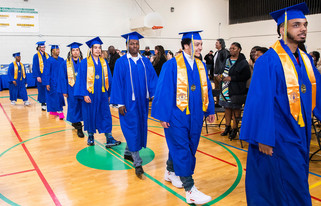
In December 2022, nine young people from Green Hill School (GHS) celebrated their triumphant graduation from Centralia College. Professors from the college performed the graduation ceremony at GHS while friends and family cheered their loved ones on as they received their associate's degrees, trade certifications, and honors of high achievement. Watch this video tribute that captures the moment!
“Dec. 7, 2019, was the day I got incarcerated, and Dec. 7, 2022, was the day I achieved the unthinkable and became a first-generation college graduate in my family,” shared youth graduate Caya. “Graduating high school was never in my future, let alone graduating college. This has shown me that the sky is the limit, and even though people have the cards stacked against them, with the right amount of dedication and support, anything is possible.”
The partnership with Centralia College began soon after the JR to 25 bill passed in 2018 (SB 6160), which allows young people to remain in JR until age 25. As a result, DCYF staff set to work identifying programs of interest for an older population and youth named college education as one of the most important opportunities.
Since then, GHS has worked closely with Centralia College to customize a college program that works for incarcerated youth. Instructors come to GHS for lessons, and students also attend classes remotely and in person on campus. Since the program launch in 2019, enrollment and interest have increased significantly among Green Hill young people, from 10 initial participants to an average of 40 students per quarter.
Read the full article.
|

DCYF recently launched an agencywide effort to grow trauma-informed practices. In JR, we know that to have effective trauma-informed environments for the young people in our care, we must establish predictability and reliability, the cornerstone of which is safety.
JR is getting back to the basics of safety and security with routine searches, welfare checks on young people in their rooms, and ensuring contraband cannot enter facilities.
“Our mission balances public safety and rehabilitation,” said JR Assistant Secretary Felice Upton. “One cannot be done well without the other. This is especially critical in the midst of a nationwide opioid epidemic.”
Upton recently issued an interim directive reinforcing existing requirements for youth and staff safety and clearly outlining new ones to ensure safer environments within both JR and the greater communities of Washington State.
“Going back to basics with regard to safety and security across our system is imperative,” said Upton. “Reliability and predictability are fundamental to a therapeutic environment. Routine and thorough safety and security procedures are a cornerstone to creating these environments and we each have to do our part.”
|
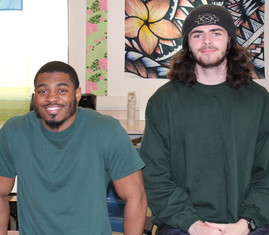
Featured Left: Ali and Caya, Capitol Classroom Participants
Through the Capitol Classroom program in JR, young people have the opportunity to work alongside peers and youth engagement specialists to learn about and propose legislation that can dramatically affect juvenile justice. In the program, they learn about laws, bills, and legislative processes and can participate in passing a bill into law, such as with House Bill 6160 (or JR to 25). As we head into the 2023 Legislative Session, Capitol Classroom participants voice their experience in the program and how it has impacted their lives.
Five years into an 11-year sentence, 20-year-old Caya shares how influencing lawmakers and legislation has been a wonderful journey and a highlight of his incarceration.
“I get the opportunity to help create positive change inside the justice system and be a voice for youth who are incarcerated alongside me,” he says. “Being able to participate in Capitol Classroom has made a huge difference in my journey. I have been in the program for about two years now, and… the main thing I have learned is the creation of a bill from start to finish… from drafting a bill all the way to the Governor signing it.”
Caya goes on to say that the vast knowledge he has gained about the justice and legislative system has influenced him to pursue a career in juvenile justice to help fix and improve the system.
“We are currently working on two bills for this year’s session. We are filing an amendment to the Community Transition Services program that will eliminate disqualifying factors, and we have also drafted up a bill that gives juveniles who were charged as adults the opportunity to petition for release after their 24th birthday.”
Read the full article.
|

In 2021, the Washington State Legislature funded a decision package paving the way for JR to provide effective community-based reentry services to all young people releasing from residential care. Community Support for All Young People ensures youth releasing to the community are connected to vital resources necessary for their successful reentry, self-sufficiency, and independence. Having least restrictive placement options coupled with therapeutic supports is a critical combination. JR has developed several fact sheets and FAQs explaining the continuum of services, which include:
“I have found that a successful transition to home upon release can be difficult and sometimes really overwhelming if the young person doesn’t have the right support system,” said Community Support Administrator Rich Taylor. “We have the ability to assist them during this challenging time in their lives by providing some basic fundamental needs, and getting them connected to the right services, at the right time. It can make such a difference in their success.”
Learn more about Community Support for All Young People, or reach out to Administrators Cristi Devers or Richard Taylor with questions.
|

JR makes data-driven decisions to improve daily practice, provide safe and therapeutic environments, and improve outcomes for young people. We measure and track what we do, how it impacts youth, and make changes based on what we learn.
Research shows that young people do best in a structured environment where they have access to activities and programs that are relevant to them, feel supported by staff, and feel that rules and consequences are fair. To support this type of environment and ensure youth are engaged in rehabilitative programs, JR examines when and how room confinement and isolation (RCI) are used.
In 2022, JR hired Confinement Prevention Administrator Dr. Grace Icenogle to review the data on RCI, work with staff to understand when and why RCI is used, and develop strategies to reduce frequency and duration so that youth are able to engage in more rehabilitative activities. The data show that JR has made progress by using RCI less often and for shorter durations. In fact, Washington JR is below the national average where targeted efforts have been focused.
Dr. Icenogle and other DCYF staff have also noted that more work is needed to improve and streamline RCI data collection across facilities. The JR team has partnered with national leaders in juvenile justice to implement best practices and is updating policy and training to improve RCI documentation and data collection, and use these data to inform decisions.
“Having data is critical to understanding what our staff and youth experience every day in JR, and is foundational to transparency, accountability, and continuous quality improvement,” said Icenogle. “Only by systematically tracking and measuring what we do over time can we ensure that we are enhancing the lives of young people in our care, their families, and communities across the state.”
The value of RCI data is greatest for our institutions to help understand the experiences and reality of our staff and the young people we serve. These data can signal which living units or individuals may need additional provisions of support, which units have found innovative ways to prevent RCI that can be replicated, and to celebrate reductions in RCI over time. Further, these data provide powerful evidence of where we need additional resources, such as more staff or different activities.
Leveraging RCI data is an exciting and burgeoning area for JR, and we are building our capacity to do so. We want youth to engage in rehabilitative activities and therefore need to understand and remove the barriers they face. Additionally, JR will provide staff with training on RCI policy and alternatives to ensure our teams understand how to document RCI and, most important, how to promote safety.
|
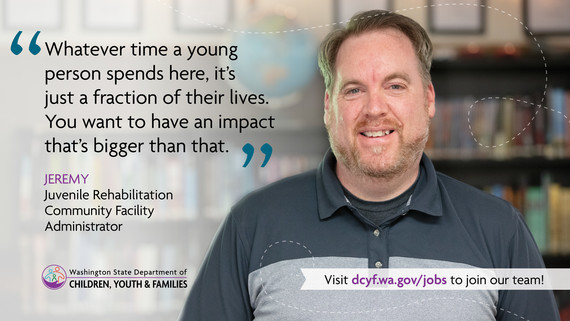
Listed below are key job openings in JR. The following positions are open to all, so please share with anyone who may be interested:
|
|
|
|
|