- Wash their hands often for at least 20 seconds with sudsy soap in warm water or with hand sanitizer if soap and water is not convenient.
- Avoid touching their eyes, mouth, and nose where germs like to enter.
- Stay home when they’re sick (even if it is “just a cold”) and isolate sick household members in separate rooms.
- Wear a mask in crowded or poorly ventilated settings.
- Limit the number of close contacts for young infants and individuals with certain chronic conditions.
- Clean high-touch surfaces frequently with a cleaner that is known to kill these common viruses.
Information to share with families whose children have symptoms or are experiencing severe illness
If a child does end up getting sick and their caregiver thinks they need to be seen, it is important for them to choose the right level of care. You may suggest that they:
- Call a nurse advice line if their health insurer has one.
- Call the child’s provider or after-hours service first to see where they should go to seek care.
- Check if a virtual medical visit is an option in their area and on their medical plan.
- Consider urgent care if a higher level of care is needed, for example if the child has dehydration, pauses or difficulty breathing, poor color, or significantly decreased activity and alertness.
- If it is a true emergency, go to the nearest emergency room or call 9-1-1.
You can find more resources here:
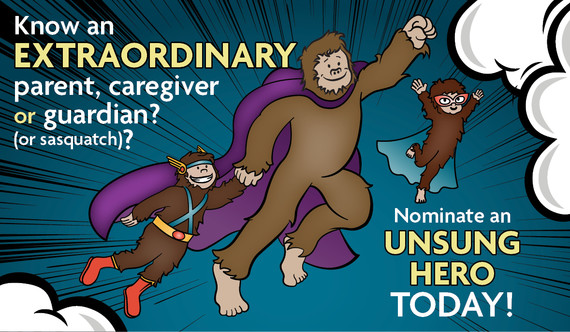 As 2023 is quickly approaching, we are gearing up for our annual Unsung Hero campaign in honor of Parent Recognition month (February) and we are hoping you can help us spread the word far and wide.
Since 2011, with your help, we have honored 309 parents and caregivers in Washington for the roles they have taken with their families, schools and communities. They have been recognized because they have shown strength, courage and empathy in their communities. We also acknowledge that for the past two years parents and primary caregivers have been called upon more than ever to be the buffer for the traumatic experiences that our world has been facing. Parents and caregivers around Washington State are supporting their children, families, and communities in exceptional ways through this pandemic and we want to show our appreciation. Please help us in honoring 28 more in February 2023 by nominating a parent/primary caregiver/guardian for the Unsung Hero award. The nomination form is available in three languages (English, Spanish and Somali) and can be found here on our website.
All nominations must be submitted by January 3, 2023. The nominations can be emailed to strengtheningfamilies@dcyf.wa.gov.
Please pass this on to your Washington networks. View and forward the bulletin here. We appreciate your ongoing support and let us know if you have any questions. Thank you.
HVSA Office Hours will be taking place Dec. 15 from 3-4 p.m. There is no specific focus for December; this optional meeting will include an opportunity for programs to connect with each other and ask open questions of DCYF staff.
Join Zoom Meeting
https://dcyf.zoom.us/j/83183457961?pwd=UHZyRC90ZnhuU2RMNmRNQlFzTk5uQT09
Meeting ID: 831 8345 7961
Passcode: 644977
One tap mobile
+12532158782,,83183457961#,,,,*644977# US (Tacoma)
+12133388477,,83183457961#,,,,*644977# US (Los Angeles)
An Overview of Attachment and Adaptation in Parent-Child Relationships December 7 | 10-11:30am | Monica Oxford, MSW, PhD This presentation will guide the participant though understanding the attachment relationship as it develops in the first year of life. Participants will gain an understanding about how infants and young children adapt to their caregiving environment and how that adaptation shapes their emotional wellbeing and shows up in adolescence and adulthood.
BabyCues: How Babies and Young Children Communicate Their Needs Through Nonverbal Behaviors December 14 | 1-2pm | Kimberlee Shoecraft, LICSW This presentation will guide the audience to become better observers of infant and toddler non-verbal communication. Participants will also learn how to link baby-toddler communication with what the child feels inside their body and how that feeling leads to certain behaviors. Once adults understand the meaning behind non-verbal communications, their options for responding become more attuned with the child’s underlying emotional and physiological needs which result in improved caregiver-child interaction and better wellbeing for both.
Thank you to everyone who attended the Fall All-HVSA meeting earlier this month. For those hoping for more information you can find:
- Slides and recordings for Day 1 and Day 2 (day 1 begins at the Systems Update portion of the day.)
- A survey link to provide additional feedback about the data dashboards, core competencies, and All-HVSA meetings
The MIECHV HV-BAT submission deadline is December 2, 2022 for those who choose to submit this year and to earn your incentive. If waiting until next year, please send a courtesy note to your Program Specialist alerting them that you’re submitting next year.
Pregnant and Parenting Recovery Services
There is an excited news to share, the DOH has launched the Pregnant and Parenting Recovery Services resource finder.
This tool is powered by Washington 211 and can help anyone find perinatal services close to them. The service finder is intended to help people connect into and between both community and clinical services, and includes services like substance use and pregnancy care, care coordination, mental health, housing, support groups, food, peer services etc.,
Please share this tool widely with your networks
Submit an application now for the Birth Equity Project!
The Washington State Department of Health (DOH) is announcing a funding opportunity for organizations working to improve healthy births and expand access to resources for birthing families in our state. The Request for Applications for the Birth Equity Project is now available. DOH is accepting applications until Monday, Dec. 19, 8:00 a.m. The Birth Equity Project funding seeks to reduce the racism birth workers and birthing families face in our state. DOH will invest in community-based birth worker organizations that reflect the communities they serve.
Priority communities for Birth Equity Project funds:
- American Indian/Alaska Native, regardless of tribal affiliation
- African Immigrants
- Black/African American (Descendants of Enslaved Africans living in the United States)
- Pacific Islander
Number of awards: Three to six
Estimated funding range: $75,000 to $200,000 per federal fiscal year
Funding years: 2.5 years of funding available
Informational webinars:
Request for Application Informational calls:
Budget support call (registration required)
- Tuesday, November 15th, at 6 p.m.
DOH/NPA BEP Grant Coaching and writing assistance (register for a one-on-one coaching session)
- Sessions available Monday, November 14 – Sunday, December 18.
For any questions, translations, or accommodation requests, please email DOH Perinatal Unit Manager Caroline Sedano. Visit the Birth Equity Project webpage for more information.
Topic: All HVSA Basic Data Collection Requirements Training
Time: Nov 29, 2022 9:00 – 10:30 AM Pacific Time (US and Canada)
The Orientation to HVSA Data Requirements for all LIAs training on Nov 29 2022 (9-10:30 a.m.) hosted by DOH is a big picture of why, how and what basic data are required for the HVSA funded programs. The webinar is beneficial for either new home visitors or new programs. It’s also a refresher opportunity for whom already have been doing the HVSA data collection. Key data categories are covered during the training are:
- Enrollment and Service Utilization
- Demographic Characteristics
- HVSA Aligned Performance Measures
You can find more information about that from DCYF Data Collection Webpage here under “Overview of HVSA Data Requirements” along with other great resources we have available on the website.
Click here to join the meeting
Meeting ID: 215 168 786 256 Passcode: RDxPGH
Download Teams | Join on the web
Or call in (audio only)
+1 564-999-2000,,302666899# United States, Olympia
(833) 322-1218,,302666899# United States (Toll-free)
Phone Conference ID: 302 666 899#
Find a local number | Reset PIN
Learn More | Meeting options
PICCOLO Refresher Training
Supervisors and visitors who have already participated in the four-part introductory PICCOLO training are invited to participate in a refresher training on December 8 from 10:00-12:00. To register, visit https://events.eventzilla.net/e/fall-2022-piccolo-refresher-training-2138570993.
Healthy Families Parenting Index (HFPI) Training
Rescheduled to December 15 from 9-11 a.m. Please click here to register!
Home Visitor Peer Connection
The Start Early Washington team is excited to be offering home visitor peer connection opportunities, which will provide a space for home visitors across Washington to connect with each other, share questions, strategies, and reflections on working with families. These will be held quarterly and facilitated by a Start Early Washington Technical Assistance Provider.
Date: Wednesday, December 7th (10-11AM)
Please follow the link below to view all upcoming dates and registration.
Home Visitor Peer Connections Registration
Sustaining Gains
Sustainability occurs when new ways of working and improved outcomes become the norm. The following example demonstrates how to sustain gains as it relates to staff retention and engagement:
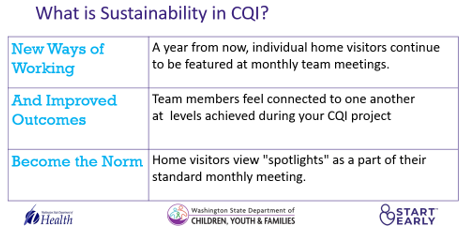 The HRSA Sustainability Worksheet is a tool which helps teams plan to sustain gains. This document can be found in Basecamp.
October Webinar Summary – Staff Engagement and Retention: Part 3
In the last webinar of the staff engagement and retention series, several LIAs were spotlighted for their innovative and creative strategies to address staff engagement and retention. Thank you to the following people for presenting:
- Lisa Apple, Okanagan County Child Development Association, Topic: Best Practices for Hiring
- Trissa Schiffner, Catholic Charities, Topic: Best Practices for Onboarding
- Shaniqua Harris, Denise Louie Education Center, Topic: Best Practices for Team Building
Lastly, a very special thank you to everyone who attended and participated in this lively discussion!
Resources (found in Basecamp CQI Project Folders)
October CQI Webinar Recording
October CQI Webinar Slides
HRSA Sustainability Worksheet
Looking ahead
Thank you again for your participation in this new webinar format! We would appreciate your feedback on this new approach for our CQI webinars. Please take a moment to complete our survey so that we can continue to improve upon this new practice:
Staff Engagement and Retention Webinar Series Survey
Upcoming Dates
November 23rd: Office Hours (Optional)
December 28th: Webinar Cancelled
January 25th: Family Engagement and Retention Series – Part 1
For questions, support, or to be added to CQI listservs, please contact Camille Carlson: ccarlson@startearly.org
Each month, DCYF ESIT Tribal Program Consultant Brian Frisina will provide a key topic to help support us all in getting to know our Tribal Nations partners better.
This week’s topic is:
StrongHearts Native Helpline
In 2012, The Hotline began discussing this issue with staff from the National Indigenous Women’s Resource Center (NIWRC) a Native-led nonprofit organization dedicated to ending violence against Native women and children. Together, they developed a program concept for a Native hotline developed by and run by Native advocates to support tribal communities across the United States. With input from tribal leaders, a Native women’s council, domestic violence experts, and the Family Violence Prevention and Services Program, the two organizations began laying the groundwork to develop a Native-centered hotline staffed by advocates with a strong understanding of Native cultures, as well as issues of tribal sovereignty and law.
By combining the technology and infrastructure of The Hotline with NIWRC’s expertise and community connections, as well as the trust of Native advocacy groups, their vision became a reality with the creation of the StrongHearts Native Helpline (StrongHearts) when it launched on March 6, 2017.
Source
StrongHearts Native Helpline | About. © 2022 StrongHearts Native Helpline
“Our Culture Is Medicine”: Perspectives of Native Healers on Posttrauma Recovery Among American Indian and Alaska Native Patients
"American Indian and Alaska Native (Native) people experience more traumatic events and are at higher risk for developing posttraumatic stress disorder compared with the general population. We conducted in-depth interviews with six Native healers about their perspectives on traumatic injury and healing. We analyzed the interviews using an inductive approach to identify common themes. We categorized these themes into four categories: causes and consequences of traumatic injury, risk factors, protective factors, and barriers to care. The implications of our study include a need for improving cultural competence among health care and social services personnel working with Native trauma patients. Additional cumulative analyses of Native healers and trauma patients would contribute to a much-needed body of knowledge on improving recovery and promoting healing among Native trauma patients."
Read the full article by Deborah Bassett, PhD, Ursula Tsosie, MSPH, and Sweetwater Nannauck:
Our Culture Is Medicine
|