How do we take care of the land we love? This week on NowThis Kids, we're talking to the author, Carole Lindstrom, and illustrator, Michaela Goade, of We Are Water Protectors, a book inspired by Indigenous-led calls for environmental conservation (watch time 4:38):
|
“…Native people were the first ecologists, as the mythologies, understandings, and technical knowledge were always directly tied to specific ecologies, or specific regions, plants, and animals. The knowledge base itself becomes one of maintaining a thoughtful, proper relationship to those natural forces.”
–Dr. Gregory Cajete, Native Science: Natural Laws of Interdependence
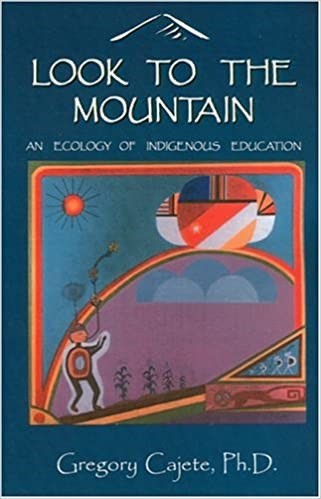
Look To The Mountain: An Ecology Of Indigenous Education, written by Dr. Gregory Cajete
Each week, DCYF ESIT Tribal Support Specialist Brian Frisina provides a key topic to help us get to know our Tribal Nations partners better.
This week’s topic is:
To understand Indigenous knowledges we must first understand their ties to land, and by extension, their multiplicities (Cajete, 91). Cosmologies (which encompass belief systems, worldviews, knowledge systems, and morality) are included in the realm of TEK because they too, are constructed relationally. Indigenous cosmologies are modes of sharing information, through storytelling and myth. Cultural knowledge moves between generations using stories about different places and species to convey the importance of relationships and of respecting all members of the broader community (Cajete, 82). Cosmologies are activated through community practices, rituals, and relationship building. People live in a community with the environment and landscape around them. Building relationships and respect through understanding, rather than extraction, allows for mutualistic, sustainable community growth of the landscape and all that live within it.
Learn more
Look To The Mountain: An Ecology Of Indigenous Education, written by Dr. Gregory Cajete, is an important contribution to the body of indigenous cultural knowledge and a way to secure its continuance:
Dr. Gregory Cajete is a Native American educator whose work is dedicated to honoring the foundations of indigenous knowledge in education. Dr. Cajete is a Tewa Indian from Santa Clara Pueblo, New Mexico. He has pioneered reconciling indigenous perspectives in sciences with a Western academic setting.
Watch interview below (watch time 51:38):
Sources
Listening to Traditional Ecological Knowledge to Reimagine Vassar’s Relationship with Land and Other Beings. Blog by ssantos, posted November 19, 2020. © 2012 Indigenous Environmental Activism, Designed by Wpshower.
Look To The Mountain: An Ecology Of Indigenous Education. © 2022 Goodreads, Inc.
Gregory Cajete: An Indigenous Ecology - The Green Interview. © 2009–2022 The Green Interview.

This two-hour, virtual interactive workshop led by The Montana Institute and provided by the Washington State Essentials for Childhood Initiative, will provide an overview of the Science of the Positive, Positive Community Norms, and Healthy Outcomes from Positive Experiences (HOPE) frameworks and how they can be used in harmony to promote child development, grow Positive Childhood Experiences, and promote a healing-centered approach to help children and adults increase resiliency.
The workshop will include current research-findings and applications of these frameworks and will provide participants with opportunities to consider and discuss how they might advance these applications in their own unique contexts.
Advancing Applications of HOPE,
the Science of the Positive, and Positive Community Norms
August 29, 2022 | 9 – 11 a.m.
|

This 2022 series is called “Going Virtual.” Webinars in this series will discusses equitable, culturally sustaining early intervention (EI) and early childhood (EC) care and education strategies and their application in a virtual, or telehealth, environment. These webinars address family coaching practices, aspects of the transition process in various contexts, and common challenges often experienced by families and practitioners in virtual settings.
Presented by the Military Families Learning Network
Sept. 14 | Nov. 16 | 8 – 9:30 a.m.
Webinar Series Flyer
Find registration information for one or more sessions:
|

Please join us for a free virtual home visitor training series with presenters from a wonderful team of experienced and wise home visitors and Washington State Coalition Against Domestic Violence (WSCADV) staff!
The first training in this series is Domestic Violence (DV) Assessment and Response, followed by Safety Planning with Families:
DV Assessment and Response
October 20 – 21|10 – 11:30 a.m.| Register here
Safety Planning with Families
September 15|9:30 a.m. – 2:30 p.m.| Register here
November 9|9:30 a.m. – 2:30 p.m.| Register here
Break from 12 – 1 p.m.
Questions? Contact Leigh Hofheimer at leigh@wscadv.org or call 206-389-2515 x202.
|
For more updates, subscribe directly to these great newsletters:
|