|
MIECHV = Maternal and Infant Early Childhood Home Visiting. MIECHV is a federal home visiting funding stream administered through the Health and Human Services Administration (HRSA), who contracts them out to DCYF to fund a portion of HVSA-supported home visiting programs.
- Medical Interventions Early Can Help Veritably (Alacia Thornton)
- My Internal Eating Clock Has Vanished (Whitney Myers)
- My Inner Ear Can’t Hear Virtually (Rochel Padron)
ARPA = American Rescue Plan Act. ARPA was passed by Congress in 2021 to support recovery from the COVID-19 pandemic.
- Anyone Really Paying Attention? (Lisa Apple)
- Aardvark Rap Party Association (Sarah Morris)
- Always Ready, Prepared Activities (Deisha Rodgers)
HVAC = Home Visiting Advisory Committee. The HVAC is in statute to advise the HVSA on research priorities and the distribution of funds from the account to eligible programs. You can learn more about the HVAC here.
- Have Very Active Children (Leanne Crippen)
- Hardly Vaulting Above Crisis (Kate Wilhite Brickell)
- Hot Volcanoes are Cataclysmic (Ryanne Zielinski)
LIA = Local Implementing Agency. LIAs are organizations throughout Washington that provide home visiting services to families.
- Lady in Action (Nita Lynn)
- Lean Into Awkwardness (Sarah Morris)
- Lovable Infants Abroad (Leslie Webb)
SFY = State Fiscal Year. Home visiting contracts through the HVSA follow the state fiscal year, meaning that they run from July 1 through June 30. SFY23 will begin on July 1, 2022, and end on June 30, 2023.
- So Far…Yeah… (Sandra Escalera)
- Shocked Furry Yaks (Krista Hanan)
- Safety First, Youngin (Lisa Apple)
FFY = Federal Fiscal Year. The federal fiscal year runs from Oct. 1 - Sept. 30, meaning that programs funded through MIECVH may experience different timelines. FFY23 will begin on Oct. 1, 2022, and end on Sept. 30, 2023.
- For Future Youngsters (Nancy Acosta)
- Furry Fans of Yankees (Katie Turgeon)
- Fine Funky Year (Susan-Lynn Walters)
The next HVSA office hours will take place on June 16, from 3-4 p.m. The focus of this office hours will be contract/budget/fiscal information and data collection. Please invite anyone from your organization that would find this information beneficial.
https://wadcyf.webex.com/wadcyf/j.php?MTID=me811c89a630ddb2649f72c8d58b4b52f
Meeting number: 177 715 7630
Password: 8WKekZdg5P2
End of Year Demographic Data Reminders
The state fiscal year is coming to an end, and we want to thank you for your continued data collection efforts during another challenging year!
DOH shared Demographics Quality Assurance (QA) reports on May 13 via SFT with programs that use Flo and Visit Tracker. These reports include a summary of missing demographic data for your program as of the end of March, as well as individual-level data for caregivers and children.
Our purpose for producing these reports is both to provide a tool that assists you in identifying areas with room for improvement, as well as an opportunity to uncover data systems issues. For example, you may find that “missing” data is documented in your data system but is not showing up in the report. This two-way QA process helps all of us tell a more complete story about families served this year.
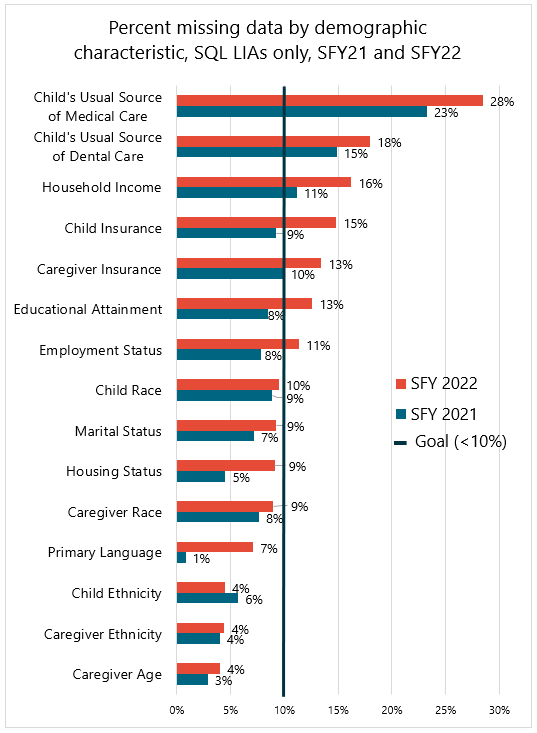
The HVSA has set a goal to report at least 90% complete data on each demographic characteristic. Across programs that report via Flo and Visit Tracker, we are meeting that goal for 8 of the characteristics shown in the graph below! Compared to SFY21, missing data is elevated across all data elements, but there is still time to submit data by the end of SFY22.
The following are areas where we hope to see improvement across the HVSA:
-
Child’s Usual Source of Medical Care, Usual Source of Dental Care, Health Insurance Status – About 1 in 4 children across programs that report via Flo or Visit Tracker appear to be missing information about their usual source of medical care, and a significant proportion appear to be missing information about their health insurance status and their usual source of dental care. (Note that most Portfolio LIAs are not required to report on usual source of dental care. Children served by Portfolio LIAs were excluded from this measure.)
-
Race & Ethnicity – The HVSA plans to apply a racial equity lens to our analyses of services provided this year. While we are meeting the goal of reporting at least 90% complete data on all measures of race and ethnicity, we encourage you to focus cleanup efforts in these areas as higher quality data will help us identify successes and disparities in service delivery and outcomes.
-
Household Income – Collecting information about income has been a consistent challenge over the years; however, last year we nearly met our goal of reporting at least 90% complete income data. This year-to-date, we see a 5-percentage point increase in missing income data compared to SFY21. For programs that use Visit Tracker, remember to enter the number of people in the household along with average monthly income. This number is not restricted to only those enrolled in your program but should include anyone in the household that depends on the reported income.
-
Primary Language – Among NFP programs specifically, we see a significant increase in missing information about primary language spoken in the home. We encourage NFP programs to review caregivers missing information about their primary language to help us identify if there is a data systems issue causing this increase.
 If your program uses Flo or Visit Tracker, please download your report from SFT and address action items where possible by June 30, 2022. Please reach out to homevisiting@doh.wa.gov if you have questions about the Demographics QA reports or you find a discrepancy between what you see in your data system and what is included in your QA report.
2021 Consent Clean-up
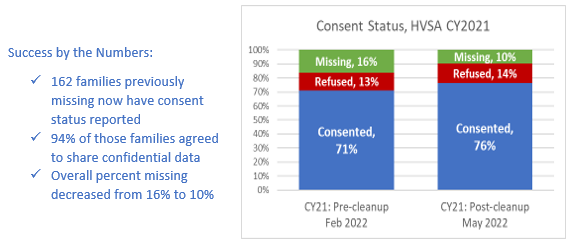
Congratulations – we are seeing great improvements in our parental consent rates following the spring clean-up. In March, we asked all of our programs to focus on reducing missing data on parental consent for all families with some enrollment time during calendar year 2021. Our data goal was to reduce missing to less than 10% of all families – and we made it! Over the past two months you all have combed through your records and contacted families, confirming and reporting the consent status of families served.
 Our NFP partners continue to provide a monthly consent review and update to families enrolled in services. For users of Visit Tracker, a webinar in March provided step-by-step instructions for how to record consent status. This recording is available on YouTube (https://youtu.be/pUc4qTlya7I ).
Following this training, our PAT sites have seen a reduction in missing consents from 19% to 13%, with seven sites reducing missing by over 10 percentage points! For each site reporting through Visit Tracker, DOH has posted an updated Consent report for CY 2021 (Jan-Dec 2021), so you can see your own progress. Additionally, your QA Report (also just shared via SFT), has client-level status of consent for all of your current families (Column Y on Caregiver tab). And just a reminder - updates to Consent (or any demographic updates) should be entered directly into Visit Tracker.
Keep up the great work, we are almost there.
A new report shows routine childhood immunization rates decreased during the pandemic, dropping by 13% in 2021 when compared to pre-pandemic levels.
The drop was most noticeable in young children. In response, the Washington State Department of Health (DOH), health care providers, and other agencies are working with families to catch up and stay current on routine immunizations.
"The pandemic has been difficult for everyone. Disruptions to schooling, child care and in-person health care made it hard for some families to stay up to date on their shots," said Tao Sheng Kwan-Gett, MD, MPH, Chief Science Officer. "We encourage parents and caregivers to schedule their well-child visits as soon as possible, to make sure their kids are happy, healthy, meeting developmental milestones, and ready for school."
The new report, compiled by DOH, compares routine childhood vaccination rates in Washington from 2021 to averages from 2015-2019. Rates were found to have declined the most in younger children, however rates in teens increased. Key findings include:
- Vaccinations decreased 9.6% in the 19–35-month age group.
- Vaccinations decreased 3.9% in the 4–6-year age group.
- Vaccinations decreased 3.6% in the 11–12-year age group.
- Vaccinations increased 1.8% in the 13–17-year age group.
Children need to be up to date on immunizations to attend pre-school, kindergarten, school, or childcare this fall. Scheduling well-child visits early ensure children can attend educational programs on time and can reduce the stress of finding a last-minute appointment. DOH has online tools to help you determine if your child is up to date on state immunization requirements. Vaccine requirement charts for parents and caregivers are available in a variety of languages here. Washington state provides all recommended childhood vaccines at no cost to children through the age of 18.
The Department of Health has implemented a variety of efforts to boost childhood immunization rates to pre-pandemic levels. Some of these efforts include direct messaging through the Watch Me Grow Washington program for parents with young children, improving equitable vaccine access and support for tribes, and collaboration with local public health. “Vaccines are the best tools we have to protect kids from getting sick from preventable diseases,” added Dr. Kwan-Gett.
Every year, WA-AIMH and DCYF team up to identify home visitors and supervisors who may be eligible for HVSA Scholarships to support an Infant Mental Health Endorsement®. If you’re interested in learning more a, please join us for one of our Zoom Information Sessions. Two sessions will be offered – one in Spanish and another in English, (which will have Chinese and Somali interpretation available on request.) In each session, participants will be able to:
- Connect WA-AIMH’s mission and activities to their work in home visiting
- Explain how the IMH Endorsement®is relevant to the infant and early childhood workforce
- Understand the different requirements for each Category of Endorsement
- Identify the steps necessary to begin the IMH application process
En esta presentación los participantes podrán:
- Conecte la misión y las actividades de WA-AIMH con su trabajo
- Explicar cómo el IMH Endorsement® es relevante para la fuerza laboral de bebés y niños pequeños (en general y en WA)
- Entender los diferentes requisitos para cada Categoría de Endoso
- Identificar los pasos necesarios para iniciar el proceso de solicitud del IMH
Tuesday, June 7, 1-2 p.m.
Endorsement Information Session in Spanish
Register in advance for this meeting:
https://us02web.zoom.us/meeting/register/tZwpde-qqj4qE9KrdL3zXbL4Z79-3j7ihhmD
Presented by:
 |
|
Veronica Rosa-Sandoval, LMSW, IMH-E®, Bilingual/Bicultural Endorsement Central Service Coordinator
Infant Mental Health Specialist
|
Wednesday, June 8, 11 a.m. to noon
Endorsement Information Session in English (Somali and Chinese Interpretation Available**)
Register in advance for this meeting:
https://us02web.zoom.us/meeting/register/tZAoduGqqTIpG9WXDl7GL4PzO_sl5LviHxlE
Presented by:
 |
|
Anicia Battles, LMSW, IMH-E®, Endorsement Central Service Coordinator
Infant Mental Health Specialist
|
** To request Somali or Chinese Interpretation for the June 8 session, please email: training@wa-aimh.org.
The nationwide infant formula shortage has caused stress for many families. The Washington State Department of Health (DOH) has compiled resources to assist families trying to find nutritionally appropriate food for their babies. The information below comes from the American Academy of Pediatrics (AAP), the U.S. Department of Health and Human Services, the Washington WIC program, the Centers for Disease Control and Prevention, and the U.S. Food and Drug Administration.
While the shortage has been persisting since the pandemic, it has worsened due to supply chain issues, the February recall of several baby formula products due to possible contamination, and the voluntary closure of a facility in Michigan by Abbott Laboratories - the country’s largest manufacturer of infant formula. Though Abbott reached an agreement with the U.S. Food and Drug Administration (FDA) on the steps needed to restart production, it will still be weeks before any formula products from that facility become publicly available.
If you are struggling to find infant formula and have concerns about your child’s nutrition, your first step is to check out the links and resources provided to get accurate information. If you still have concerns about your child’s health, contact your child’s primary care provider’s office and ask to speak with a nurse, medical assistant, or health educator on your child’s care team.
“Your child’s doctor and care team are a great source of information for any concerns about your baby’s health and nutrition,” says Dr. Tao Sheng Kwan-Gett, Chief Science Officer, Washington State Department of Health. “They may be able to make recommendations about switching to a formula that’s easier to find or give tips on where to go when your usual sources of formula are out of stock.”
For people needing connection to health care providers, call the Help Me Grow WA hotline at 1-800-322-2588 for referrals and to apply for food and health resources in Washington. Additional support and resources are also available to participants in federal and state nutrition programs.
For WIC participants and families, contact your local WIC clinic to get infant formula benefits replaced or change baby formulas. WIC has expanded the types of formula they provide to offer more choices for families participating in the program. They can often tell you which stores have formula in stock. If you can’t reach your local clinic, call the state WIC office at 1-800-841-1410 Monday to Friday, 8:00 am – 5:00 pm. Check the Washington WIC web page for more information on approved replacement infant formulas.
For participants in Basic Food (SNAP), visit the Parenthelp123 web page or call 1-800-322-2588.
In this urgent situation, the AAP says it’s ok for most babies to switch to any available formula, including store brands, unless your baby is on a specific extensively hydrolyzed or amino acid-based formula for certain medical conditions. Contact your child’s primary care provider to ask about specialty formula alternatives.
Though it might be tempting to try to make homemade formula, the AAP cautions not to do this because formula recipes might not have enough vital nutrients or could contain too much salt or other elements that could be harmful to your baby.
Also, at the request of the FDA, Abbott is releasing limited quantities of metabolic nutrition formulas that were previously on hold following Abbott's recall of some powder infant formulas from its Sturgis, Mich., facility. These products have been tested, are safe for distribution, and were not included in the recall. These products also require a medical referral. Patients, caregivers and healthcare professionals in need of these products should contact Abbott at +1-800-881-0876 to provide necessary information.
If you suspect you have recalled formula on hand, you can check to see which formulas are recalled at Washington WIC.
Some additional tips to help with your infant formula search:
- Check smaller stores and drug stores or buy online from reputable distributors and pharmacies.
- Contact manufacturers directly:
- Gerber’s MyGerber Baby Expert: reach a certified nutrition or lactation consultant by phone, text, Facebook Messenger, web chat, or video call, who can help you identify a similar formula that may be more readily available
- Abbott’s Consumer Hotline: call 1-800-986-8540
- Abbott’s urgent product request line: ask your OBGYN or your infant’s pediatrician to submit an urgent product request by downloading and completing the form - PDF
- Mead Johnson/Reckitt’s Customer Service line: call 1-800 BABY-123 (222-9123)
- Check out community resources:
-
Locate your nearest Community Action Agency (CAA). Your neighborhood CAA may be able to provide you with formula or connect you with local agencies that have formula in stock.
- United Way’s 2-1-1: dial 2–1-1 to be connected to a community resource specialist affiliated with United Way who may be able to help you identify food pantries and other charitable sources of local infant formula and baby food.
-
Feeding America: call your local food bank to ask whether they have infant formula and other supplies in stock.
-
Human Milk Banking Association of North America(HMBANA): certain HMBANA-accredited milk banks are distributing donated breast milk to mothers in need; please note that some may require a prescription from a medical professional. Find an HMBANA-accredited milk bank.
Relactation or induced lactation is also possible and can be an alternative to using formula, but it does take time and effort. La Leche League International has resources on how to stimulate milk supply.
“No family should be in a position where they are worried about how they are going to feed their children,” says Kwan-Gett. “We need to prioritize food security so that every family can be sure that their child is getting nutrition for optimal growth and development.”
Please visit DOH's new nutritional guidance resources page for more information on what to do and actions to take that are safe for your child.
The federal research project Supporting and Strengthening the Home Visiting Workforce (SAS-HV) is looking for local home visiting staff to participate in a Practitioner Workgroup, with the purpose of developing a measure of reflective supervision that is informed by practitioner experience and perspectives. Six virtual Practitioner Workgroup sessions will be held between May 2022 and January 2024, each meeting about 90 minutes long; participants will receive an honorarium of $150 per meeting. Those interested can check out the link below for information to submit via email to sashv@jbassoc.com.
For more information on this work: https://www.acf.hhs.gov/opre/project/supporting-and-strengthening-home-visiting-workforce-sas-hv?mc_cid=35f38b2ebc&mc_eid=fc2fe9703b
For LIA Leaders interested in Management Practices to Promote Home Visitor Retention!
A September 2021 OPRE Report shares insights from the recent National MIECHV Career Trajectories study that looked at the demographics of home visiting staff and management practices across home visiting programs. The report can be downloaded here: https://www.acf.hhs.gov/opre/report/management-practices-promote-home-visitor-retention-what-does-national-study-home
Communities of Practice
Communities of Practice (COP) are being launched this spring. Each COP is limited to 15 members to encourage trust, meaningful interaction, and give space for rich dialog that results in a productive, positive group experience. Consistent attendance (at least five of the six 90-minute sessions) is required of those who register for a COP. A staff member of Start Early HUB supports each COP with facilitation and resources.
For more information please see attached a description of each community of practice offered or follow a link below to learn more.
For questions, please reach out to Alex Patricelli - Start Early Technical Assistance and Training Specialist at apatricelli@startearly.org
Register Here: Supervisor Community of Practice
Register Here: Home Visitor Community of Practice
Peer Connections
The next Peer Connections is Thursday, June 30 (10-11 a.m.)
Please feel free to forward this to any colleagues with an active home visiting caseload that may be interested in connecting with other Home Visitors.
Register Here for Home Visitor Peer Connections
CQI Spotlight
CQI Monthly Webinars - every fourth Wednesday of the month from 1:30-2:30 p.m.
Upcoming topics include:
- May 25: Sustaining Gaines
- June 22: HVSA FY23 CQI Updates
For new supervisors or new CQI team members that need to be added to the calendar invite or Basecamp resources please reach out to rcontreras@startearly.org
Each month, DCYF ESIT Tribal Program Consultant Brian Frisina will provide a key topic to help support us all in getting to know our Tribal Nations partners better.
Through a Culture Lens
Cultural landscape: A geographic area (including both cultural and natural resources and the wildlife or domestic animals therein), associated with a historic event, activity, or person or exhibiting other cultural or aesthetic values. There are four general types of cultural landscapes, not mutually exclusive: historic sites, historic designed landscapes, historic vernacular landscapes, and ethnographic landscapes. Historic vernacular landscapes evolved through use by the people whose activities or occupancy shaped it, and ethnographic landscapes contain a variety of natural and cultural resources that associated people define as heritage resources (Birnbaum and Peters 1996).
Cultural Landscape Approach: A management approach that uses cultural landscapes as a framework to understand places and their associated resources. This approach is analogous and complementary to ecosystem-based management, and examines the relationships among living and non-living resources, and their environment. This approach enables a better understanding of the human connections to places, as well as the important human influences on ecosystems over time (MPA FAC 2011).
Cultural resources: The broad array of stories, knowledge, people, places, structures, and objects, together with their associated environment, that contribute to the maintenance of cultural identity and/or reveal the historic and contemporary human interactions with an ecosystem. This can include both tangible and intangible cultural heritage. According to UNESCO, tangible heritage includes buildings and historic places, monuments, artifacts, etc., which are considered worthy of preservation for the future. These include objects significant to the archaeology, architecture, science or technology of a specific culture. Intangible heritage includes the practices, representations, expressions, knowledge, skills – as well as the instruments, objects, artifacts and cultural spaces associated therewith – that communities, groups and, in some cases, individuals recognize as part of their cultural heritage.
Culturally sensitive information: Information that is culturally privileged or otherwise controlled or regulated, often by gender, age, or cultural norms. Sharing this knowledge with non-tribal members may be contrary to tribal practices. Even though culturally sensitive information may sometimes be publicly available, respect for the nature of this information must be demonstrated when consulting with tribe.
Sources
Top 20 quotes of CHEIF DAN GEORGE famous quotes and sayings. Copyright © 2022 Inspiring Quotes.
Tribal Cultural Landscapes: Appendix | Glossary of Terms. National Ocean Service, NOAA, Department of Commerce.
Federal report highlights historical injustices of Native boarding schools
On May 11, a national investigative report was released by the U.S. Department of the Interior identifying more than 400 federally-run schools for Native American children, including 15 in Washington State. Beginning in the 1880s and continuing into the 1960s, federal officials forcibly removed children from their families and placed them with educators who suppressed the use of Native language and any learning of Native cultures and beliefs. This included changing their Native names, cutting their hair, wearing uniforms and more.
The report is the first step for the Federal Indian Boarding School Initiative launched by Secretary of the Interior Deb Haaland last June following stunning revelations of hundreds of unmarked graves at Indian residential schools in Canada. The institutions identified in the report that operated in Washington include:
- Chehalis Boarding and Day School in Oakville
- Colville Mission School in Kettle Falls
- Cushman Indian School in Tacoma
- Fort Simcoe Indian Boarding School in White Swan
- Fort Spokane Boarding School in Davenport
- Neah Bay Boarding and Day School in Neah Bay
- Puyallup Indian School in Squaxin Island
- Quinaielt Boarding and Day School in Taholah
- S'Kokomish Boarding and Day School in Olympia
- St. George Indian Residential School in Federal Way
- St. Joseph's Boarding School in Federal Way
- Paschal Sherman Indian School in Omak
- Tonasket Boarding School in Tonasket
- Tulalip Indian Industrial School in Tulalip Bay
- Tulalip Mission School in Priest's Point
“The federal and state governments of the United States have dealt tremendous loss and suffering to the Native and Indigenous people throughout generations, including the horrific and systematic erasure of their culture and their children,” Inslee said in response to the report. “It is difficult to confront such hard truths about our past, but it is necessary for healing and progress. Washington state stands ready to do what we can to acknowledge the trauma and harm these schools caused, and uplift the efforts of those who fight to ensure the many Tribal languages, cultures and knowledge persist and flourish.”
Secretary Haaland is the first Native American to serve as a Cabinet secretary. You can read her op-ed about her family’s experience with federal boarding schools.
More information about the national report.
The Home Visitor Responsive Partnership Toolkit
A new free online resource to help home visitors strengthen their communication with caregivers, both virtually and in person. The Toolkit teaches users to “Learn, Identify, Practice, and Apply” techniques across key communication strategies. Developed in collaboration with local home visiting programs, the self-paced modules include:
- Communication techniques based on theory and research
- Videos of real home visits that display techniques in action
- Sample transcripts, vignettes, and role play exercises
- Guidance to incorporate the content into ongoing supervision
- Downloadable certificates of completion
Register now to access the toolkit on the Home Visiting Applied Research Collaborative (HARC) website.
Perinatal Mental Health: Culturally Informed Approaches to Screening, Assessment, and Treatment
The webinars will present an overview of perinatal mental health screening, assessment, treatment, and referral pathways through the lens of culturally-informed care and best practices in the treatment of perinatal mood and anxiety disorders. Register and attend one or both webinars.
-
May 18, 2022: Webinar #1 will focus on the impact of social determinants of health, the effects of the pandemic, and improving healthcare clinicians' awareness of trauma-informed care and culturally informed approaches for perinatal mental health care.
-
May 24, 2022: Webinar #2 will focus on historical trauma and structural racism and its impact on maternal health and mental health care, defining and recognizing implicit bias and microaggressions, practicing cultural humility, and incorporating cultural identity into a patient’s care.
Continuing Education Credits: Each webinar is 1.5 credit hours (See registration page for more details)
Register for the two-part webinar today
Registration Open for ACF’s National Research Conference on Early Childhood 2022
Registration is now open for the Administration for Children and Families’ (ACF) National Research Conference on Early Childhood (NRCEC) 2022. NRCEC 2022 will present the latest research on early childhood programs and the young children and families they serve.
Register now!
The conference will be held virtually June 27–29, 2022. There is no registration fee to attend the conference, although all participants must register.
A dynamic virtual platform will host plenary sessions, breakout sessions, poster sessions, and more. Attendees will receive a confirmation email immediately upon registering and a second email with instructions to access the virtual platform when it opens in June.
An overview of the conference schedule, including session types and times, is now available.
|