American Indian Older Adults
Learn more about American Indian Older Adults in this module, designed to provide information and increase "awareness of specific cultural, racial ethnic and tribal influences on health and health care of the older American Indian."
|
"A point of reference: those people who have earned the respect of their own community and who are looked upon as elders in their own society...We have misused the role of elder through our ignorance and failure to see that not all elders are spiritual leaders and not all old people are elders.”
- Roderick Mark, 1985. The Role of Elders in Contemporary Native Education" (manuscript), University of Calgary. Cited in Medicine (2001), p.77
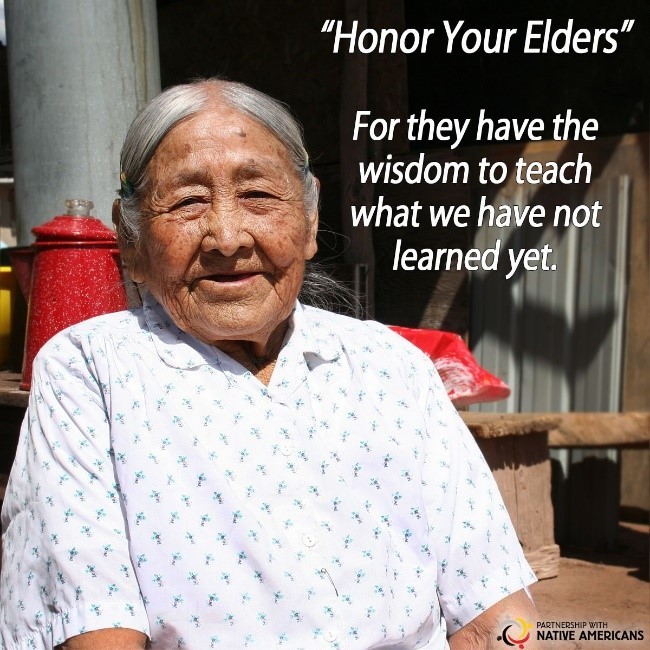
"Honor Your Elders. For they have the wisdom to teach what we have not learned yet."
Each week, DCYF ESIT Tribal Support Specialist Brian Frisina provides a key topic to help us get to know our Tribal Nations partners better.
This week’s topic is:
Elders
Native American elders are revered individuals who provide wisdom and leadership for their Tribes by exuding grace, wisdom, and gentleness in their daily words and actions. A Native American is usually considered an Elder when they are above the age of sixty to sixty five, although it varies from Tribe to Tribe. In rare instances, a Native American is also considered an Elder if he or she is often sought out as a source of spiritual and traditional wisdom, regardless of age.
Elders are the heartbeat of their Tribes. Their age and wisdom allow them to perceive clearly from a cultural perspective and understand deep truths about God and nature. It is of utmost importance that Elders be treated with respect and reverence. Oftentimes in Native communities one will see the younger generation getting Elders their food at community gatherings, or acquiring comfortable seats for them. Another way in which we honor our Elders is by waiting for them to dance at Powwows before we begin dancing. Also, many Tribes initiate Elders’ programs to show how much their Elders are cared for.
When an Elder speaks, an informed individual knows to listen. An Elder’s wisdom is invaluable to a tribe’s prosperity and well-being. Elders are sacred bearers of golden truths and know many valuable stories about the Old Ways.
Learn More
Elder and co-author of the Oceti Sakowin Essential Understandings, Dottie LeBeau, discusses the thinking and the objectives of the Elders during the writing of the Essential Understandings. Watch series 1-7:
Find interviews accompanied by “Learn About” and “Learn From,” from Oceti Sakowin elders of the South Dakota lands:
Wisdom records, preserves, and shares oral history, cultural arts, language concepts, and traditional ecological knowledge of exemplary Native American elders, storytellers, and scientists in collaboration with diverse institutions, agencies and organizations. Our vision: Native American cultural sustainability, multimedia education and race reconciliation:
Sources
Photo: National Cirriculum. Unidad de Currículum y Evaluación, Ministerio de Educación.
Elders - We R Native. © 2022 All rights reserved. We R Native.
All Video Interviews - WoLakota Project. TIE and the SD Department of Education. TIE © 2013.
Wisdom of the Elders. Founded in 1993 by the late Martin High Bear, Lakota medicine man and spiritual leader, and Rose High Bear, Deg Hitan Dine (or Alaskan Athabascan) and Inupiat.
American Indian Older Adults. Hendrix, L, GNP, MSN, PhD: Heath and health care of American Indians Older Adults. In Periyakoil VS eds, eCampus Geriatrics, Stanford CA, 2010. © eCampus Geriatrics.

The ESIT Data Systems and Analysis Team is recruiting for a Help Desk Coordinator! The position closes May 25.
The Help Desk Coordinator will:
- Provide ongoing technical support for local contractors regarding data analysis activities and the resolution of issues related to the statewide DMS.
- Assist with testing of the ESIT Data Management System and compile test results.
- Coordinate and implement systems and data collection in support of the federally required Part C data, to meet federal timelines for reporting activities, and track compliance and verification of correction of any identified noncompliance.
- Develop and implement systems that support the retrieval, maintenance, and analysis of accurate, high-quality data.
- And more!
Click here to learn more about this position and apply:
|

Receiving Birth-to-Three Services During COVID-19
Watch Leslie and Brian share their personal story of how they got connected to birth-to-three services and the continued support they receive for their 3-year-old son, Cooper. Presented at ESIT’s State Interagency Coordinating Council Meeting, April 20, 2022 (watch time 8:22):
You can find Leslie and Brian's story on ESIT's Meetings page, posted under the meeting date April 20, 2022.
|

ESIT is recruiting for the Parent Institute for Engagement (PIE) program. PIE is a 12-month leadership program for parents and caregivers of children who have received early intervention services through ESIT. We will help you build your skills and allow you to become better leaders, advocates, public speakers and active members in your state.
If you are interested in this opportunity, please submit an application by Aug. 1. We will notify selected individuals the week of Aug. 8. Download the flyer here.
Fill out the PIE interest survey: English | Hindi | Vietnamese | Chinese | Spanish | Arabic
You can also find PIE recruitment information at the bottom of ESIT’s Parent Rights & Leadership page. For more information on how to apply, contact Vanessa Allen, ESIT Family Engagement Coordinator, at Vanessa.allen@dcyf.wa.gov.
|
 |

Early experiences in relationships contribute mightily to children’s mental health and identity formation. The presentation will begin by sensitizing participants to the seminal influence of the first years of life and will then draw attention to the detrimental impact of racial and gender bias on infants and young children. Early childhood mental health consultation, an indirect mental health modality shown to disrupt harmful racial biases, will be introduced. The power of the mental health intervention in reducing racial disproportionalities in disciplinary and expulsion practices in Early Care and Education settings will be described.
Presenting: Kadija Johnston, LICSW
Wednesday, May 18 | 10 – 11 a.m.
|
For more updates, subscribe directly to these great newsletters:
|