There Is No Apolitical Classroom: Resources for Teaching in These Times
The National Council of Teachers of English (NCTE)’s Standing Committee Against Racism and Bias has created a list of resources related to responsibly discussing and standing up to racism in the classroom and in the community. This document includes six sections:
- Resources for Working with White Students
- Resources for Understanding White Supremacy
- Charlottesville-Specific Resources
- Resources for Understanding Bias
- Articles
- Other Readings — With Two Subsections:
- Books for Teachers
- Books for Students — and a small list of websites to follow for other student books
Learn and do more to make a positive change:
|
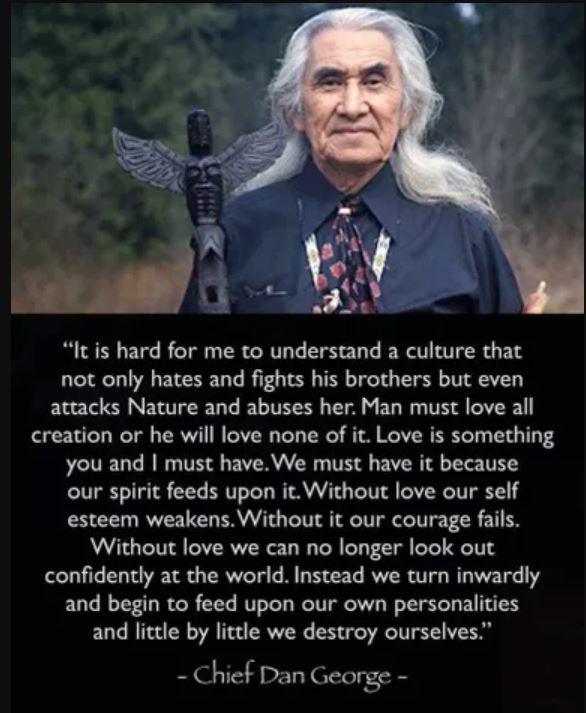 |
“It is hard for me to understand a culture that not only hates and fights his brothers but even attacks Nature and abuses her. Man must love all creation or he will love none of it. Love is something you and I must have. We must have it because our spirit feeds upon it. Without love our self-esteem weakens. Without it our courage fails. Without love we can no longer look out confidently at the world. Instead we turn inwardly and begin to feed upon our own personalities and little by little we destroy ourselves.”
-Quote by Chief Dan George.
Each week, DCYF ESIT Tribal Support Specialist Brian Frisina provides a key topic to help us get to know our Tribal Nations partners better.
This week’s topic is:
Through a Culture Lens
Cultural landscape: A geographic area (including both cultural and natural resources and the wildlife or domestic animals therein), associated with a historic event, activity, or person or exhibiting other cultural or aesthetic values. There are four general types of cultural landscapes, not mutually exclusive: historic sites, historic designed landscapes, historic vernacular landscapes, and ethnographic landscapes. Historic vernacular landscapes evolved through use by the people whose activities or occupancy shaped it, and ethnographic landscapes contain a variety of natural and cultural resources that associated people define as heritage resources (Birnbaum and Peters 1996).
Cultural Landscape Approach: A management approach that uses cultural landscapes as a framework to understand places and their associated resources. This approach is analogous and complementary to ecosystem-based management, and examines the relationships among living and non-living resources, and their environment. This approach enables a better understanding of the human connections to places, as well as the important human influences on ecosystems over time (MPA FAC 2011).
Cultural resources: The broad array of stories, knowledge, people, places, structures, and objects, together with their associated environment, that contribute to the maintenance of cultural identity and/or reveal the historic and contemporary human interactions with an ecosystem. This can include both tangible and intangible cultural heritage. According to UNESCO, tangible heritage includes buildings and historic places, monuments, artifacts, etc., which are considered worthy of preservation for the future. These include objects significant to the archaeology, architecture, science or technology of a specific culture. Intangible heritage includes the practices, representations, expressions, knowledge, skills – as well as the instruments, objects, artifacts and cultural spaces associated therewith – that communities, groups and, in some cases, individuals recognize as part of their cultural heritage.
Culturally sensitive information: Information that is culturally privileged or otherwise controlled or regulated, often by gender, age, or cultural norms. Sharing this knowledge with non-tribal members may be contrary to tribal practices. Even though culturally sensitive information may sometimes be publicly available, respect for the nature of this information must be demonstrated when consulting with tribe.
Sources
Top 20 quotes of CHEIF DAN GEORGE famous quotes and sayings. Copyright © 2022 Inspiring Quotes.
Tribal Cultural Landscapes: Appendix | Glossary of Terms. National Ocean Service, NOAA, Department of Commerce.
Tatsuko Go Hollo, ESIT’s Technical Assistance Manager, is leaving her position with the ESIT State Leadership Team to prioritize family needs. She has been a tremendous asset to our state team and we will miss her contributions to the work – especially her commitment to collaboration, racial equity, language access, and ensuring that the needs of families come first in our approach to systems work. Tatsuko’s last day with ESIT will be Monday, May 9.
We will miss you, Tatsuko!
|

DeEtte L. Snyder, PhD, has worked in the field of early childhood for more than 30 years. She received her Master’s degree in Special Education with an emphasis of blind/low vision (BLV) and early childhood education from Portland State University and her PhD in Special Education from the University of Northern Colorado.
She has been an adjunct faculty member in both her alma mater universities in the Visually Impaired Learner Program and the Early Intervention/Early Childhood Special Education Program. She has worn many hats over the years, including teacher (classroom and home-based), service coordinator, and program administrator. For the past eight years, she was the Associate Director of Outreach, Birth to 5, and State Coordinator for Birth to 3 Services at the Washington State School for the Blind, a state agency where she worked to build a program for infants and toddlers with BLV and their families, where one did not exist prior. Before coming to Washington, she worked at the Foundation for Blind Children, a large non-profit agency in Phoenix, Arizona, for 17 years.
She lives in Vancouver with her husband, Brett, and their four-legged fur baby, Porter. DeEtte is a life-long learner! Her passion is to support and mentor all early childhood service providers, in both pre-service and in-service work, and truly believes the learning never stops!
DeEtte will be transitioning into this new position over the next two months and starting full time on the ESIT State Leadership Team on July 1.
Welcome, DeEtte! We are excited for you to join us!
|

The Early Support for Infants and Toddlers (ESIT) program is recruiting for the Parent Institute for Engagement (PIE) program. PIE is a 12-month leadership program for parents and caregivers of children who have received early intervention services through ESIT. We will help you build your skills and allow you to become better leaders, advocates, public speakers and active members in your state.
If you are interested in this opportunity, please submit an application by Aug. 1. We will notify selected individuals the week of Aug. 8. Download the flyer here.
Fill out the PIE interest survey: English | Hindi | Vietnamese | Chinese | Spanish | Arabic
For more information on how to apply, contact Vanessa Allen, ESIT Family Engagement Coordinator, at Vanessa.allen@dcyf.wa.gov.
|

We want to hear from you! Our June Hot Topic Round Table will present the results of this winter’s ESIT Practice Guidance Priorities Survey and dive deeper into your priorities for each of the top pick guidance topics. Come join us and help shape our upcoming practice guidance materials.
The Hot Topic Roundtable forum is an opportunity for ESIT service providers to share successes, challenges, guidance, and support with one another and communicate with the ESIT state leadership team.
Please join us for this upcoming session:
June 21 | 8 - 9 a.m.
Practice Guidance Priorities
|
 |

The HCA’s Children and Youth Behavioral Health Work Group develops recommendations for the Legislature and the Governor regarding family and child mental health and substance use services.
The Work Group is asking families who have used mental health/substance use services, and providers who offer and refer families to services, to fill out a 5-15 minute survey about how easy or hard it was to get connected to needed counselors or programs.
Responses to these surveys are anonymous and will help build HCA's understanding of the challenges and improve access for children and their families seeking mental health and substance use services. Please complete the survey by Monday, May 16:
Family Access to Behavioral Health Survey
Provider Access to Behavioral Health Survey
|
For more updates, subscribe directly to these great newsletters:
|