|
Spring Feeling. Art by Jahla Brown, DCYF ESIT Partnership & Collaboration Specialist
"Hold on to what is good, Even if it's a handful of earth. Hold on to what you believe, Even if it's a tree that stands by itself. Hold on to what you must do, Even if it's a long way from here. Hold on to your life, Even if it's easier to let go. Hold on to my hand, Even if someday I'll be gone away from you." - Crowfoot, Blackfoot warrior and orator 1830 - 1890

What Does Two-Spirit Mean?
"Two-Spirit is a contemporary English term to reflect gender diversity that Indigenous nations have always had. As Indigenous people, we’ve always had gender diversity and sexual diversity in our Nations before colonization existed on Turtle Island (North America)." - James Makokis (Cree)
Learn more and check out this series of short videos, shining a light on some Two-Spirit folks:
|
“This Two-Spirit Movement is re-establishing our culture. The Two-Spirit Movement if anything is a decolonization process, to support the Native Community and to reclaim those roles we used to have. We’re doing this not for ourselves, but for those who can’t - those who are young and just coming out, and for Elders who haven’t felt supported throughout their life.”
– Raven Heavy Runner, Blackfeet Nation
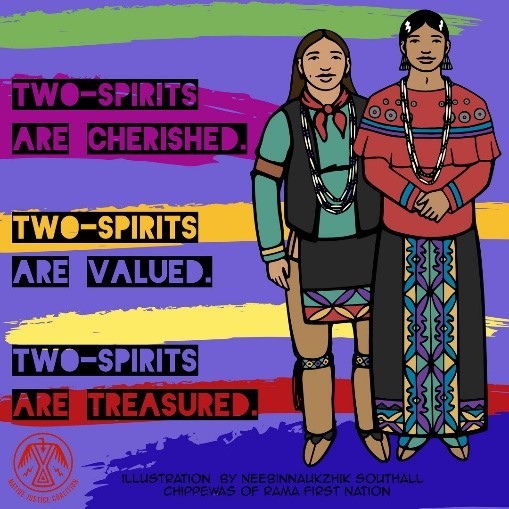
Art by Neebinnaukzhik Southall, Chippewas of Rama First Nation. Colorful illustration of two-spirited Native People, standing next to text saying: “Two Spirits are Cherished. Two Spirits are Valued. Two Spirits are Treasured.”
Each week, DCYF ESIT Tribal Support Specialist Brian Frisina provides a key topic to help us get to know our Tribal Nations partners better.
This week’s topic is:
Two-Spirit
The term/identity of two-spirit does not make sense unless it is contextualized within a Native American frame. Two-Spirit within a traditional setting was a gender analysis and not a sexual orientation. Today, most people associate the term with LGBT Natives; however, the work of the two-spirit organizations is more akin with the traditional understanding.
Learn More
"Two Spirits interweaves the tragic story of a mother’s loss of her son with a revealing look at the largely unknown history of a time when the world wasn’t simply divided into male and female and many Native American cultures held places of honor for people of integrated genders." Watch the movie preview here:
"Filmmaker Lydia Nibley explores the cultural context behind a tragic and senseless murder. Fred Martinez was a Navajo youth slain at the age of 16. But Fred was part of an honored Navajo tradition – the nadleeh, or 'two-spirit,' who possesses a balance of masculine and feminine traits. In relating Fred's story, Nibley reminds us of the values that America's indigenous peoples have long embraced." Download Two Spirits discussion guide for the film:
Download Two-Spirit People: Sex, Gender & Sexuality in Historic and Contemporary Native America: an in depth guide by Harlan Pruden (Nehiyawe/First Nations Cree) and Se-ah-dom Edmo (Shoshone-Bannock, Nez Perce, Yakama),
including history, concept, roles, names, historical elders, and research (circa 2013):
Sources
Two Spirits, Native American Gender Diversity Independent Learning, via pbs.org. © 2022 Independent Television Service (ITVS).
Two Spirits, Tiger Productions LLC. Curated by ITVS, PBS, and funded by the Corporation for Public Broadcasting (CPB), PBS and the National Endowment for the Arts.
Two-Spirit People: Sex, Gender & Sexuality in Historic and Contemporary Native America. By Harlan Pruden (Nehiyawe/First Nations Cree), Managing Editor, TwoSpiritJournal.com and Se-ah-dom Edmo (Shoshone-Bannock, Nez Perce, Yakama), Program Coordinator, Lewis & Clark Graduate School.

Washington State has adopted policies and procedures to ensure public participation in the annual grant application for the Individual with Disabilities Education Act (IDEA) Part C funds. Public participation notices will be published in a manner to ensure circulation throughout the state for at least a 60-day period, with a 30-day opportunity for public comment and public hearings, as appropriate, during that period. It can be found on DCYF’s Office of Innovation, Alignment and Accountability Reports page.
DCYF's ESIT program posted the following materials for public review and comment:
The public comment period closes on May 7: Submit Public Comment.
Please Note: We are gathering public comment only. This is not a rule or Washington Administrative Code (WAC) revision or change.
If you would like to receive this notification in an alternate format or language, please contact the ESIT Partnership & Collaboration Manager at 564-999-0449 or dcyf.esit@dcyf.wa.gov.
For questions, please contact Laurie Thomas, ESIT Program Administrator and IDEA Part C State Coordinator at laurie.thomas@dcyf.wa.gov.
|

Children with disabilities receiving early intervention services who turn three years old by May 1 and transition out of ESIT services often experience a gap in services due to summer closures of public schools and preschool programs. This summer gap in services is an issue that is particularly impactful for children with special needs and other historically marginalized children and families including children of color and children in families experiencing financial insecurity and other stressors.
Extending ESIT Part C services for children over age three for the summer months has the potential to narrow the gap by supporting the following outcomes:
- Children have positive social-emotional skills (including social relationships).
- Children acquire and use knowledge and skills (including early language, communication, and literacy).
- Children use appropriate behaviors to meet their needs.
The ESIT Program and its OSPI Special Education partners are collaborating to address potential disparities in access to summer services by offering families a summer extension of ESIT services for children meeting the eligibility criteria for expanded services and who turn three between May 1 and September 1 beginning with the summer of 2023. Initial start-up funding for this extension of services for eligible children is being sought through an anticipated IDEA Part C State Incentive Grant (SIG) opportunity.
To be eligible for the SIG, states must have OSEP-approved state policies and procedures for the Extended Part C option. Of note for IDEA Part B partners, the timeline for transition from Part C to Part B will not be impacted by this opportunity, and the IEP still needs to be in place by the child’s third birthday. Stakeholder voice will be very important as this initiative moves forward with the planning and initial implementation phases. There are several stakeholder, community, and tribal partnership opportunities being planned over the next several months. Upcoming opportunities planned to date include:
Upcoming Feedback Opportunities
- Public Comment Periods for both the DCYF-ESIT (IDEA Part C) and OSPI (IDEA Part B) federal grant applications. These specific 30-day periods will be announced in the March 2022 Special Education Monthly Update and ESIT Weekly publication.
- DCYF-ESIT (IDEA Part C) Federal Grant Public Hearings will be held in early April 2022 for real time feedback.
- Update and feedback at Pre-K Inclusion Champions gathering on April 14, 2022.
- A joint DCYF-ESIT and OSPI Family Input Forum will be scheduled in spring 2022 – keep an eye out for more information!
- OSPI Special Education Office Hours with Fiscal and Data partners on March 30, 2022 at 1 p.m.
- Update and feedback from DCYF/ESIT Statewide Interagency Coordinating Council on April 20, 2022.
If you have questions, comments, or would like further information, please contact DCYF State Lead Agency representative Laurie Thomas, ESIT Program Administrator, at laurie.thomas@dcyf.wa.gov or OSPI State Education Agency representative Tania May, State Special Education Executive Director, at tania.may@k12.wa.us.
|

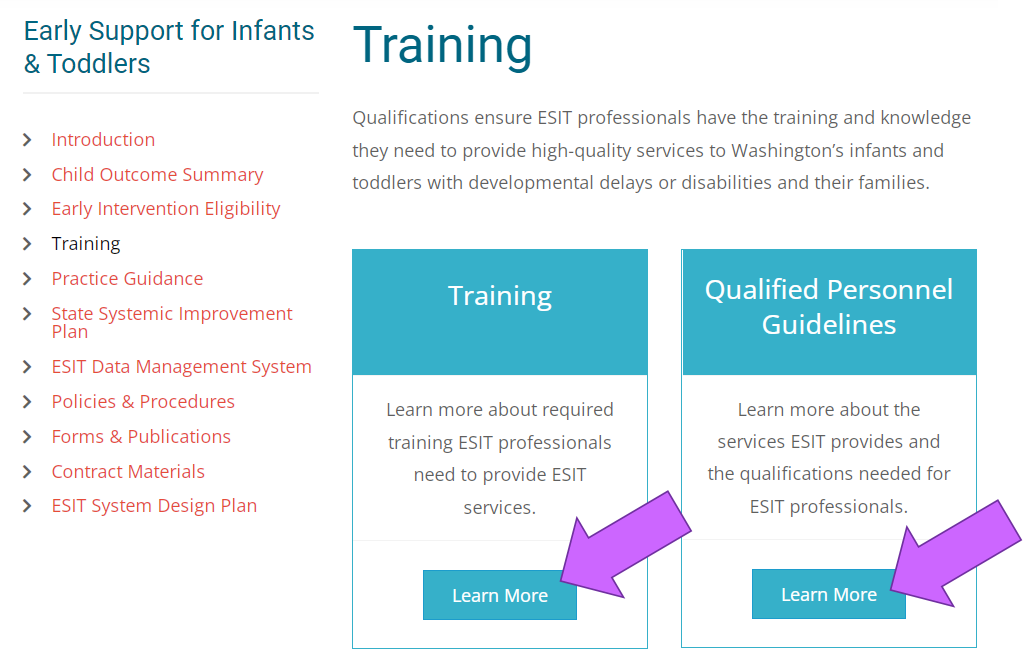
DCYF is excited to introduce the new and improved ESIT Qualifications and Roles Requirements page! This new page is intended to assist in locating information for qualifications and training requirements. Additionally, the DCYF Professional Development team has consolidating information across DCYF programs. This is great news for anyone interested in learning more about becoming an ESIT provider and for existing providers interested in learning more about expected qualification and training requirements.
|
Click Learn More on ESIT’s Training page to access the new Qualifications and Role Requirements page to find the following:
- Training requirements for members of the ESIT workforce.
- Qualified Personnel Guidelines.
- ESIT Core Competencies and related materials to support supervisors and staff, located in the Resources section.

Beginning in May, ESIT will be changing the date of our monthly Hot Topic Roundtable gatherings to the third Tuesday of the month. The time will remain the same, from 8-9 a.m. The Hot Topic Roundtable is an opportunity for service providers to converse, share successes and challenges, seek guidance and support, and learn from one another. Please join us for these upcoming sessions:
The New Provider Training Structure
Second Wednesday Monthly
April 13 | 8 – 9 a.m.
Register Here
Child Transitions: Part 2
Third Tuesday Monthly
May 17 | 8 – 9 a.m.
Register Here
|

ESIT is recruiting for a Workforce Development Manager. This position works to support the ESIT program within the Family Support Programs Division and provides oversight and coordination of specialized, expert level Workforce Development Specialists. This position is responsible for ensuring consistent implementation of all aspects of early intervention services including developing and managing the Comprehensive System of Personnel Development (CSPD) budget, drafting relevant policy, and maintaining the required elements of state and federal early intervention laws and regulations in a manner consistent with DCYF values including integrity, compassion, transparency, respect, and inclusion.
To learn more about this position click on the link below:
|
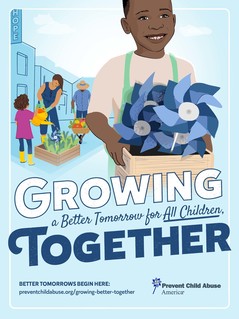
DCYF’s Strengthening Families team is preparing to observe Child Abuse Prevention Month this April by raising awareness in communities about child abuse and neglect prevention.
As the Prevent Child Abuse Washington State Chapter, we encourage you to join the Pinwheels for Prevention initiative. This initiative uses pinwheels – a timeless symbol for childhood – to represent its campaign.
Last year, we distributed around 15,000 pinwheels to communities around the state. Pinwheels for Prevention is a reminder that it is not enough to respond to child abuse and neglect – we must build and support strong families through community engagement, programs, and policies. This movement works toward developing communities that are healthy, safe, and nurturing for all children and all families.
Order pinwheels today! Please share this information with your child abuse and neglect prevention partners across the state. Pinwheels can be ordered using the form found here. Pinwheels are available on a first-come, first-served basis.
If you have any questions, please email strengtheningfamilies@dcyf.wa.gov.
|

Great news – registration is live and online!
The IECC will span over five days, May 2 – 6, to allow total flexibility. Thanks to the support of community partners, IECC intends to offer the 2022 registration at no charge for attendees, making this high-quality training accessible for as many providers and families as possible – we hope to see you there!:
IECC | May 2-6
Register online
Conference schedule
Download program
Download flyer
|
 |

In an effort to increase access to at-home rapid COVID-19 test kits, Washington State residents can order free rapid-antigen COVID-19 tests online and will receive those tests delivered at no cost. The Washington State Department of Health (DOH) online portal originally opened in January and quickly ran out of supplies. The state has increased its supply of testing kits and is now open again. Providers can access both of the following Washington State DOH and federal portals to order and receive tests:
Providers can assist with ordering tests through both programs for each household they support and are not limited to accessing one of the above sources.
|

The Fair Start for Kids Act, passed by the Washington State Legislature in 2021, is a historic $1.1 billion investment to expand access to child care, cap rates, build the child care workforce, and help strengthen the recovery from the COVID-19 pandemic.
DCYF is launching a monthly newsletter showcasing the Fair Start for Kids Act and the positive impacts on making quality child care more affordable and accessible for Washington families.
Subscribe here to receive the Fair Start for Kids monthly newsletter.
|

Please join the Washington Fatherhood Council for the 4th-annual Washington Fatherhood Summit
May 24 – 26
Daily events 8:30 a.m. – 1 p.m.
Click here to register
Including: presentations, forums, and panels scheduled with leadership from Washington State agencies, experts in the education field, and advocates for fathers everywhere. Check out the Save the Date flier to learn more about the scheduled speakers.
|

New services
The Health Care Authority’s (HCA) interpreter services team and Universal Language Service has signed a new spoken language contract to provide over the phone and video remote interpreting services.
The contract will go live this spring and will assist Apple Health Medicaid providers in meeting their Title VI of the Civil Rights Act of 1964 responsibility. The new services will increase health equity for Apple Health providers, language access providers, and Apple Health clients.
Providers
To register to use the over the phone and video remote interpreting contract, email accounts@ulsonline.net.
Language access providers (LAP)
To register to provide interpreting services for the over the phone and video remote contract, email interpreter@ulsonline.net.
|
For more updates, subscribe directly to these great newsletters:
|