|
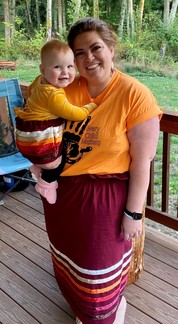
For the last 10 years, I have worked for the Tulalip Tribes’ Justice System, working to combat substance use disorder within Indian Country. Since 2019, I served as the Program Manager for the Tulalip Healing to Wellness Court and Tulalip Family Wellness Court programs. Under my direction, the Tulalip Healing to Wellness Court was named a National Mentor Court for the National Association of Drug Court Professionals—the second Tribe to be so honored. During my time with Tulalip, I graduated from the University of Washington with my Bachelors in Law, Societies and Justice and continued my studies at Arizona State University to receive my Masters in Criminal Justice.
I am so excited to join DCYF and the Prevention Services team as a Home Visiting Program Specialist! I am extremely passionate about our tribal communities and their children and cannot wait to collaborate with our tribal partners and organizations. I am looking forward to being a part of DCYF’s commitment to build relationships with tribal partners and expand home visiting services to our Washington State tribal communities!
Wado (thank you),
Ashley U. Cook
DCYF Trainer Conference Advisory Group
We are pulling together individuals who will help us plan this year’s trainer conference. We are in search of four trainers who are not affiliated with a DCYF training organization.
The advisory group will help inform the vision for this event, guide the program structure, support with session selection, among other things. If you are interested, please email training@dcyf.wa.gov for more information.
Region 6 News
The Cowlitz Indian Tribe - Child Care Development Program has created a “Parents as Teachers” (PAT) Program and will soon be providing in person and/or virtual visits for tribal families. PAT is a home-visiting, evidence based program that provides parents with increased knowledge about early childhood development from prenatal through kindergarten. We are excited that this resource will be available for our Tribal Families. We are waiting to hear back from the Program Director for more details. Please reach out to Antonia Bancroft, our Tribal Child Welfare Early Learning Navigator, to be connected for more information at Antonia.bancroft@dcyf.wa.gov.
Treehouse is launching a new program to center lived expertise of young adults who have experienced the foster care system: the Collaborative Learning Lab (CLL).
This program is just one step Treehouse is taking as it commits to becoming a racially equitable Please share this announcement with any of your alumni of foster care and amplify the opportunity to young people you know who may be interested. The young adults will be compensated for their time and will be able to better help improve the services that are provided at Treehouse.
Learn More: One-Pager (English) | One-Pager (Spanish) | Flyer
Child Development invites manuscripts for a Special Section on Highlighting Indigenous Child Development: Edges and Possibilties in State-of-the-Art Research. The Special Section Co-Editors are Adam J. Hoffman (Cornell University), Ashley B. Cole (Oklahoma State University), Megan Bang (Northwestern University), Charissa S. L. Cheah (University of Maryland, Baltimore County) and Glenn I. Roisman (in his role as Editor-in-Chief of Child Development).
Papers that are of interest for this Special Section will feature empirical research (i.e., quantitative, qualitative, and mixed methods) that highlights these diverse contexts and the implications that they have for developmental processes among Indigenous children and youth.
Authors who plan to submit a manuscript must submit a letter of intent (LOI) through the SRCD application site by May 12, 2022.
Read the Full Call | Read the Submission Guidelines
NM: Indian Child Welfare Act Unanimously Passes Committee
HB 135, the Indian Child Welfare Act, which would require New Mexico's Children Youth and Families Division (CYFD) to prioritize placing Native American children within their tribes and keeping Native families together, passed the House Health & Human Services Committee this morning with a unanimous bipartisan vote. HB 135 would also require CYFD to help children determine and establish tribal membership. Placing Native children within their tribe would protect family units and preserve traditions and cultures. This bill would provide many of the same protections for New Mexico's Native American children as the federal Indian Child Welfare Act, which is currently before the US Supreme Court and could be struck down.
Source: Grant County Beat - January 31, 2022
-
American Indian Endowed Scholarship: The American Indian Endowed Scholarship (AIES) helps financially needy students with close social and cultural ties to an American Indian community in the state of Washington. Students can use the scholarships at public colleges and many independent colleges in Washington. The program prioritizes upper division and graduate level students, however, all applicants receive award consideration. Learn more and apply here. Apply by March 1.
-
Catalyst for Infant Health Equity: The Health Resources and Services Administration (HRSA) is now accepting applications for the fiscal year 2022 Catalyst for Infant Health Equity program. The purpose of this new funding opportunity is to support the implementation of existing action plans that apply data-driven policy and innovative systems strategies to reduce infant mortality (IM) disparities in a specific county/jurisdiction. The Catalyst for Infant Health Equity program is open to applicants from domestic or private entities, community-based organizations, tribes and tribal organizations. HRSA anticipates that Catalyst awards will accelerate the reduction of IM disparities and excess infant deaths by supporting policy and systems changes that improve conditions to promote equity. Letters of Intent to apply are requested by Feb. 18. Applications are due April 19, 2022. More information is available in the NOFO: https://www.grants.gov/web/grants/view-opportunity.html?oppId=334421.
-
Arts in Education Grant Opportunities: The Arts for All (A4A) Recovery Grant provides staffing support in service of PreK-12 students as they navigate the ongoing impact of the COVID-19 pandemic. A4A Recovery Grants are intended to stabilize community-based learning options, stimulate hiring and rehiring, bring teaching artists into the classroom, and relaunch arts and cultural programs. Applications are due Feb. 24.
-
Tribal MIECHV: The Administration for Children and Families (ACF) is now soliciting applications for the Fiscal Year 2022 Tribal Maternal, Infant, and Early Childhood Home Visiting Grant Program: Development and Implementation Grants. This funding is intended for tribal entities that do not have prior experience with implementing evidence-based home visiting models, performance measurement systems, and continuous quality improvement (CQI) activities. Applications are due April 15. More information is available in the NOFO: https://www.grants.gov/web/grants/view-opportunity.html?oppId=335554.
-
Grant Opportunity for Tribal Colleges and Universities: The U.S. Department of Education, Office of Special Education Programs is pleased to announce a grant opportunity related to the preparation of special education, early intervention, and related services personnel attending minority serving institutions (MSIs), including Historically Black Colleges and Universities (HBCUs), Hispanic Serving Institutions (HSIs), Tribal Colleges and Universities (TCUs), and Asian American and Pacific Islander Serving Institutions (AAPISIs). The purpose of this priority is to increase the number of ethnically and racially diverse personnel who are fully credentialed to serve children, including infants, toddlers, and youth with disabilities. Under this grant competition, the Department will fund high-quality projects within MSIs that prepare special education, early intervention, and related services personnel at the certification, bachelor’s degree, master’s degree, educational specialist degree, or clinical doctoral degree levels. For more details on grant application requirements please review the notice informing applicants: https://www.federalregister.gov/documents/2022/02/04/2022-02392/applications-for-new-awards-personnel-development-to-improve-services-and-results-for-children-with
-
Pathways to Prevention | Racism, Racist Inequities and the Child Welfare System: Implications for Prevention: Feb. 16, 11 a.m. (MT). Register Here.
-
NICWA's 40th Annual Protecting Our Children Conference: April 4-6. This year's theme is “Homecoming: 40 Years of Connecting for Our Children.” Register here.
-
Second annual Sapsik'ʷałá Teacher Education Program’s Grow Your Own (GYO) Future Teachers Project: This project will support the next generation of Indigenous educators through a 12-week virtual mentoring program (March 28 – June 17, 2022). Let’s grow our own Native educators! To apply to be part of this exciting new mentorship program for American Indian/Alaska Native high school and undergraduate students, please visit this website. Email Dr. Rena Dunbar at renad@uoregon.edu with any questions.
2022 Legislative Session
Guidance
Listen
- Over the course of eight months, Jessica Washington, a reporter with the Fuller Project spoke with Native families, lawyers, and other experts to understand why Minnesota has the highest disproportionality of Indigenous children in the child welfare system in the country. The Takeaway speaks with Washington about her investigation. We also hear from one of Washington's sources, Teresa Nord, who is a Navajo and Hopi Indian descendant, and who has personal experience with the child welfare system in Minnesota. Listen to the podcast here.
- New Season of "American Diagnosis" Podcast to Explore the Resilience of Indigenous Peoples in the Face of Adversity, Social Inequity, and Health Injustice. The new season of the "American Diagnosis" podcast will explore the impact of hundreds of years of adversity on the health of Indigenous peoples in America, examining the resilience of the Navajo Nation during the covid-19 pandemic as an entry point into this history. Early in the coronavirus pandemic, the Navajo Nation made headlines for having the nation’s highest covid infection rates. And yet the Navajo people, also known as the Diné, rebounded spectacularly. They rallied around their elders. They banded together to make sure their communities had the food, water, and protective equipment they needed. And they’ve led the way in getting their people vaccinated. Listen to the podcast here.
|
|