The Strengthening Families Washington Home Visiting Team identified some resources that may be helpful for your team or agency. Based on your questions at office hours, we’ve done some research on available resources to support all families in Washington who are encountering challenges caused by the COVID-19 pandemic, regardless of whether they are families funded by the HVSA or other sources in your home visiting program or participants in other programs at your organization.
American Rescue Plan Act (ARPA) Opportunities
The 2021 ARPA provides relief to address the continued impact of COVID-19 on the economy, public health, state and local governments, individuals, and businesses. ARPA funds are flowing through many state and local government agencies. You can learn where ARPA funding is in Washington available at the Washington Nonprofits webpage: How nonprofits can access ARPA funding.
Washington Nonprofits has compiled an ARPA grants Excel spreadsheet listing county funding programs across Washington State (all counties are listed; not all counties have additional ARPA funds to apply for): Washington ARPA Funding Opportunities.
There are also other resources listed on this webpage to assist organizations/agencies with the grant application process; continue to scroll down the webpage to see what Washington Nonprofits offers. We are in no way endorsing any of their offerings.
Washington State Department of Commerce offers a variety of funding to support healthy and safe communities. Visit the Department of Commerce website to view current opportunities and sign up for Commerce updates.
Diaper Banks and Food Banks
Diaper Banks provide diapers and other basic needs in their communities. They take on the work of collecting, warehousing, and distributing diapers for a large service area so that there is a consistent and reliable supply for populations in need. Each diaper bank is unique. Diaper banks may provide supplies to community organizations including home visiting programs, directly to families, or both.
The following Washington State diaper banks are members of the National Diaper Bank Network and may be able to partner with you. There may be other diaper banks not part of the network.
Many food banks also carry diapers and other supplies. You may want to check with your local food bank to see if they can partner with you. You can find food banks near you on ParentHelp123, Northwest Harvest Hunger Response Network, and/or the Washington State Department of Agriculture Food Access webpages.
The Children’s Funding Project has a new online database that highlights ARPA funding available to all 50 states, U.S. territories, and the District of Columbia as well as more than 27,000 counties, cities, and towns; nearly 17,000 school districts; and 3,500 higher education institutions in four key areas.
If there are other resources you know of that are you’d like to share with the other LIAs, please send your ideas to your program specialist and Home Visiting email (dcyf.homevisiting@dcyf.wa.gov) so we can include them in the upcoming newsletters/emails.
Thank you for your continued dedication and service to the families in your communities – they are so fortunate to receive your care abd services.
Family First in Washington State is a multi-phased, multi-year implementation. DCYF chose the initial set of EBPs in the state plan in part by the current contracts DCYF already had in place for prevention as well as stakeholder feedback and federal guidance. In the implementation planning, it was discovered that more integration work is needed to meet the FFPSA requirements for claiming Title IV-E funding for services such as home visiting. While work will continue to integrate systems so that Title IV-E claiming and funding will support service expansion in the future, currently the combined In-Home services contract is the focus for initial roll-out. This in no way impacts the ability of child welfare caseworkers to refer to community services including home visiting to support families.
To date, some progress has been made in the implementation process including:
- 9 Early Implementor child welfare offices have been identified to begin first with implementation in 2022. Family Voluntary Services and CPS-FAR service cases are the first candidate programs to begin working prevention cases with families. The offices include: Wenatchee, Richland, Ellensburg, Yakima, Everett, Puyallup, Tumwater, Long Beach, and South Bend.
- 6 regional FFPSA leads have been hired to support implementation
- Motivational Interviewing training has begun for the early implementor offices to support strong engagement and the prevention work.
- Necessary IT infrastructure within DCYF is being developed to support prevention cases.
DCYF is looking forward to supporting and cultivating partnerships between child welfare local offices and home visiting programs to better support referrals to home visiting and collaboration on cases. Please reach out to your HVSA program specialist if you would like to meet with the FFPSA regional lead to build partnership between your program and your regional/local child welfare office. If you are interested in further information, please visit the DCYF FFPSA webpage to learn more about this work.
Courtney Jiles will be ending her time as the Home Visiting Project Manager position effective Feb. 4, 2022. She will be taking an intentional pause to reset and spend quality time with her family.
"It has been a true honor and a privilege to work with and learn from each of you," Courtney said. "Your compassion for children and families, dedication to high-quality services, and grace and flexibility during a pandemic has inspired me over the years and I have no doubt this great team will continue to do great things for the home visiting system. Thank you for partnership and I hope our paths cross again in the near future."
Thank you so much for sharing your gift and wisdom with us Courtney, you will be greatly missed!
 |
|
Underused housing resource for survivors
There is an underused housing resource for CPS-involved families who are trying to get their children back. It is called the Family Unification Program Housing Choice Vouchers (FUP vouchers), for families who are CPS-involved, their children have been removed from the home, but there is the possibility to get their child back. In other words, for families who can’t get their children back primarily due to housing problems. Being housed is a primary factor in the reunification of children and their families.
|
In Washington State, Public Housing Authorities used to distribute the FUP vouchers to community-based non-profits, like homelessness services programs and domestic violence or sexual abuse advocacy organizations. Now, community-based agencies no longer get FUP vouchers for families. The only way a family can get a FUP voucher is a direct referral from their assigned CPS worker. Additionally, undocumented adult survivors are unable to get a FUP voucher. The only exception is if the undocumented adult has children with documentation.
By ending the partnership between Public Housing Authorities and community-based organizations for the FUP vouchers, survivors and their families lost critical housing advocacy support for things like negotiating with landlords, the housing search process, or providing flexible financial support for move-in costs and rental security deposits.
Survivors of domestic violence are depending on their CPS worker to tell them about this housing option. Historically, CPS’s inconsistent response to the experience of living with domestic violence and judgement about survivor’s decisions about what families say they need most, can undermine a survivor’s access to these housing options – when housing is what you need to get your child back.
How can you help? As a home visitor, you have an important role in supporting survivors in their relationship with their assigned CPS worker. You can ask the family’s CPS worker if there any FUP vouchers available. You can share with the CPS worker the ways the survivor is protective of their children – all the ways you see survivors using their courage, strength, and resilience. Your relationship matters! Housing is human right and fundamental to loving families!
Despite decades of efforts to reduce sudden unexpected infant deaths (SUID), including sudden infant death syndrome (SIDS), accidental suffocation in bed, and deaths from unknown causes, about 3,400 infants die from sleep-related deaths in the U.S. each year.[i] SIDS was the second leading cause of infant death in Washington State in 2019. Data suggest that SUID disproportionately affect families of color in Washington, especially American Indian and Alaska Native (AI/AN), multiracial, and Native Hawaiian and Pacific Islander families.[ii]
To reduce the risk of sleep-related infant deaths, the American Academy of Pediatrics (AAP) recommends that caregivers:
- Place the baby on their back on a firm sleep surface with a tight fitted sheet.
- Avoid use of soft bedding in the crib, including crib bumpers, blankets, pillows, and soft toys.
- Sleep in the same room as the baby, but on a separate sleep surface, for at least six months but preferably until the baby turns 1.
- Don’t smoke around the baby or use drugs or alcohol while caring for the baby.
Measuring MIECHV Performance
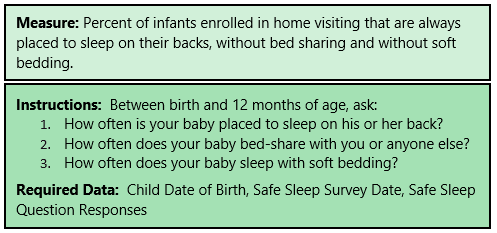
HVSA programs that receive MIECHV funding are required to report on safe sleep practices for each enrolled child that is between 0 and 12 months of age.
[ii] Washington State Department of Health, Center for Health Statistics, Death Certificate Data, 1990-2019, Community Health Assessment Tool (CHAT), Nov 2021
To meet the measure, the responses to the safe sleep questions must be as follows:
- How often is your baby placed to sleep on his or her back? Always
- How often does your baby bed-share with you or anyone else? Never
- How often does your baby sleep with soft bedding? Never
How are we doing?
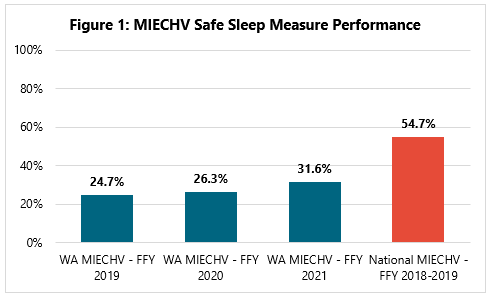
Figure 1 displays performance among Washington MIECHV-funded families in Federal Fiscal Years (FFY) 2019-2021. In FFY 2021, 32% of MIECHV infants in Washington were always placed to sleep on their backs without bed sharing or soft bedding. Nationally across all state and territorial MIECHV programs, 55% of eligible children met this measure in FFY 2018 and FFY 2019. Note that data was missing for over one-third of Washington MIECHV children each year.
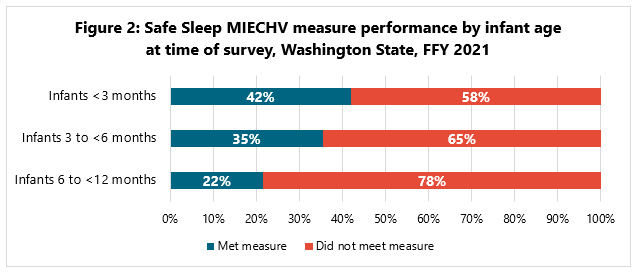
Figure 2 provides performance by age group among eligible children in FFY 2021. Caregivers reported higher rates of compliance with recommendations among younger infants.
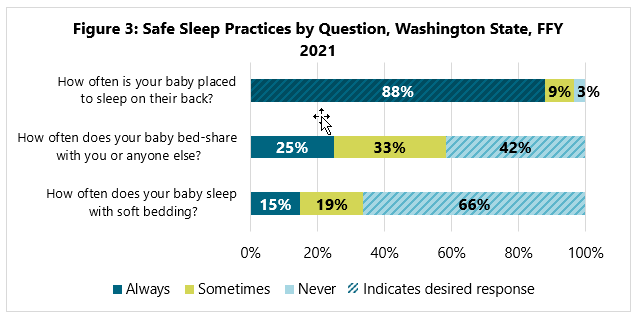
Figure 3 highlights the areas of safe sleep that families had the most difficulty in achieving. Bed-sharing appeared to be the most challenging area, with 58% of caregivers of children aged 0-12 months reporting that their child sometimes or always bed-shares.
There are many reasons why caregivers may choose to bed-share, including comforting a fussy baby, convenience for feeding, helping the caregiver and baby sleep better, and bonding. However, research has found that bed-sharing exposes infants to additional risks like suffocation, entrapment, falls, and strangulation. This is particularly true for infants younger than 4 months and those who were born preterm or with low birth weight, because these babies may lack the motor skills or muscle strength necessary to escape potential threats.[i]
Instead, AAP recommends infants sleep in the caregivers’ room, close to the caregivers’ bed, but on a separate surface. This allows caregivers to be close to the infant for comforting, feeding, and monitoring, while reducing exposure to risks that may lead to suffocation, asphyxia, entrapment, falls, and strangulation, etc. Research suggests that sleeping in the caregivers’ room but on a separate surface decreases the risk of SIDS by as much as 50%.iii
What’s next?
AI/ANs in particular experience elevated rates of SUID nationally and here in Washington State.ii, [ii] Home visitors are in a unique position of being a trusted resource to educate families on safe sleep practices and help create safer sleep environments for infants. To learn more about safe sleep and how to promote safe sleep in AI/AN communities, please join this three-part webinar series hosted by the Healthy Native Babies Project:
Wednesday, Feb. 16, 11 a.m. – 12:30 p.m.
Evidence for Helping Babies Sleep Safely in AI/AN Communities
Safe sleep statistics, public health perspectives, and educating diverse AI/AN communities
Register
Wednesday, March 16, 11 a.m. – 12:30 p.m.
Strategies and Practical Tips for Teaching Safe Infant Sleep in AI/AN Communities
Lessons learned, best practices, and real-life stories from Indian Country
Register
Wednesday, April 13, 11 a.m. – 12:30 p.m.
Tools for Addressing Safe Infant Sleep in AI/AN Communities
Resources for successful outreach, technical assistance, and effective communications
Register
Healthy Native Babies Project materials
[1] CDC/NCCDPHP, Sudden Unexpected Infant Death and Sudden Infant Death Syndrome Data and Statistics. Accessed here: https://www.cdc.gov/sids/data.htm
Tested positive for COVID-19?
If you have symptoms of COVID-19, get tested as soon as possible. Public Health Connection explains what you should do if your test comes back positive. For more information from DOH, please sign up for the Public Health Connection blog.
HVSA Data Training
Please join us for an HVSA Basic Data Requirements training on Wednesday, Feb. 2, from 1– 2:30 p.m. DOH will provide an overview of data that is required to be reported by each LIA and describe each of the aligned performance measures. This training is targeted to new supervisors and home visitors, but any LIA staff who would like a refresher are welcome to attend.
Join on your computer or mobile app: Click here to join the HVSA Basic Data Requirements meeting
Or call in (audio only): +1 564-999-2000,,196585991#
Conference ID: 196 585 991#
Please contact homevisiting@doh.wa.gov for more information.
Aligned Measures Quality Assurance reports
Quality Assurance Reports detailing your program’s performance on Aligned Measures in SFY 2021 will be posted to your SFT accounts by Jan. 20. QA reports covering the same time period were provided to your program in August 2021. For programs that report into the SQL database, the newly-posted reports have been refreshed to reflect data cleanup efforts and slight changes in measure calculations. Programs that do not report into SQL will receive the same report they received in August.
New Shared DOH Email Address
The DOH home visiting team now has a shared email address. If you have a training or technical assistance need, data question, or a question you don’t know where to direct, please send an email to homevisiting@doh.wa.gov.
Your Voice and Experience Continues to Matter! Join us for an Update & Input – Listening & Learning Session. See the core competencies framework in development and provide your input. Please share to all home visiting supervisors and home visitors with an active caseload of families in your organization or network. For more information view the attached flyer with details and an agenda.
The next peer connection is on Thursday, Jan. 27, from 2:30 – 3:30 p.m.
We encourage any Home Visitor interested to sign-up using the link below:
Register for Home Visiting Peer Connections
CQI webinars will continue to be held the fourth Wednesday of the month from 1:30 – 2:30 p.m.
For access to calendar invites and resources in Basecamp please reach out to rcontreras@startearly.org
Upcoming topics include:
- Jan. 26: Motivation
- Feb. 23: Data Overview with DOH
- March 23: Mental Health and Depression Resources
Each month, DCYF ESIT Tribal Program Consultant Brian Frisina will provide a key topic to help support us all in getting to know our Tribal Nations partners better.
The Lakota Winter Count
"A winter count is a record of history. For generations, Plains Indians drew pictographs to document their daily experiences. The Lakota term for winter count is wniyetu wowapi. The word Wowapi translates as “anything that can be read or counted.” Waniyetu is the Lakota word for year, which is measured from first snow to first snow.
Usually drawn on buffalo skin or deer hide, Lakota winter counts are composed of pictographs organized in spiral or horizontal rows. Each pictograph represents a year in history of a Lakota community. The pictographs were organized in chronological order so that the winter count provided an outline of events for the community’s Keeper or oral historian."
Text from The Lakota Winter Count. Akta Lakota Museum & Cultural Center.
Learn More
"Two Smithsonian experts describe the Lakota tradition of creating Winter Counts as a way of recording events:"
This video is part of the "Tools" exhibition at Cooper Hewitt, Smithsonian Design Museum from December 2014 to May 2015.
Redlining Explained
"Redlining: the racist housing policy from the Jim Crow era that still affects us today."
Watch: The Disturbing History of the Suburbs
Beyond the Dream
"For Black Americans, no protest can be peaceful enough."
How Martin Luther King Jr.’s Legacy Has Been Distorted To Insulate White Supremacy
- Washington NFP graduate Chelsea Lawyer is now on the Board of Directors for the National Service Office for Nurse-Family Partnership and Child First! Congratulations, Chelsea. Read the press release.
- The Washington State Broadband Office awarded $145 million in infrastructure acceleration grants to help provide broadband connections to unserved and underserved communities and Tribal nations. Read the press release.
- Parents of young children are hitting rock bottom with the surge of Omicron. NPR checks in.
|