|
One of DCYF’s critical tasks is to strengthen the linkages between our state’s child welfare and early learning systems. Evidence suggests that early learning and family support programs can help families prevent maltreatment, reduce entry into foster care, and improve well-being, but fewer than half of Washington’s eligible families involved with Child Protective Services (CPS) were reaching these programs.
The goal is to promote long-term positive outcomes for children, and decrease subsequent reports of abuse or neglect and out-of-home placements for families with active child welfare cases. DCYF collected and analyzed data to identify opportunities to better serve families and children through child welfare, early learning, and family support connections. Those connections are made by DCYF Child Welfare Early Learning Navigators, or CWELNs, who collaborate with CPS caseworkers to support and connect families with young children to high-quality early learning and family support experiences. Currently, this work is being carried out across three regions of the state, including South King, Grays Harbor, Mason, Pacific, and Yakima counties. Soon, an Indian Child Welfare navigator will begin to serve tribal communities, and an additional CWELN in King County will join the team.
The CWELN team is trying new ways to more consistently track when child welfare staff and navigators refer families to community early learning resources such as: child care, Early Childhood Education and Assistance Program (ECEAP), Head Start, home visiting, Early Support for Infants and Toddlers (ESIT), and Early Childhood Intervention and Prevention Services (ECLIPSE). We hope this information can help to achieve three things:
- Determine what strategies for making referrals are most effective in getting families enrolled in early learning services — including the creation of a conversation guide and accompanying grid
- Identify and address “missed connections” — when a family wants to be connected to an early learning resource but gets lost in the process
- Develop systems that allow us to identify gaps in needed services, pinpoint bottlenecks in real time, and regularly adjust practice as needed
The CWELN Project is currently funded by the Preschool Development Grant Birth Through Five (PDG B-5), which was renewed in 2019 to carry out approved activities over three years. As the CWELN team prepares for its third year, they are excited to take the lessons learned from the project to inform ongoing practice and policy change across the state. This project is likely just one of many toward achieving our ambitious goal of connecting all families, especially those with active child welfare cases, to early learning resources. The team is capturing data and learnings from the project about necessary changes, as well as actively evaluating the impact of the navigators’ referrals to make sure this critical effort is as effective as possible.
To learn more about the CWELN project, email minnette.mason@dcyf.wa.gov or call 360-480-9563. Other resources include: CPS Investigations and the Family Assessment Response (FAR) brochures. For more information about the impact of the CWELN project, visit https://govlab.hks.harvard.edu/files/govlabs/files/wa_dcyf_project_feature.pdf.
 This time of year means opening the new federal fiscal year and closing the last. The Strengthen Families Locally team (housed within the Strengthening Families Washington team) submitted the Semi-Annual Progress Report for the federal grant that funds the Strengthen Families Locally Initiative. These moments give us an important time to pause, reflect, and note the milestones that are being achieved and some that have been complete rewrites of our intent. Many of the elements we planned in the grant application (parent nights, community events) have had to shift entirely. Some pieces that stood out proudly for your consideration:
- This last year brought the contracts with the Strong Community Network facilitators. This group of dynamic leaders in the local communities will be guiding the framing for each Community Prevention Plan. It has been exciting to see the passion and commitment each of these leaders is bringing.
- Formal evaluation plan for the project has been approved
- Establishment of the Our Tomorrows tool to help the communities collect and respond to stories. Using stories to design community based interventions is a key element of our project and has been used successfully in Kansas and other states to dramatically change services to meet family needs.
- Community participation and design – each of the locale meetings has a robust network of parents and partners working on the plans.
DCYF Community Correspondents will help families share their stories with DCYF, and also collaborate with DCYF and communities to improve systems and services based on family input. They receive funds for their time and effort. This paid opportunity is available for both individuals and organizations. Learn more and fill out the application here. Two trainings currently scheduled: 11/22, 1-3 pm and 11/23, 12-2 pm.
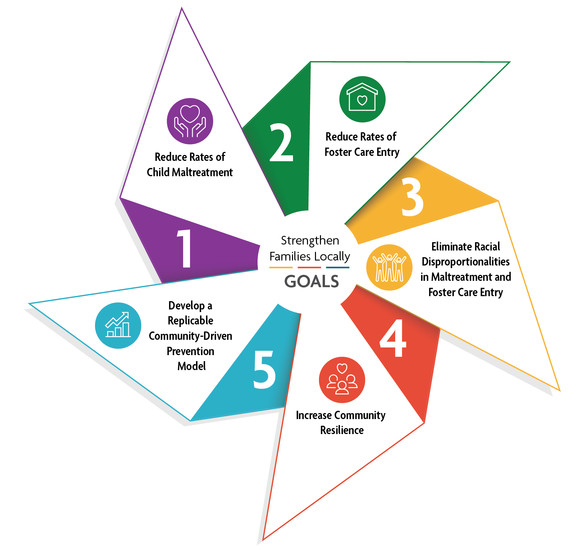
The Strengthen Families Locally team also created a new graphic (see above) that we hope will be helpful in communicating the purpose of the Strengthen Families Locally project. You might recognize the pinwheel shape from the Prevent Child Abuse America campaign, of which DCYF holds the Washington chapter. If you’re in Olympia in April, you’ll notice the blue pinwheels planted around the capitol by our team! For more resources on how to prevent child abuse and strengthen families, visit the Strengthening Families Washington website.
Congratulations to 3 LIA Supervisors who will be retiring in the next year: Nita Lynn, First Step Family Support Services, Pat Shaw, Clark County Public Health and Yuko Umeda, Jefferson County Public Health Department. Thank you for all your work to support children and families in Washington. You will be greatly missed! We wish you a wonderful retirement!
Lecroy and Milligan will provide a free training on using the HFPI screening tool with families. Participants will watch a pre-recorded webinar to learn about the tool and then attend a live webinar on Wednesday, Dec. 8, from 1-3 p.m.
The HVAC met this past October and began framing the recommendations to DCYF and the Legislature due June 2022.
For more information including notes and slides please visit: https://www.dcyf.wa.gov/about/community-engagement/hvac
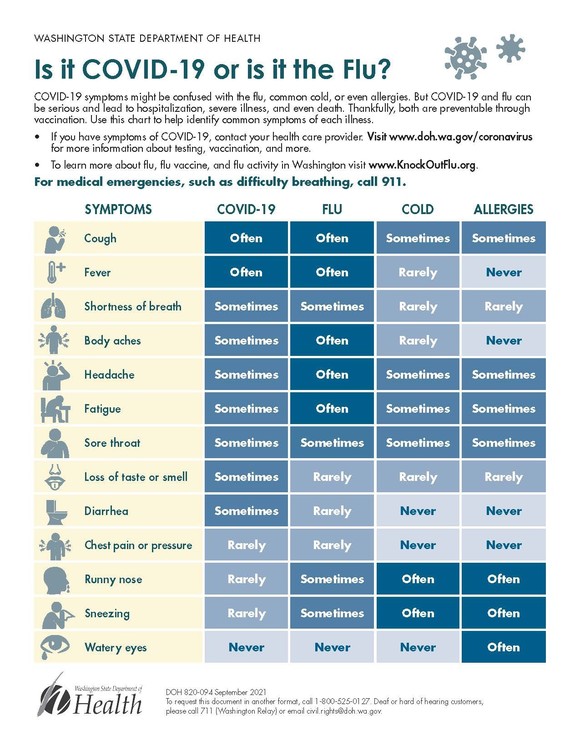 Click the image above to view full size. Courtesy of the Washington State Department of Health.
October – Thinking About the Holidays
 Breakout Group Discussion
- How do you take care of yourself during the holidays?
- What activities do you enjoy creating with families during the holidays?
- What activities do families want to create with you that reflect their culture or traditions?
- Families might not be able to reach you during the holiday season. How do you prepare families who might need a little more support during the holiday season?
- What resources do you find most helpful to share with families during the holidays?
- Is there a list of resources you share with families during the holidays?
October HVPC Jamboard Notes
October HVPC Slide Deck
Home Visitor Peer Connection Google Folder
Resources
Upcoming Dates – Thursday, Jan. 27 (2:30-3:30 p.m.)
We will take a pause during November and December and will resume Home Visitor Peer Connections in January. We encourage all Home Visitors to signup using the link below and share any questions or topics you would be interested in focusing on.
Register for Home Visiting Peer Connections
For questions, please contact HVStartEarlyWA@startearly.org.
October – Goal Setting
For October participants focused on using a CQI lens in goal setting. In quality improvement, an aim statement helps to create a shared vision and builds will and excitement for the work. In small groups goals were shared and developed into a SMART aim as well as creating strategies that could connect to those goals using the aim statement to breakdown objectives.
CQI PDSA Log Change Ideas:
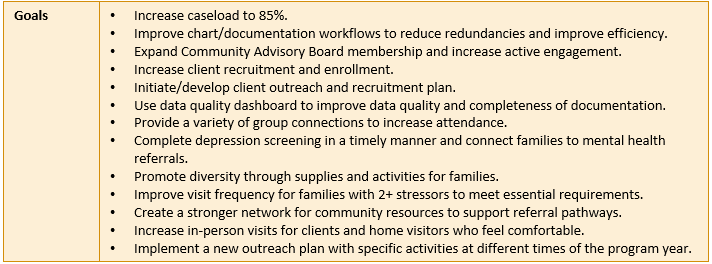 October CQI Webinar Breakout Notes
Resources
-
What is Health Equity? And What Difference Does a Definition Make? (PDF)
-
Applying a Health Equity Lens to Analyze Performance Data and Inform CQI Work
-
SMART Goal Setting Template - Kazoo
-
SMARTIE Goals Worksheet – The Management Center
Upcoming Dates – CQI Webinars are held every fourth Wednesday of the month from 1:30 – 2:30 p.m.
Updates and Reminders
For new supervisors or new CQI team members that need to be added to the calendar invite or Basecamp please reach out with a name and email to rcontreras@startearly.org.
For any other CQI questions or support please feel free to reach out to Camille Carlson, Continuous Quality Improvement and Innovation Manager at ccarlson@startearly.org.
Tribal Term of the Month
Each month, DCYF ESIT Tribal Program Consultant Brian Frisina will provide a key topic to help support us all in getting to know our Tribal Nations partners better.
American Indians - Native Americans
Each week, DCYF ESIT Tribal Support Specialist Brian Frisina provides a key topic to help us get to know our Tribal Nations partners better.
This week’s term is: American Indians - Native Americans
A Note on Terminology
The term "Indian," in reference to the original inhabitants of the American continent, is said to derive from Christopher Columbus, a 15th century boat-person. Some say he used the term because he was convinced he had arrived in "the Indies" (Asia), his intended destination. Others say the term refers to his diary entry, in which he describes the natives as "una gente in Dios" (a people in God).
Whether from confusion or romanticism, "Indian" is a word of illusion, not a description of reality. But the word has stuck. It is commonly used by indigenous peoples of this continent to refer to themselves in a generic way, as a supplement to their real names. It is used throughout "federal Indian law," the domain of United States law concerned with rights and status of the original peoples of this land.
"Native American" is a phrase coined in the liberal years of the 1960s to replace "Indian" with a supposedly more appropriate term. Regardless of the intent, the term is no more appropriate than its predecessor. "America" is derived from Amerigo Vespucci, a 16th century Italian navigator who was once said to be the "discoverer" of the continent. How can the people who were already here be named with his name?
Other generic words are also problematic. "Native" and "indigenous" can rightfully be applied to anyone (or thing) born in a place, not only those who were born first. "Aboriginal" refers only to what was here "from the beginning," but the concept of "beginning" poses problems, too.
Perhaps the best course is to refer to a people by the name they take for themselves. Sometimes this means using a word that means "we are the only true people," but at least it does not mean using a word that means "you are who others say you are."
American Indians - Native Americans
DCYF’s Office of Tribal Relations and ESIT Tribal Support Specialist Brian Frisina created a list of Native American Heritage Month Resources. From videos and documentaries to podcasts and articles, this list will help educate and inform staff, partners, stakeholders, providers, and the general public about American Indian history, culture, language, traditions, storytelling, wellness, and more.
Check often as we continue to add resources to this list throughout Native American Heritage Month and beyond.
Six Misconceptions About Native American People
These Native American girls debunk the common misconceptions about their culture.
Featuring: Laurel Cotton, Daunnette Reyome, Evannah Moniz-Reyome, Wacantkiya Mani Win Eagle, and Wanbli Waunsila Win Eagle.
The REAL History Behind Thanksgiving
Watch Native American Girls Describe the REAL History Behind Thanksgiving, from Teen Vogue.
What is Thanksgiving?
"There are interesting events leading up to what is termed "Thanksgiving." What is being celebrated in the USA and Canada is based on a mythological concept that must be addressed. To create an example of this myth, I decided to do some research. I asked middle school, and university students: what comes to your mind, when I ask you about Thanksgiving? Most then gladly answered in some sort of the same fashion: ''Some Pilgrims, who arrived at Plymouth, were fed by some Indians," and most of these students had the opinion that the Pilgrims were very religious and both the Native and the Pilgrim lived in harmony. The myth is perpetuated and evolves from the lack of understanding the true history - ninety-nine percent of North America's history is before contact."
Read full article by Thomas A. Ferguson
|
Meet Opal: Our partners at Kindering have worked with her and her family to help her thrive despite a rare diagnosis as a newborn. After being told she may never walk or run, thanks to her therapy, she is not only walking but also running and tumbling over her own legs.
The Real Costs Of Child Care In America, Crosscut
Why more companies are considering employer-based child care benefits, KOMO NEWS
Local schools respond to Pfizer vaccine authorization for children, The Daily Evergreen
|