Racial Equity Resource of the Week
White supremacy is a violent system of oppression that harms Black, Indigenous, and People of Color, and if you are a person who holds white privilege, then you are complicit in upholding that harm, whether you realize it or not. And if you are a person who holds white privilege, the question you should be asking isn't whether or not this is true, but rather, what are you going to do about it?
Watch Layla Saad talk about her new book Me and White Supremacy.
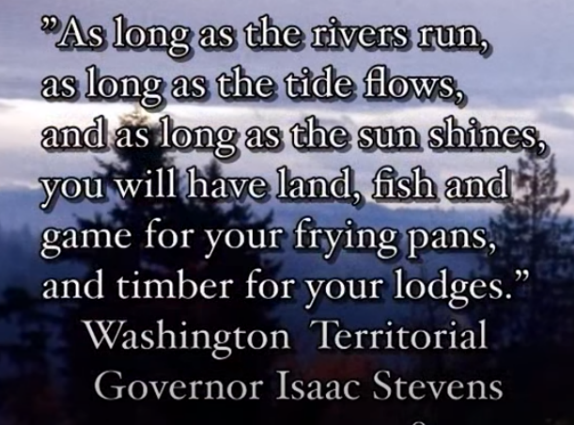
“As long as the rivers run, as long as the tide flows, and as long as the sun shines, you will have land, fish, and game for your frying pans, and timber for your lodge.” Washington Territorial Governor Isaac Stevens
Each week, DCYF ESIT Tribal Program Consultant Brian Frisina will provide a key topic to help support us all in getting to know our Tribal Nations partners better.
This week’s term is: Treaties
What did the treaties say about hunting?
Under the terms of the treaties, the tribes ceded millions of acres of land to the federal government. However, the tribes retained certain rights that would enable them to provide for themselves. Among these reserved rights was the “privilege of hunting on open and unclaimed lands.” The Washington State Supreme Court has ruled that there is no legal distinction between a tribal “right” or “privilege” regarding hunting.
What does hunting mean to Indian Tribes?
Indian tribes allow their members to hunt to meet their ceremonial and sustenance needs. All tribes prohibit hunting for commercial purposes. Deer elk meat are elements of feasts that are part of tribal ceremonies and other cultural events such as potlatches, funerals and naming ceremonies. These occur throughout the year. Tribes harvest only a small number of animals for ceremonial purposes. Tribes also depend on hunting to feed themselves. On some reservations, unemployment reaches 80 percent. Indians hunt after the fall fishing season to provide food for their families. Deer elk and other species provide important nutrition.
Source: Northwest Indian Fisheries Commission, Treaty Hunting Rights FAQ, © 2016.
Videos to Watch
Three years before he died, the last full-blooded Nisqually Indian, Willie Frank Sr., recalls the dramatic history of his people and his life along the Nisqually River with the mysterious salmon. The stories of Willie Frank inspired his son, Billy, to devote his life to the fish.
In his own words: The memories of Billy's father, Willie Frank Sr.
Traces the struggle of the American Indians of the Northwest to maintain their fishing rights and way of life, with particular reference to the Nisqually Indians of Frank's Landing in Washington.
-Anonymous, IMDB. Watch the 1971 film on YouTube:
As Long As the River Runs

We are excited to share that Sue Rose is starting a new adventure. She is leaving her role on the ESIT State Leadership Team as the Stakeholder Engagement Manager to pursue a role on the DCYF Professional Development Team. Her last day in the virtual office is May 28. She starts in her new role on June 16.
During her tenure on the ESIT State Leadership Team, Sue Rose has served as the staff liaison to the State Interagency Coordinating Council and worked to get its committees actively engaged. Sue started the Parent Institute for Engagement (PIE) in partnership with her team, and coordinated and facilitated numerous stakeholder gatherings.
We are sad to see Sue Rose go, but we know that she is eager to support the professional development of our workforce, including ESIT!
Valerie Arnold, ESIT Strategic Innovations Administrator, will lead the stakeholder engagement work while ESIT recruits for a candidate.
Farewell, Sue Rose. We will miss you!
|
The Department of Children, Youth, and Families (DCYF) is soliciting applications for appointments to the Washington State Interagency Coordinating Council (SICC) for infants and toddlers with disabilities and their families. SICC is mandated by the Individuals with Disabilities Education Act (IDEA) Part C and established through the Governor’s Executive Order 14-03. As such, the Governor appoints the members of the Council. Council members advise and assist DCYF in implementing the ESIT program per the federal requirements of IDEA Part C.
Applications are currently sought for representation in the following vacancies on the Council:
-
Parent/Caregiver of an infant, toddler, or child with a disability aged 12 or younger, who has knowledge of or experience with programs for infants, toddlers, and children with disabilities
-
Tribal Leader (any Washington Tribe)
-
Tribal Part C Provider (Bureau of Indian Education funded)
-
Early Intervention Service Provider (from one of the six DCYF regions not currently represented on the council – prioritize rural community)
- Washington Head Start Representative
Interested individuals are encouraged to apply by completing the application on the Governor’s website. In the drop-down list, the SICC is titled Infants & Toddlers with Disabilities and their Families.
If you have questions, please email Valerie Arnold at valerie.arnold@dcyf.wa.gov.
|
 |
For more updates, subscribe directly to these great newsletters:
-
DCYF ESIT Subscription List Signup: Get the latest communications by signing up for DCYF ESIT's subscriber lists and manage your subscriptions.
-
DCYF Office of Tribal Relations (OTR) Signup: Subscribe to DCYF's OTR newsletter, under DCYF Leadership, for information, updates, learning opportunities, and upcoming events.
-
Stay up to date by subscribing to Early Childhood Learning & Knowledge Center.
Join MyPeers, created by the Office of Head Start (OHS) to connect with Head Start and early childhood colleagues around the country on this and other topics. The Teacher Time community currently has more than 1,300 members who are networking, sharing, and learning from each other. Find it under "All Communities" and select the blue "Join" button.
-
Northwest Regional Telehealth Resource Center: Get the latest in your inbox and Sign up for the NRTRC Mailing List.
-
The DEC Update, Division for Early Childhood's Weekly Newsletter: If you're interested in receiving the latest news, offerings, and event updates from DEC, subscribe to the DEC Newsletter.
-
Early Childhood Technical Assistance (ECTA) eNotes: ECTA eNotes newsletter shares the new resources from ECTA Center as well as news items related to early intervention and early childhood special education gathered from a variety of reliable sources. Subscribe to the ECTA Newsletter.
-
Washington Hands and Voices: To get updates, subscribe to the
Washington Hands & Voices Newsletter by clicking at the very top left of the screen, then scroll down to the quick sign-up on the bottom right of the screen.
-
Washington State Health Care Authority: For updates, or to access your subscriber preferences, click here for the Washington State Health Care Authority list.
|