-
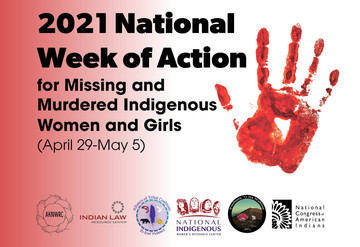
Friday, May 7, from 10:30 a.m. to 2 p.m. The Presidential Task Force on Missing and Murdered American Indians and Alaska Natives, also known as Operation Lady Justice, will hold a Listening Session/Roundtable Discussion. Register for the webinar. The session will be split into two parts, with public comments from one member of each organization in the first half, and a series of questions for anyone on the call to address in the second half. Speakers from organizations will be called upon in the order in which their registration is received.
-
Saturday, May 15, Seattle: MMIP Solidarity Prayer Walk and Call for Justice Gathering, organized by the Missing and Murdered Indigenous People and Families Facebook community based in Seattle.
- The Washington State Attorney General's Office is coordinating a 21-member task force on Missing, Murdered Indigenous Women. The task force will assess systemic causes behind the high rate of disappearances and murders of Indigenous women. Read the announcement here.
-
National Indigenous Women’s Resource Center is an excellent place to learn more.
-
MMIWG2SMB Spokane (Missing and Murdered Indigenous Women Girls 2-Spirit Men Boys) is a Facebook community based in Spokane.
-
Missing and Murdered Indigenous Women USA is a non-profit based in Portland, Oregon. They also have a Facebook page with upcoming events.
- Read the RCW re: MMIP Liaisons in Washington State Patrol, and an article on the legislative decision to create these positions.
- Read this powerful article on MMIP in Eastern WA, including info about the Yakama Nation and recent news that a Spokane Tribal leader was chosen as the WA State Patrol MMIP Liaison.
- WA State Patrol’s List of Missing Indigenous Persons. As of April 2021, there are more than 100 people on this list, representing Tribal communities from across the state. The youngest on this list is Lucas M. Snavely, age 2, missing since 1/28/2021, reported in Pierce County. Real people, real children, real names. And these are only those who have been reported.
- Great information here on gender diversity and violence against Native people.
Submit Applications for 2021 Young Native Women’s Leadership Academy
Native Action Network is now accepting applications for the 11th annual Young Native Women’s Leadership Academy, which will take place virtually June 24-26, with a graduation celebration on July 9. Native women anywhere in the U.S., ages 18-24, are invited to apply, including those who identify as two-spirit, trans, and genderqueer. This year, in honor of NAN’s 20th anniversary, the 20 young women selected to participate will be offered a $500 stipend for their successful completion of the program. The deadline to apply is Monday, May 17, at 11:59 p.m.
|
Fatherhood Engagement Sessions
Real Time Human Services is starting a new round of virtual Bringing Back the DADS class on Wednesday, June 2. This is open to all DCYF dads, because the class is virtual!
Bringing Back the DADS is designed for fathers who lack vital skills, knowledge, and attitudes. This nationally used curriculum will help equip fathers with self-awareness, compassion, and sense of responsibility that every good parent needs.
Fathers from across Washington State are raving about this class and asking to be enrolled in the follow-up sessions. Classes are 1½ hours each and meet weekly for 12 weeks (12 sessions total) via Zoom. Classes are on Wednesday nights from 6-7:30 p.m.
The curriculum is progressive and the students develop a great deal of trust and vulnerability over time, so this is not a course that students can just drop into periodically. Students are required to attend a minimum of 10 sessions to earn their certificate.
Call Grant Lyons at 206-539-7837 for additional information about the classes.
-Provider Name: Real Time Human Services
-Class Ending Date: 08/18/2021
-Provider #: 1618231
-Mark the “Parenting Instruction (Group Parenting Instruction Only)” box
-Authorized hours: 15hrs
Please contact Jessica Hatch at Jessica.hatch@dcyf.wa.gov or 206-900-5472, if you have any questions about registration.
Expression of Interest: Healthy Beginnings with Title V: Advancing Anti-Racism in Preterm Birth Prevention
Seeking participation and leadership from community-based organizations, Tribal governments, and Tribal organizations.
The Association of Maternal & Child Health Programs (AMCHP), with support from the Pritzker Children’s Initiative and the W.K. Kellogg Foundation, is hosting an 18-month Learning and Practice cohort as part of the Healthy Beginnings with Title V: Advancing Anti-Racism in Preterm Birth Prevention program. Six state MCH agencies will be partnered with local organizations that intentionally serve Black, Indigenous, Hispanic/Latine/x, Asian, Pacific Islander, and other birthing people of color and distinct cultural groups made marginalized by white supremacist culture. AMCHP seeks to partner with and compensate Community-Based Organizations (CBO), Tribal governments, or Tribal organizations serving birthing communities to lead and participate in the Healthy Beginnings Learning and Practice cohort. Interested CBOs/Tribal governments and Tribal organizations working in perinatal health should submit an interest form, and letter (or video) expressing interest by 8:59 p.m. on Friday, June 4: http://bit.ly/HealthyBegEOI.
Please see below for the quick details on the Healthy Beginnings Learning and Practice cohort.
-
EOI Q&A Call: May 12 at 11 a.m. http://bit.ly/QnAEOI
-
Applications Due: Friday, June 4, by 8:59 p.m.
-
Selection Announcement: Tuesday, June 15
-
Project Period: July 2021 – December 2022
-
Number of Participants: Up to six state MCH/CBO teams
-
Point of Contact: Jessica Stieger (jstieger@amchp.org) and Shanel Tage (stage@amcho.org)
Upcoming Events
-
May 10, 12-1 p.m. Webinar for Tribal Administrators: CCDF Program Updates, Supplemental Funding, and Preparation for Tribal Consultation. The Office of Child Care (OCC) will conduct a national webinar with Tribal lead agencies to provide Child Care and Development Fund (CCDF) program updates and plans for the upcoming Tribal consultation on the development of the Federal Fiscal Year (FFY) 2023–2025 CCDF Tribal Plan Preprint, which is scheduled for May 25. OCC recommends that Tribal CCDF administrators schedule to meet with their Tribal leaders before the OCC Tribal consultation to equip their leaders with guidance on how to prepare for the consultation. Register here.
-
May 11, 9-10:30 a.m. Children Thrive Outside: A New Day for Outdoor Play in Child Care. Join an ECE/outdoor play policy conversation happening nationally, featuring DCYF's very own Aliza Yair, M.Ed., Outdoor Preschool Pilot Program Specialist. RSVP here.
-
May 12, 11:30 a.m. to 1 p.m. Parent Partner Programs: Understanding Their Value, Research, Impact, and Application. The Casey Family Programs is hosting a webinar to discuss the value, impact, and application of parent partner programs, in order to deepen strategic thinking about implementing and expanding effective programs serving children and families. Research has shown the effectiveness and positive outcomes for families impacted by the child welfare system when working with Parent Partners. This conversation will highlight those findings, explore various Parent Partner programs, and describe key components of these programs, which leverage meaningful engagement through lived experience to support families in navigating systems. This introductory presentation and discussion will help elevate what is known about parent partner programs and encourage increased exploration and implementation of these critical programs. Questions? Email KMresources@casey.org. Register here.
-
May 12, Noon. Learning to Listen: Conversations for Change Series Webinar. This webinar features Terry (Ha-ne-ga-noh) Cross, who will be talking about: “Uniting Worldviews to Advance Relationships in Indigenous Communities.” Learn more here and register here.
-
May 17 and June 15, 9 a.m. to Noon. Qualified Expert Witness Training for Tribes. The Alliance for Child Welfare has scheduled two 2.5-hour webinar classes on Qualified Expert Witness trainings for Tribes. Learn more here.
-
May 18, 12:30-2 p.m. The Washington Fatherhood Council has been gathering interested statewide Tribal partners over the past year to talk about the Fatherhood is Sacred® curriculum and how to work together to increase support for this important work in tribes in Washington. Join the conversation about what you're doing and what you want to do to increase support to fathers in the coming years. As we come out of COVID-19, what are our opportunities to shift our story around fathers? Please participate in this one-minute survey to share whether you are available to attend. “The curriculum offers participants the opportunity to gain a deeper understanding of the importance of responsible fatherhood as reflected in Native American values and beliefs. There is an immediate need to bring men back to strengthening families— they are the greatest untapped resource. Fathers are the solution to the problems that face communities and must take the leading role in keeping their families together!” Albert Pooley Native American Fatherhood and Families Association– curriculum founder. Join Zoom Meeting. Meeting ID: 847 1563 8018. Passcode: 698871.
-
June 5, 9-10:30 a.m. Office of Equity Listening Session About Education. Promoting access to equitable opportunities and resources that reduce disparities and improves outcomes for everyone statewide across state government, for the next seven generations and beyond, is all of our work. The new state Office of Equity has set a listening session for educators, families, students, and communities. The purpose of the meeting is to gather the collective wisdom for co-creating a five-year equity strategic plan that helps Washington to bridge opportunity gaps and reduce disparities so everyone in Washington flourishes and achieves their full potential and there is equity and justice for all. Join via Zoom. Meeting ID: 947 5555 4926. Passcode: 2021.
-
July 19-23, 10 a.m. to 2 p.m. John Hopkins Center for American Indian Health Virtual Summer Institute 2021: Early Childhood Research with Tribal Communities. This course is designed for American Indian and Alaska Native tribal early childhood program directors and staff, health and education professionals and paraprofessionals, and others interested in tribal early childhood development and intervention research. The goal of the course will be to explore methods and theoretical approaches to early childhood development and intervention research in tribal contexts to inform improvements in early childhood programming, as well provide an overview of some of the unique aspects of research with tribal history, such as the history of research in tribal communities, the incorporation of traditional ways of knowing, the promise of research for tribal communities, and community engaged approaches. It is appropriate both for participants who have not had any formal research training and for those who have some experience but would like additional training specific to early childhood research in tribal communities. Two credits - Tuition: $2,466 for credit, $1,874 non-credit. Limited Scholarships are available: Apply now! Scholarship Application Deadline: Saturday, May 15, at 2 p.m.
|