|
Thank you to all the water professionals and volunteers who work to ensure safe and reliable drinking water in Island County! We appreciate you!
The essential work that water professionals and volunteers do in the background ensures most of us don't have to give too much thought to our water. Their work is vital to our health and well-being and helps maintain the viability of our communities. To learn more about a career in drinking water, check out this brochure from the Washington State Department of Health and scholarship opportunity from the Whidbey Island Water Systems Association.
|
|
 |
Water Wisdom
Water seems simple, yet understanding drinking water can be complicated. Water Wisdom is a new addition to the newsletter that will provide information and resources to make drinking water easier to understand. This issue: coliform bacteria in drinking water.
Water Quality - Coliform Bacteria
What is it? Coliform bacteria are microorganisms that are naturally found in the environment and feces of humans and animals. Water from a properly located and constructed well should be free of coliform bacteria. Most coliform bacteria don't cause disease but their presence in drinking water indicates that pathogens may have entered the water system.
How it impacts you: ensuring that drinking water isn't contaminated with feces will reduce the risk from waterborne pathogens, including bacteria, viruses, parasitic protozoa, and their associated diseases. As contaminated water may not look, smell, or taste any different, testing is the only way to ensure fecal contamination is not present. Federal, state, and county laws require that public water systems test drinking water for coliform bacteria regularly. Individual water systems should test annually.
How to test for it: water samples can be collected by water professionals, volunteers, and well owners and sent to state accredited labs to be analyzed for Total Coliforms and E. coli within 30 hours of sample collection. Eurofins-Edge Analytical provides sample bottles at the Island County Public Health offices in Coupeville and on Camano Island, as well as at B&W Pump Co. in Freeland and Island H2O Systems in Oak Harbor. Sampling instructions can be found on the back of the lab form with the sample bottle. Video instructions and additional drop off locations are also available.
How to understand the test results: lab results will show "absent" or "not detected" if bacteria were not in the water sample and "present" or "detected" if bacteria were found in the water sample. Total coliform includes many different types of coliform bacteria that are commonly found in the environment. E. coli is a type of coliform bacteria that is usually found in feces. If any coliform bacteria are present, additional action may be required.
Next steps: if coliform bacteria are present, the water system should investigate possible pathways of entry. If E. coli is present, all customers should be notified right away, DO NOT DRINK THE WATER without treatment. Boiling water for 1 minute is the best way to kill germs in water. Once the issue has been investigated, fixed and additional testing shows coliform bacteria are absent, treating water through boiling is not necessary. Absent results mean bacterial contaminants are not in the water. However, these results do not mean the water is free of other contaminants, like nitrate. Next issue: nitrate in drinking water.
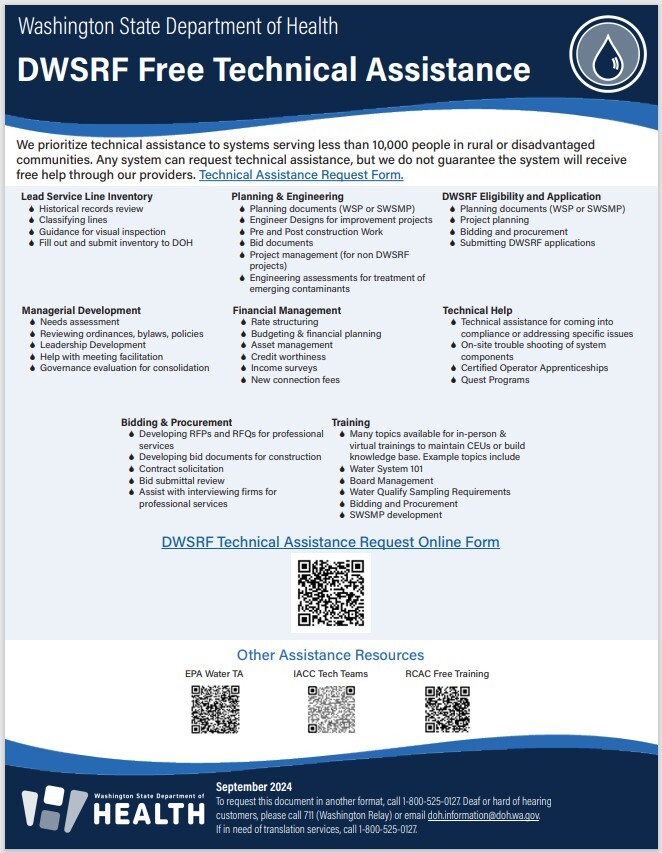
Does your water system need help? The Washington State Department of Health and its partners are offering free technical assistance. Their technical assistance includes help with engineering, water system planning and management, budgeting, and more.
Resources |
|
 |
Want to find information about your well or water system? Check out our Hydrogeology Map and Hydrogeology Dashboard.
Need to measure the water level in your well? A water level tape is available to borrow from the Island County Public Health Coupeville office.
Have drinking water questions? Check out our Drinking Water webpage.
Still have questions? Email us at drinkingwater@islandcountywa.gov.
|