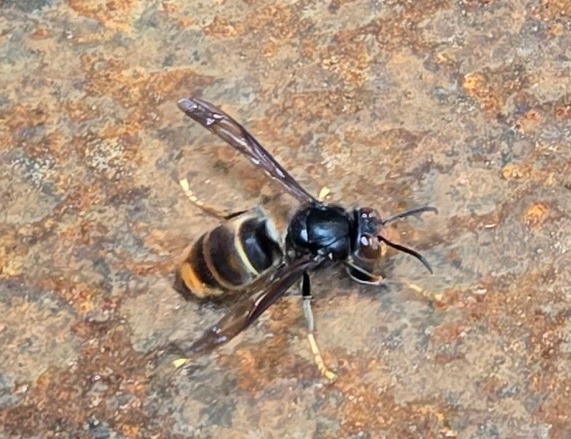
OLYMPIA, WA – The Washington State Department of Agriculture (WSDA) Pest Program is asking the public to be on the lookout in the Vancouver, WA area after a live yellow-legged hornet (Vespa velutina) was intercepted on a vessel at the Port of Vancouver.
The yellow-legged hornet is highly invasive. It has spread rapidly through Europe, where it has caused a 30% reduction in honey bee hives and honey production. It was introduced to Georgia near the Port of Savannah in 2023 and has since spread to nearby South Carolina. Both states are currently undergoing eradication efforts.
What to look for
The yellow-legged hornet is smaller than the northern giant hornet, which was introduced to Washington in 2019 and which WSDA declared eradicated from the state in 2024. Worker hornets are about .75 – 1 inch long, with queens being somewhat larger. The hornet is named for its legs, which are yellow on the lower half of the leg. The fourth segment on the abdomen is also yellow-orange.
Unlike the northern giant hornet, which tends to nest in tree cavities or in the ground, yellow-legged hornets usually build nests surrounded with a paper-like covering in tree branches or other outdoor areas. These nests can be extremely large and have up to 6,000 worker hornets.
Reporting suspected sightings
As a precaution, WSDA is asking the public in Vancouver and surrounding areas to be on the lookout for and report suspected yellow-legged hornet sightings. Take a photo and, if you can safely do so, collect the specimen and put it in the freezer and report your sighting to WSDA. You can report sightings at:
How the hornet was found
The hornet was discovered by a WSDA grain inspector who was inspecting a ship as part of a routine grain inspection on April 30. The inspector noticed and photographed the hornet. The hornet was then destroyed and discarded, but the photo was sent to the WSDA Pest Program for review. WSDA entomologists agreed it appeared to be a yellow-legged hornet.
On May 1, WSDA Pest Program and US Customs and Border Protection staff inspected the ship and the surrounding area for evidence of hornets. No additional hornet evidence was found. WSDA has placed traps in the area as a precaution.
“We are hopeful that this was a one-off interception, which occasionally happens at our ports,” Sven Spichiger, WSDA Pest Program manager, said. “But given the serious nature of this hornet and its potential impact to honey bees, we are asking for extra vigilance from people in the Vancouver area. The public was critical to our ability to eradicate the northern giant hornet, and they will be just as important in responding to this introduction if there are more hornets in the area.”
Visit agr.wa.gov/hornets to learn more about invasive hornets, native lookalikes or to report suspected sightings.