2025 season report
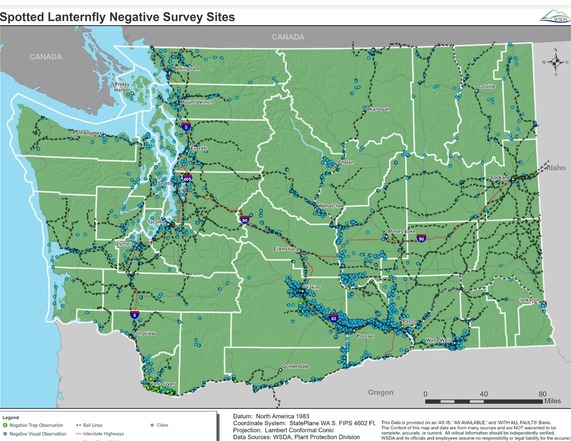
The 2025 spotted lanternfly (SLF) season was very successful, with no positive detections in Washington State. On May 5, 2025, an iNaturalist report of SLF in a park in Portland, Oregon, prompted WSDA to elevate monitoring efforts on Washington’s side of the state boarder. Within weeks, WSDA monitored traps across 18 counties. WSDA trappers maintained and monitored traps from Spokane to Vancouver and conducted visual inspections on tree-of-heaven. In the end, WSDA had 40 trap placements in the field with over 1,895 SLF negative visuals collected.
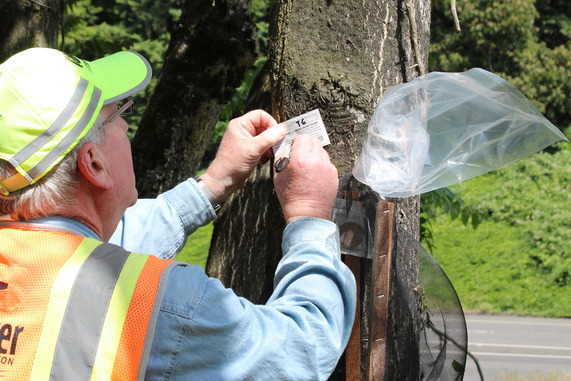 WSDA strategically placed traps in high-traffic areas associated with semi-trucks and near rail transport corridors. WSDA trappers also went out of their way to stop and check for egg masses at rest stops, stores, and other high-traffic areas as SLF is an excellent hitchhiker.
WSDA had three SLF trappers covering roughly ~13,000 square miles of land with traps and negative surveys site.
As part of the SLF survey, trappers also documented ants feeding on tree-of-heaven. Ant specimens were collected and shipped to researchers to examine the gut contents of ants for evidence of feeding on SLF honeydew. The idea is simple: if there is any SLF DNA in the ant’s gut, and if it is detected early, WSDA might be able to begin an eradication program before it establishes in the state.
Host plant research
 |
|
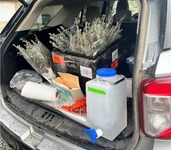
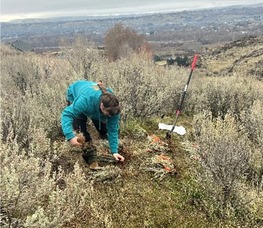
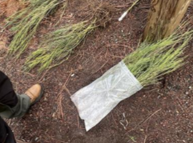
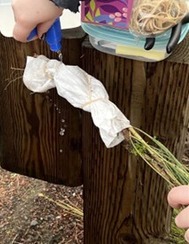
During the winter season, WSDA trappers collected a variety of Washington host plants, which were shipped to Penn State University for alternative host plant screening. |
The objective of this work is to determine whether other Washington plant species—in addition to tree-of-heaven—may support SLF and facilitate its spread. |
|
 |
 |
|
In collaboration with Dr. Julie Urban’s laboratory at Penn State University, a grant was submitted to USDA APHIS to evaluate more than 23 plant species commonly found in and around ports of entry across the state. |
This project will help WSDA and partner states better prepare for SLF introductions and improve readiness for future invasive insect threats. |
|
 |
One of our WSDA’s SLF trappers, Jeff Kessenich, was awarded the Washington Invasive Species Council Valiant Volunteer award for his outstanding volunteer work treating and eliminating 4,958 tree-of-heaven during the 2025 season. He is a dedicated man helping stop the spread of this invasive tree along with helping to minimize the impact that SLF could have in our state. Without his help, Vancouver would be swimming in tree-of-heaven.
WSDA’s objective is to intercept and eradicate SLF adults, nymphs, or egg masses that hitchhike into our state. It can get here by car, semi-truck, or railcars. This invasive pest has been slowly making its way to the West Coast since its introduction in Pennsylvania. SLF has spread into 20 states in the U.S. with established SLF populations as far west as Chicago, IL. WSDA is taking proactive measures to identify SLF as quickly as possible when it arrives with the intention of preventing it from establishing in the state.
|