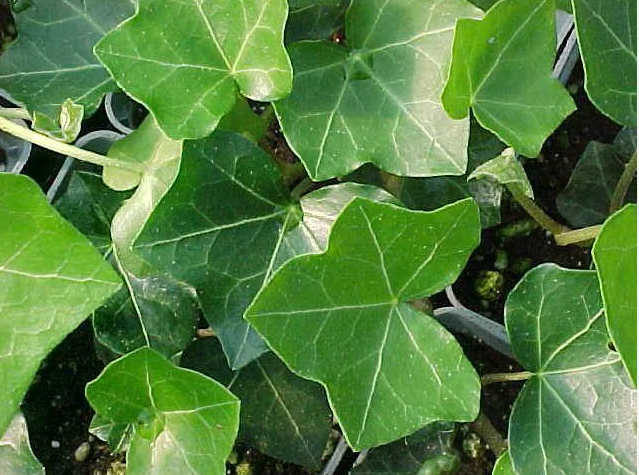
English ivy no longer allowed to be sold in Washington state
WSDA recently completed rulemaking to add 19 new species to the Noxious Weed Seed and Plant Quarantine, WAC 16-752. The agency received multiple petitions from the general public and stakeholders to add Hedera helix (English ivy) to the list. During rulemaking, a survey was conducted to gauge the impact to small businesses if English ivy, or any of the other proposed species could no longer be sold. The results of the survey, a summary of the public comments and the outreach the agency did over the last two years, can be found on WSDA's rulemaking page here.
The quarantine prohibits the transport, buying, selling, offering for sale, or distribution of these plants, seeds, or plant parts, into or within the state of Washington, either in person or online.
WSDA inspectors will be reaching out to plant sellers and installers to educate them about the quarantine and ensure any prohibited plants are removed from sale. Failure to comply after being educated about the quarantine can result in fines.
Why the change?
The intrusion and spread of invasive, non-native, weed species into Washington state continues to concern land managers, both public and private, and places economic well-being at risk for agriculture, forests, horticulture, and floriculture industries, as well as the environment and natural resources. The rule amendment prevents the sale and importation of the plants listed as nursery plants and seeds. The "escape" of these plants has resulted in large public and private expenditures by landowners and land managers, weed boards, and weed districts to control. Initiating quarantines for these plants, forbidding entry or distribution of them gives a critical tool to control and prevent infestation.
Additions to the prohibited plant list:
- All cultivars of common (English) ivy (Hedera helix);
- Atlantic Ivy (Hedera hibernica);
- Spotted touch me not (Impatiens capensis);
- Cape pondweed (Aponogeton distachyos);
- Hanging sedge (Carex pendula, Carex pendula subsp. pedula, and Carex pendula subsp. agastachys);
- Green alkanet (Pentaglottis sempervirens);
- Common Fennel (Foeniculum vulgare (except bulbing fennel, F. vulgare var. azoricum));
- European coltsfoot (Tussilago farfara);
- Herb Robert (Geranium robertianum);
- Houndstongue (Cynoglossum officinale);
- Sulfur cinquefoil (Potentilla recta);
- Wild basil/basil savory (Clinopodium vulgare);
- Yellow nutsedge (Cyperus esculentus);
- Camelthorn (Alhagi maurorum);
- Russian knapweed (Rhaponticum repens);
- Puncturevine (Tribulus terrestris);
- Rough chervil (Chaerophyllum temulum);
- Turkish thistle (Carduus cinereus)
- Palmer's amaranth (Amaranthus palmeri)
WSU researching tea production in WA
Camellia sinensis plants available for nurseries
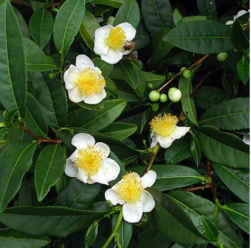 |
Research on tea (Camellia sinensis) is underway at the Washington State University Northwestern Washington Research and Extension Center in Mount Vernon, Washington. Dr. Carol Miles, a horticultural specialist, and McKenzie Shelton, a graduate student in the horticulture program, have developed a greenhouse propagation method for tea in western Washington, and are testing it with 14 tea cultivars. They have created new information regarding tea propagation, planting and establishment, pest management, long-term care and maintenance, and processing into a dried tea leaf product, all available on their WSU Tea Webpage (https://vegetables.wsu.edu/tea/). This work aims to introduce tea as a specialty crop in Washington, and current experiments have resulted in a collection of 1 ½-2 year old tea plants available for distribution. If your business is interested in receiving tea plants from this project, please contact McKenzie Shelton (morgan.shelton@wsu.edu) or Dr. Carol Miles (milesc@wsu.edu) for more information.
This project was voted on and approved for funding by the Nursery Advisory Committee using surcharge fees collected from nursery plant seller/installer license renewals. See WSDA's webpage on Nursery Research for more information.
The Plant Services Program is part of the WSDA Plant Protection Division.
Our program is committed to facilitating agricultural trade and ensuring consumer protection by providing accurate and reliable inspection, testing, and certification of agricultural plant products, and serving on the front line of defense against the introduction and spread of pests.
The Plant Services Program provides certification services to exporters of plant products, conducts regulatory inspections of nursery stock and licensed retail and wholesale nurseries, enforces plant quarantines to prevent pest introduction, and certifies disease-free planting stock.
Plant Services contributes directly to the Washington agriculture industry by certifying agricultural exports in excess of $2 billion annually.
|