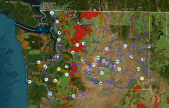
WA collection count
June wraps up with a record monthly count of 5,670 specimens (so far)—in June 2024 we collected a total of 5,226 specimens. Way to outdo yourselves, Washington!
Our current 2025 total is 14,415 specimens. Curious how this compares to 2024? We are 79% of the way to matching last year's collection effort!
Last chance to register!
Registration for the July 12th event at Willapa NWR closes Saturday, July 5th. Don't miss your chance to sign up for this event!
Special reminder: Submit your volunteer hours
WaBA will generate its quarterly volunteer report the first week of July. If you have not already submitted your hours for April, May, or June, please input your volunteer hours into PISCES.
New to WaBA? Check out this PISCES how to guide for setting up your account.
July 27, Seattle Bee Hangout
Peter Abrahamsen will be hosting a Bee Hangout in Seattle on July 27th from 3-5PM!
Get some practice using keys, share tips, tricks, and trivia. He’ll have a few snacks, five microscopes, and small teaching collections. Bring any bees you’ve caught, and hard copies of keys if you have them.
Please RSVP to rainhead@gmail.com. For last minute questions, call or text 206.334.0293
7548 Ravenna Ave NE, Seattle, WA 98115
Upcoming outreach opportunities
Looking for ways to share your passion for native pollinators? Check out these upcoming outreach opportunities:
- August 9 - City of DuPont annual Moonwalk (1-2 volunteers needed) - contact Caleb Lankford by August 6 if interested
- August 14-19 - Clallam County Fair - contact Ingrid Carmean if interested
- September 13 - Steppe into the Square, Tieton (1-2 volunteers needed) - contact Caleb Lankford if interested
Participation in these events can be applied as service points for your Master Melittologist certification. You can also earn service points by helping with data entry at the Yakima office - if interested, contact Caleb at caleb.lankford@agr.wa.gov to learn more.
WA Native Bee Booklet - send in your feedback!
The Native Bee Booklets have been a hit! We have already distributed many copies and will soon need to submit a second order.
Many of you have already sent in your feedback, but with a second order in mind we're doing a special call out for any feedback you have that should be taken into account before we go to print. Please submit any notes you have by July 15th.
To access the most up-to-date version of the booklet, check out the digital copy available on our webpage: Washington's Native Bees
|
What's blooming in June?
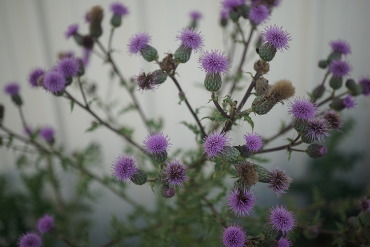 Cirsium arvense (Creeping Thistle)
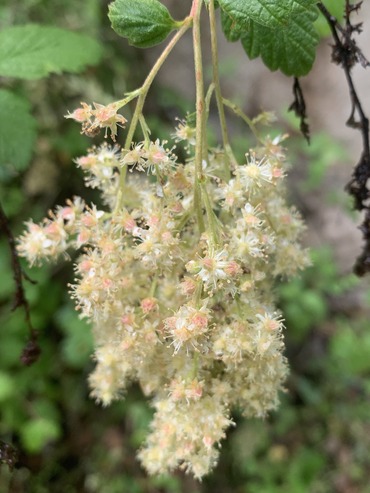 Holodiscus discolor (Ocean Spray)
Taxonomy tip of the week
With summer in full swing, we've got two genera of bees that are out flying right now: Diadasia and Melissodes.
Some species of these genera may look superficially similar—they have medium builds, dark integument with light hairs, and big, fuzzy scopae on the females.
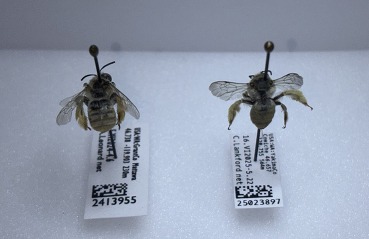
Melissodes saponellus (left) vs. Diadasia ochracea (right)
Though similar appearing, there are a host of small differences that set them apart. Today, we'll be looking at just one—the shape of their heads.
Bee head shapes: Emphorini vs. Eucerini
Diadasia belong to a tribe of bees called Emphorini. (Quick note: a tribe is a taxonomic ranking between family and genus. Both Diadasia and Melissodes belong to the family Apidae. However, this family is so large that it's helpful to group its many genera into tribes.)
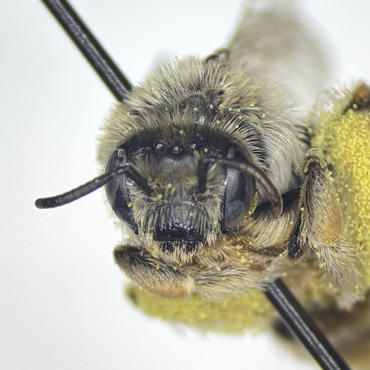
Bees in the Emphorini tribe have rounded heads. When viewed from the front, the head will dome up and above the ocelli, starting at the upper corners of the compound eyes.
The tops of the heads of Emphorini bees (like the Diadasia female pictured here) are domed or rounded.
While Diadasia are the only Ephorine bees in the state of Washington, Melissodes are just one example of the genera in our state that belong to the Eucerini tribe. Other Eucerine bees include Epimellisodes and Eucera.
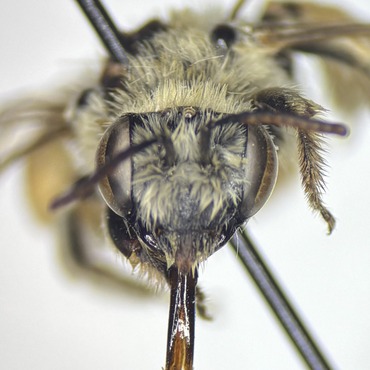
Bees in the Eucerini tribe have flat top heads. When viewed from the front, the line between the top of the compound eye and the ocelli will be straight, sometimes dipping shallowly to form a slight concave profile.
The tops of the heads of Eucerini bees (like the Melissodes female pictured here) are flat.
Head shapes can be a helpful tool to keep in your mind while IDing bees. Though not all bee tribes have unique head shapes, the general shape of a head can help you figure out if you're on the right track in a key. As you sort the bees you've collected, take a look at their heads and see what patterns you can see emerge!
|