New video
Are you curious about the threats spongy moth poses to Washington State? Do you know what methods Washington State Department of Agriculture (WSDA) uses to protect our trees from this invasive species? Learn how spongy moth can be a nightmare for trees and you by watching this video.
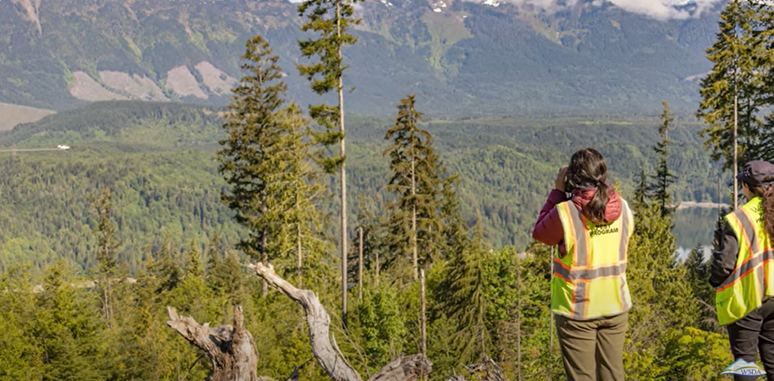
Seasonal trapping underway
WSDA’s Pest Program seasonal staff is working across the state setting and checking traps to help monitor for invasive species. Trappers plan to monitor 20,000 spongy moth traps this season. This work will help detect if adult spongy moths are present in the area. Unlike young spongy moth caterpillars, adult moths do not feed on plants, so traps placed near residences do not threaten to increase damages to trees.
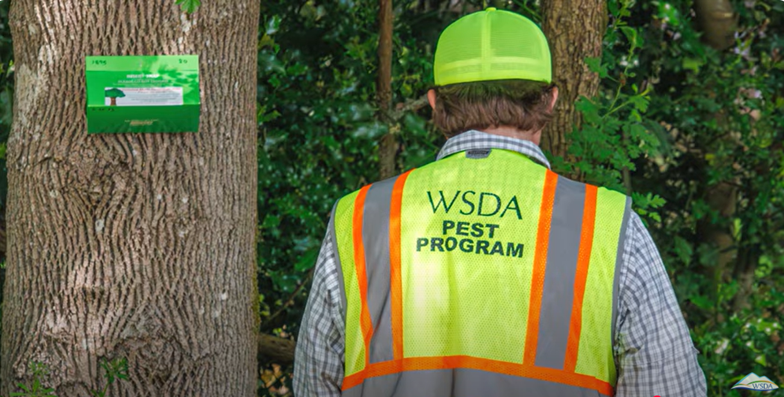 Kent and Lakewood areas
Several moths were trapped last season near Kent and Lakewood. WSDA is increasing efforts in these areas by placing and monitoring additional traps. Residents around these detections can expect to see more traps than normal in their parks and neighborhoods. If you see a trap, please don’t disturb it.
The trap
The triangular traps are made of green folded cardboard. The trap does not contain pesticides. A string lure inside uses a pheromone, or specific scent, to attract the male moths. The inside is coated with a sticky substance that captures the moths when they land. Traps are checked periodically through the summer and removed in September. Once a moth is caught, collection details are recorded and the specimen is sent to a lab for identification.
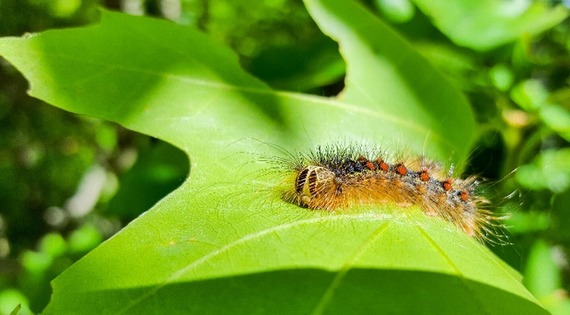
Spongy moth caterpillars are typically seen from April through July. They start out tiny but quickly grow up to 3 inches long. They have a yellow head, bristle like hairy body, and distinct 5 pairs of blue dots followed by 6 pairs of red dots on their backs. They feed on the leaves of more than 300 species of trees and shrubs, eventually killing them. Infested trees may be partially or completely bare of leaves.
 Imposters
Spongy moth caterpillars do not build tents or webs, however some less destructive common caterpillars in Washington do. In the spring, the tent caterpillar covers branches in webs and has orange and blue markings. In the fall, the fall webworm covers branches in webs and are usually brownish in color. Learn more about these imposters on our identification webpage.
|