Happy Pollinator Week!
Pollinator Week is coming to a close! We hope that this week you've had an opportunity to enjoy bees (and all the other pollinators!) in some capacity. Whether it be by collecting, observing, or sharing knowledge with others, there is value in celebrating native bees a little extra during this specially designated week.
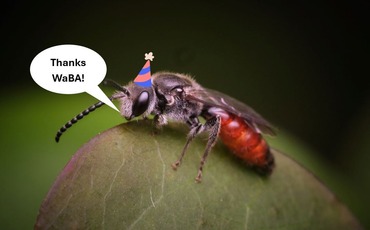
We'd like to thank YOU for being a part of our program and for the work you do to help survey our native bees!
Photo courtesy of Mike Davidson: https://www.inaturalist.org/observations/210737989
Last chance to register!
Registration for the June 28th event at Ridgefield NWR closes this Saturday, June 21st.
Special reminder: Submit your volunteer hours
WaBA will generate its quarterly volunteer report the first week of July. If you have not already submitted your hours for April, May, or June, please input your volunteer hours into PISCES.
New to WaBA? Check out this PISCES how to guide for setting up your account.
Help wanted: Wild Bees of Washington trading cards
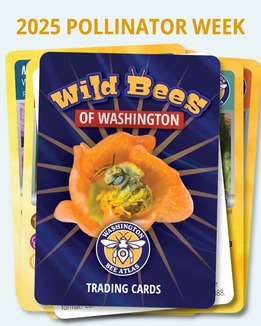
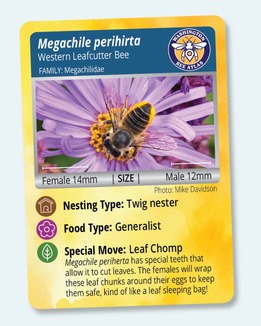
Have you seen our new Wild Bees of Washington trading cards? Five cards are being launched digitally this week, and so far they've been a hit!
We'd like to create more cards for a printable version in the future. You can help us by sharing photos of bees or by thinking of "special moves" for new species. The special moves should be 1-2 sentences and can be based on behaviors or physical characteristics. Share your ideas for future cards by emailing Caleb Lankford.
Kudos to WSDA's Becca Sotelo for the amazing card design!
Seattle Bee Hang, June 22
Peter Abrahamsen will be hosting the next Seattle Bee Hang on Sunday, June 22nd from 3:00-5:00PM. Close out Pollinator Week by hanging with your fellow beeple!
Get some practice using keys, share tips, tricks, and trivia. Peter will have a few snacks, five microscopes, and small teaching collections. Bring any bees you’ve caught, and hard copies of keys if you have them. RSVP to Peter at rainhead@gmail.com.
Not in Seattle? No problem - drop your info in our Contact Form to let others know what area of the state you're in, then reach out to the folks near you for a get together!
Sharing the electronic "Washington's Native Bees" booklet
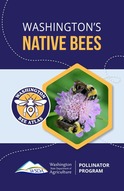
The "Washington's Native Bees" booklet is a hit! People are loving and sharing both digital and hard copies of the booklet.
If you are sharing the electronic version of the booklet, please share the link to the online version that people can download or the Native Bees page on our website. That way, people will always receive the most up-to-date version of the booklet. Believe it or not, we’ve already made a few updates to the electronic version, including correcting typos and misattributed photos.
Here are the links:
|
Research highlight: Aidan Hersh's work on Spalding's catchfly
Check out this research highlight from USDFW on WaBA volunteer Aidan Hersh's work (and photography!) on the pollinators of Spalding's catchfly: Taking a Closer Look at Pollinators for a Rare Species | U.S. Fish & Wildlife Service. Kudos Aidan!
Upcoming outreach opportunities
Looking for ways to share your passion for native pollinators? Check out these upcoming outreach opportunities:
Participation in these events can be applied as service points for your Master Melittologist certification. You can also earn service points by helping with data entry at the Yakima office - if interested, contact Caleb at caleb.lankford@agr.wa.gov to learn more.
What's blooming in June?
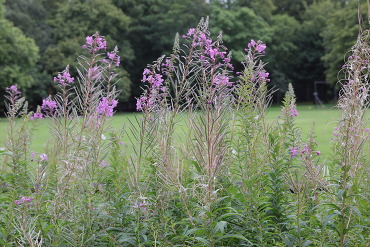 Chamaenerion angustifolium (Fireweed)
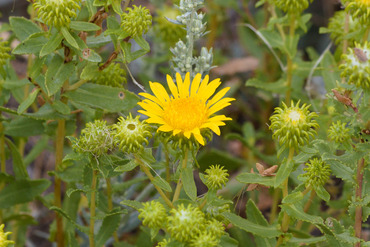 Grindelia squarrosa (Curlycup Gumweed)
Taxonomy tip of the week
Last week looked at Megachilidae with maculations. This week, we'll take a closer look at two unique species of Anthidium and the features you can use to identify them.
Exotic Anthidium
Anthidium manicatum (European woolcarder bee) and Anthidium oblongatum (oblong woolcarder bee) are exotic bees that have been introduced into the United States. They are both native to parts of Eurasia, but have become established throughout parts of the North American continent.
Identifying Anthidium manicatum
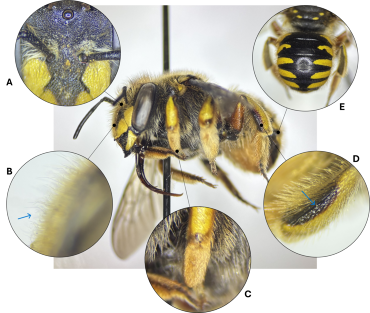
Features used to reliably identify Anthidium manicatum females
Female A. manicatum can be identified using a suite of features:
- Hooked hairs on the clypeus (B)
- Near continuous punctures on the frons (area above the antennae) with shiny integument between the punctures (A)
- Interrupted yellow maculations on the abdomen that narrow apically, creating a V-shape (E)
- White hairs on the forelegs, dense enough that they obscure the surface of the front basitarsus (C)
- Hind tibia with a distinct longitudinal carina (D)
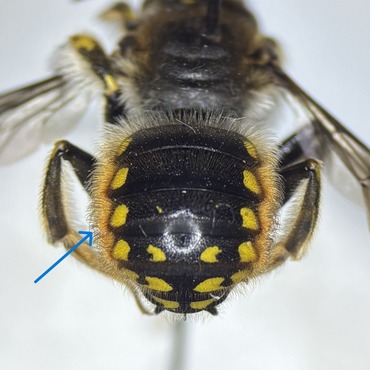
Lateral hair tufts on the abdomens of male Anthidium manicatum
Male A. manicatum can be identified using the following:
- Hind tibia with a distinct longitudinal carina
- Near continuous punctures on the frons (area above the antennae) with shiny integument between the punctures
- Interrupted yellow maculations on the abdomen that narrow apically, creating a V-shape
- Dense, yellowish hair tufts on the sides of the abdomen
Identifying Anthidium oblongatum
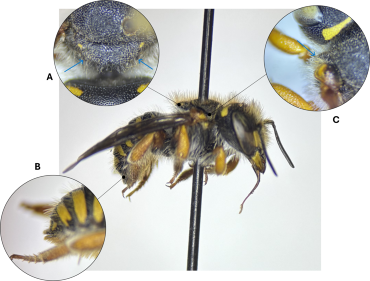
A. oblongatum can be confusing. While most Anthidium have rounded pronotal lobes, A. oblongatum has lamellate (blade like) pronotal lobes like Dianthidium. However, it can still be spotted as an Anthidium species because it lacks arolia between its tarsal claws.
Features used to reliably identify Anthidium oblongatum females.
Female A. oblongatum can be identified using the following features:
- Lamellate pronotal lobes (C)
-
Scutellum with lateral teeth or angles (A)
- T6 (last abdominal segment) is strongly concave in profile (B)
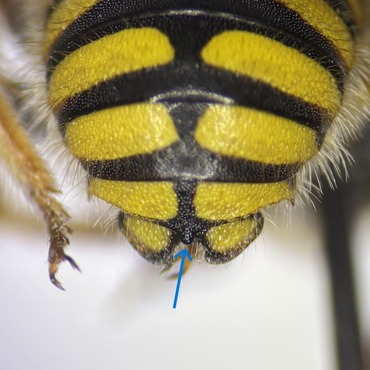
Midapical projection on T6 of male A. oblongatum.
In addition to lamellate pronotal lobes and lateral teeth on the scutellum, male A. oblongatum can be identified by a midapical projection on T6 (pictured above). In laymen's terms, there's a central bump on the edge of the second-to-last abdominal segment.
|