Update from Oregon
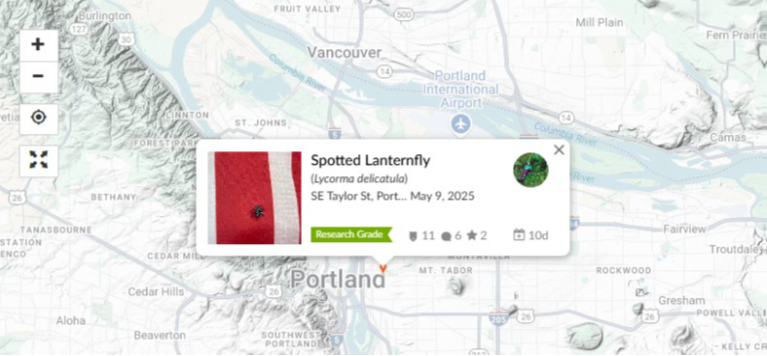
On May 12, 2025 the Oregon Department of Agriculture (ODA) was made aware of an online report from iNaturalist sharing an image of a single early instar nymph (i.e. immature) spotted lanternfly (SLF) Lycorma delicatula at Colonel Summers Park in Portland, Oregon. That same week the ODA, USDA Animal Plant Health and Inspection Service Plant Protection and Quarantine (USDA APHIS PPQ), and Washington State Department of Agriculture (WSDA) conducted visual surveys in Colonel Summers Park and the surrounding neighborhood. The goal of the survey was to find any sign of SLF, set monitoring traps, and conduct outreach with neighborhood residents. After two survey efforts no sign of SLF were found, thus the iNaturalist report is not confirmed. Read more in ODA’s latest news release.
 |
Immature lanternflies (called nymphs) fall out of tree canopies as they feed and then climb back up the tree to feed more. Adult spotted lanternflies walk or hop up trees throughout the day. WSDA uses this predictable behavior help monitor for potential introductions. Over the past month WSDA has been putting up traps.
Circle traps are installed around tree-of-heaven (Ailanthus altissima) trunks. These trees are spotted lanternflies’ preferred host. The trap has a funnel-shaped opening that works to guide lanternflies up into a bag to be collected.
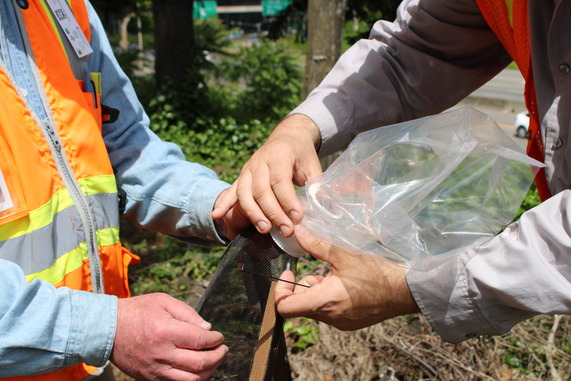 Experimental lures are being added to the trap in order to attract both SLF nymphs and adults into the trap. These lures may give WSDA an additional opportunity to detect potential lanternflies.
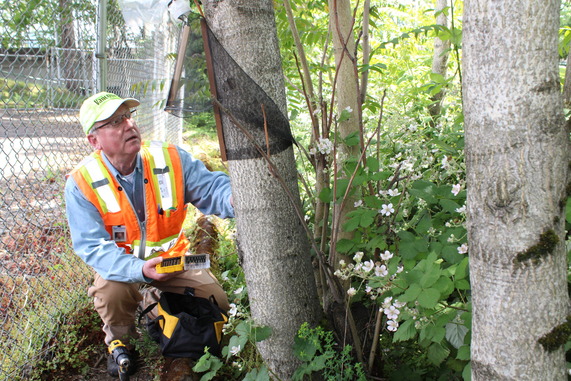
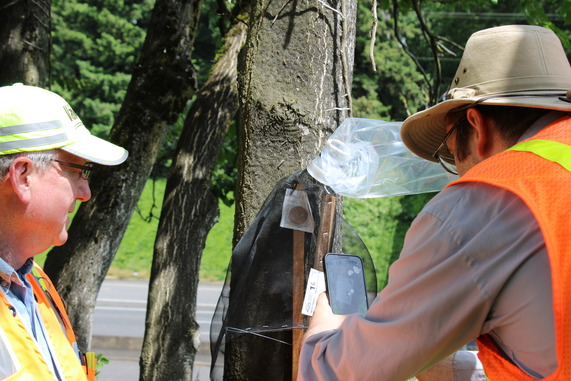 WSDA is collaborating with volunteers to help monitor traps across Washington. Jeff Kessenich, pictured below, is an active resident working with the City and Port of Vancouver to map and remove tree-of-heaven. His knowledge of the spotted lanternflies host plant makes him the perfect cooperator for the job. He is actively working to install and monitor traps around the Vancouver area.
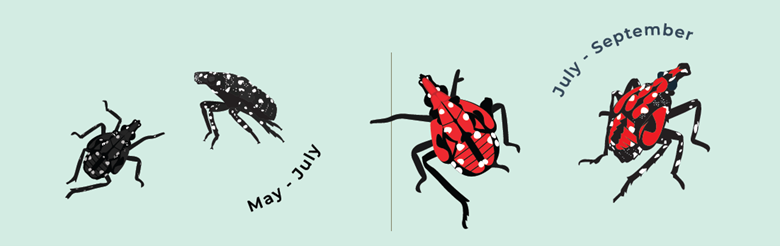
Right now, spotted lanternflies are likely in their juvenile or nymph stage. Spotted lanternfly nymphs jump and crawl. When nymphs emerge, they quickly turn black with white spots. By summer, they turn red and strut around still flaunting spots while they feed on trees.
If you think you have seen spotted lanternfly, please photograph it and note the location to report it. If possible, attempt to collect the specimen so officials can verify the report. SLF do not bite and are safe to handle. Place the specimen in a bottle or sealable plastic bag. Specimens can be stored in a freezer or in alcohol or hand sanitizer.
|