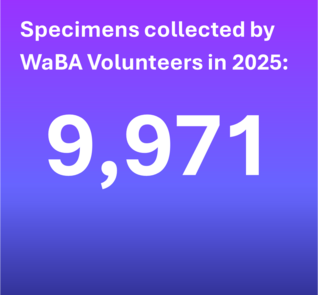
WA collection count
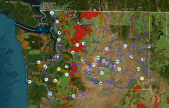
The current collection count is 9,971. Outstanding work WaBA!
Last chance to register!
Registration for the June 21st collecting event at Camas Meadows closes on Saturday, June 14th. There are four spots remaining for this event.
Highlights from Whitman Mission
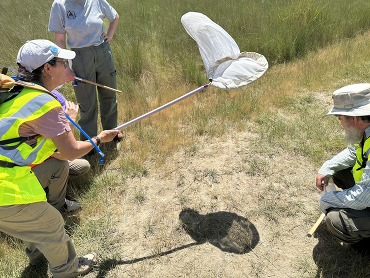
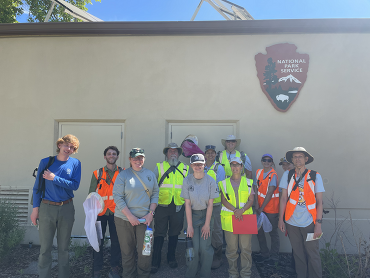
Last weekend WaBA volunteers gathered in Walla Walla to survey bees at Whitman Mission National Historic Site. We had a great time interacting with park staff, interns, and guests. Notable bee highlights included three nesting aggregations, including two of Calliopsis personata!
Karen and Will collecting at a nesting aggregation.
Group photo with park staff and interns.
Where should WaBA go next?
We'd like to hear from you! Where would you like to see events organized in the future? Take the survey below to let us know.
Writers wanted: June blog posts for Pollinator Month
Pollinator Week, June 15-21, will be here before we know it! To celebrate this important week, we will be releasing a blog post each Monday in June (5 total) to draw attention to the ongoing work of protecting pollinators. We would love for YOU, our stupendous volunteers, to be a part of this process by guest writing a blog post!
Below is a list of potential ideas to get those creative juices flowing:
- Why I Volunteer with WaBA...
- Are all bees social?
- Where do bees sleep?
- Where do bees go in winter?
- Different types of bee nests
- Pollinator Mug Shots/Bee "Class Yearbook" (headshots of cool bees)
- Bees of Unique Habitats (ex: dune bees)
- Cool bee/plant interactions
One blog post is still open for June 16th. If you are interested in writing this post, contact Caleb at caleb.lankford@agr.wa.gov for more details!
Seattle Bee Hang, June 22
Peter Abrahamsen will be hosting the next Seattle Bee Hang on Sunday, June 22nd from 3:00-5:00PM. Close out Pollinator Week by hanging with your fellow beeple!
Get some practice using keys, share tips, tricks, and trivia. Peter will have a few snacks, five microscopes, and small teaching collections. Bring any bees you’ve caught, and hard copies of keys if you have them. RSVP to Peter at rainhead@gmail.com.
Not in Seattle? No problem - drop your info in our Contact Form to let others know what area of the state you're in, then reach out to the folks near you for a get together!
Upcoming outreach opportunities
Looking for ways to share your passion for native pollinators? Check out these upcoming outreach opportunities:
Participation in these events can be applied as service points for your Master Melittologist certification. You can also earn service points by helping with data entry at the Yakima office - if interested, contact Caleb at caleb.lankford@agr.wa.gov to learn more.
What's blooming in June?
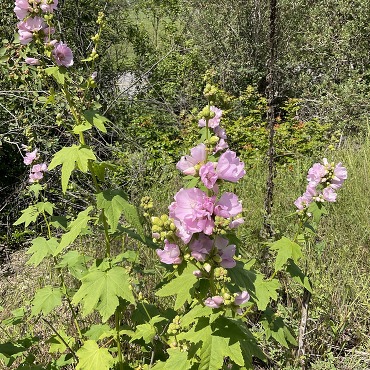 Iliamna rivularis (Streambank Wild Hollyhock)
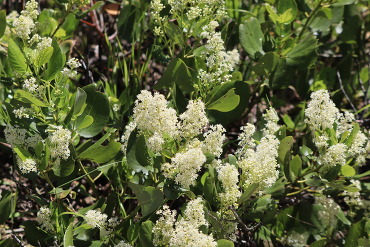 Ceanothus velutinus (Snowbrush Ceanothus)
Taxonomy tip of the week
Megachilidae with maculations
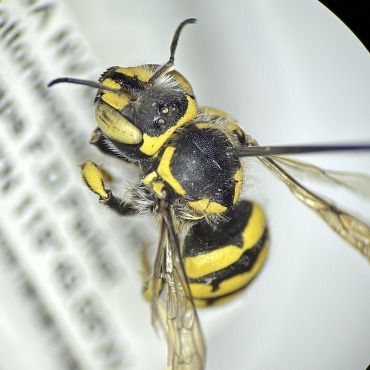
This week's glance at the Megachilidae family of bees will look at genera that have maculations. Maculations usually present themselves as areas of yellow colored integument, but some bees have cream, blue, or even red maculations.
This female Anthidium has striking yellow maculations.
There are four Megachilidae genera with maculations that occur in Washington: Anthidium, Anthidiellum, Dianthidium, and Stelis (in part - some Stelis are metallic blue like Osmia). Here are five features to look for that can help sort these genera out:
Presence or absence of an arolium
Like Megachile, Anthidium do not have arolia between their tarsal claws. The other three genera have them.
Number of midtibial spines
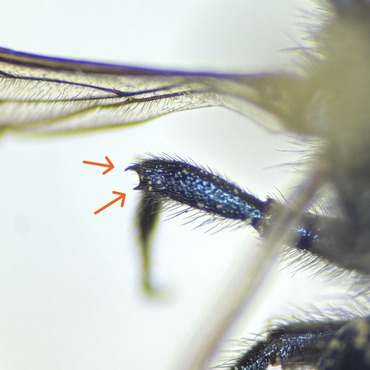
Most bees have a single spine located at the apical end of the midtibia (the end closest to the claws). Stelis are unique because they have two spines at this location. To see this, look down the length of the outside edge of the tibia.
The midleg of Stelis have 2 tibial spines, while most other bees have just 1.
Pronotal lobes
Pronotal lobes are sort of like a bee's shoulders. They can be found immediately anterior to the tegula (the semicircular caps at the base of each wing).
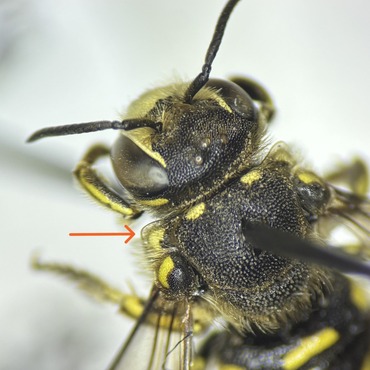
Like most other bees, Anthidium, Stelis, and Anthidiellum have rounded pronotoal lobes. Dianthidium have lamellate (flat and blade-like) pronotal lobes.
Dianthidium have lamellate pronotal lobes. They would have done well in the shoulder pad culture of the 80's.
Scutellum
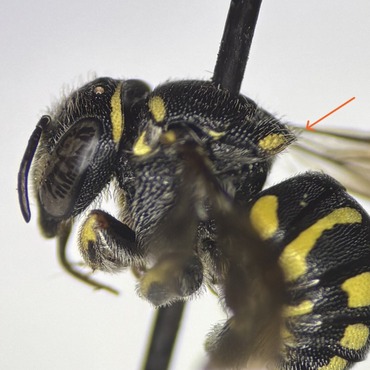
Anthidium and Stelis have rounded scutellums, which transition smoothly into the propodeum. Anthidiellum have a distinctly lamellate scutellum that hangs over their propodeum like a shelf. Dianthidium can also have a scutella that extends past their propodeums, but they are not shelf-like in the same way those of Anthidiellum are.
Anthidiellum have a lamellate scutellum that hang over the propodeum like a shelf.
Subantennal sutures
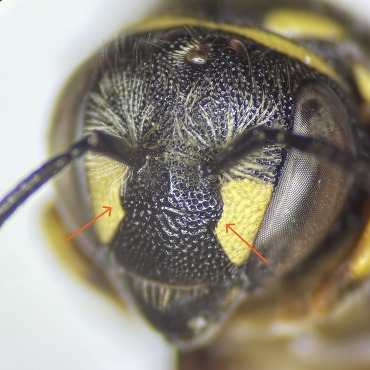
Anthidiellum have outwardly curved subantennal sutures, while the other genera have straight antennal sutures.
Anthidiellum have subantennal sutures that curve outwards.
|