|
 |
|
VIPTA Bulletin
|
|
|
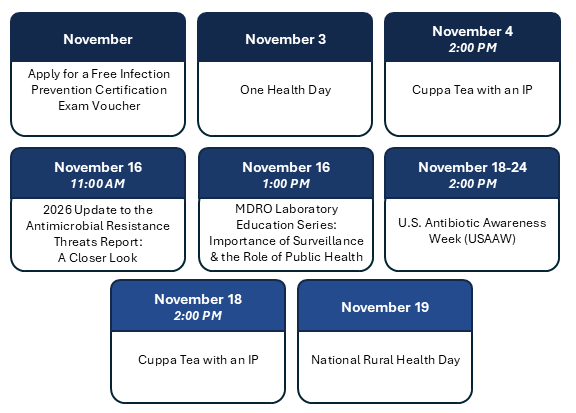
November Event Calendar
Check out the VIPTA Event Calendar for more details and to register for events.
Events in November
|
|
Featured Training Resources
Source: CDC U.S. Antibiotic Awareness Week Toolkit (2025)

Antibiotic Mythbusters! Can You Set the Record Straight?
Some antibiotic myths are easy to spot. Others contain just enough truth to be convincing. With the right facts and a little curiosity, you can help others make informed decisions about antibiotic use.
1. Spot the Myth! ‘Every positive urine culture needs to be treated with antibiotics.’
Bust the Myth! Diagnosis of a UTI requires both finding bacteria in a urine test and the presence of specific symptoms. Having both is important, because bacteria can live naturally in the bladder without causing any pain or symptoms.
Find the Facts:
2. Spot the Myth! “I don't prescribe antibiotics, so antibiotic resistance isn't my problem.”
Bust the Myth! Drug-resistant germs don't stay in one place! They can spread between patients, residents, staff, and healthcare settings. Everyone can help stop their spread. Hand hygiene, cleaning, disinfection, and proper personal protective equipment (PPE) use all play a part.
Find the Facts:
How to Bust Myths in Your Workplace
-
Start a myth-busting huddle. Share a myth and ask staff, “What would you say?” Practice friendly responses and use trusted resources to explore the facts together.
-
Make the facts easy to find. Share the patient handout in waiting areas or add the CDC infographic to staff newsletters and breakroom boards.
|
|
|
Guidance, Recommendations, & Regulatory Updates |
|

Centers for Disease Control and Prevention (CDC)
Candida auris for Healthcare Providers (10/1/2026)
-
The CDC updated its Candida auris screening, infection control guidance, and prevention and response recommendations for healthcare providers, emphasizing targeted screening, early detection and reporting, appropriate precautions, environmental and equipment disinfection, staff education, communication of C. auris status during healthcare transfers, and coordinated public health responses to prevent healthcare-associated transmission.
-
The CDC recommends that healthcare facilities review the revised seasonal influenza infection prevention and control guidance, which highlights vaccination, early identification and triage, respiratory hygiene, Droplet Precautions, healthcare personnel illness management, and timely outbreak response.
-
CDC updated its Viral Respiratory Pathogens Toolkit for Nursing Homes to help facilities strengthen prevention and response to COVID-19, influenza, and RSV through vaccination, testing, early treatment, surveillance, source control, appropriate precautions, and rapid outbreak response.
|
|
|
Cheers for Peers
Fairfax County Health Department: Strengthening Antimicrobial Stewardship for Skilled Nursing Facilities

Strengthening Antimicrobial Stewardship, One Partnership at a Time
During U.S. Antibiotic Awareness Week (November 18–24), we’re celebrating two public health leaders who are improving antibiotic use in skilled nursing facilities (SNFs) across Northern Virginia.
Sahar AlHarazi, Epidemiologist at the Loudoun County Health Department and Christina Chommanard, Epidemiology Supervisor at the Alexandria Health Department, are expanding the Strengthening Antimicrobial Stewardship for Skilled Nursing Facilities (SASS) Program. They build strong partnerships and tailor support to local needs.
Sahar has introduced the program in one Loudoun County SNF and is actively engaging additional facilities. She listens closely to staff, learns about their challenges, and provides practical support without adding extra paperwork.
Christina has introduced the program in two SNFs in Alexandria. One facility is fully participating and preparing to share antibiotic use data, and she is engaging additional facilities. She has also strengthened SASS training materials, developed local resources, and launched the Antimicrobial Stewardship Kickstart (ASK) Program.
Both leaders work closely with Fairfax County SASS Program Coordinator Taylor Crosby and Scale-up Coordinator Mamata Kamat, who provide technical support and help facilities put the program into practice.
Their work shows that stewardship succeeds when people build trust, understand local needs, and make proven practices easier to use. Cheers to Sahar and Christina for helping facilities improve antibiotic use and protect residents!
-
Build relationships. Talk with facility leaders and frontline staff.
-
Listen first. Fit each effort to the facility’s needs and daily work.
-
Start small. Choose realistic steps, then build on success.
-
Keep tools useful. Adjust resources to meet local needs.
-
Use data. Track antibiotic use in a simple way and use results to improve.
|
Helpful Resource: Fairfax County Health Department’s Strengthening Antimicrobial Stewardship Program offers tools for SNF stewardship programs.
|
|
Search the VIPTA library of curated infection prevention and control (IPC) education and training resources. The IPC Education & Training Resource Library includes state and national resources related to healthcare-associated infections, antimicrobial resistance and/or IPC. |
|
 |
|
|

Subscribe to the Bulletin
Was the VIPTA Bulletin forwarded to you? Subscribe and get the VIPTA Bulletin sent directly to you!
|

We Want to Hear From You
Your feedback matters to VIPTA. Help us improve or ask questions using the VIPTA feedback form.
|
|
|
|
|