|
October 2026 Newsletter
Timely Information for Virginia's Waterworks
|
|
 |
|
Technical & Regulatory Updates
|
Big Changes Coming to the
Consumer Confidence Report (CCR) in 2027
The Consumer Confidence Report Rule Revisions (CCR3) implements changes to strengthen the public health protection “Right to Know” access by improving a CCR’s readability, clarity, accessibility, and understandability. These revisions also provide for more practicable, cost-effective ways to directly deliver the CCRs, improve risk communication including non-English considerations, and provide supplemental information regarding lead levels.
The 2027 CCR Must...
- Use the new format.
- Begin with a summary of key information, and, if applicable, brief descriptions of violations and public notices.
- Contain new and updated definitions and revised educational statements for certain contaminants.
- Notify community waterworks customers about lead tap sampling data and how to access the data.
- In communities with a large proportion of consumers with limited English proficiency, CCRs must contain either information where consumers can obtain a translated copy of the report or assistance in the appropriate language.
- Be distributed CCRs twice a year, by July 1 and December 31, for waterworks serving 10,000 or more people. Beginning in 2027, owners can take advantage of additional good faith delivery methods.
For a comparison of the CCR3 to the previous requirements, see EPA’s CCR3 Comparison Fact Sheet. ODW has amended the Waterworks Regulations, effective on September 23, 2026, to reflect the CCR3 changes.
ODW Webinar: Navigating the Consumer Confidence Report Rule Revisions in Time for 2027 CCR Delivery
November 10, 2026
Online, 2:00 - 3:30pm EST
Cost: Free
All community waterworks are required to distribute a Consumer Confidence Report (CCR) to their customers. The EPA has made substantial changes to the regulations that govern the content and distribution of the CCR. Those changes will impact CCRs in 2027. The VDH Office of Drinking Water is providing this webinar to inform waterworks of the changes and what they need to do to meet the new requirements. There will be live question and answer with our panelists from the Office of Drinking Water. Sign up using the button below.
 |
|
2-Hour Reporting Requirement
|
ODW Transitioning to New Phone Number this Fall
The 2-hour Reporting Call Center is being changed from VDH's call center to the Virginia Department of Emergency Management (VDEM) Situational Awareness Unit (SAU). There is no change in the process for 2-hour reporting, only a different phone number that waterworks will call. Waterworks may begin using the new Call Center Number now, with a complete switch over effective December 7, 2026.
New 2-Hour Reporting Number: (804-750-8845)
ODW Webinar: 2-Hour Reporting - Updates & New Phone #
October 29, 2026
Online, 10:00 - 11:00am EST
Cost: Free
Join the Office of Drinking Water for a webinar that will cover the 2-Hour Reporting Requirement. Included in this webinar will be information on the transition to the new phone number for reports. The webinar will include an opportunity for questions.
|
|
 |
|
Funding Updates and Resources
|
Drinking Water Infrastructure Needs Assessment - Heads Up!
VDH’s Office of Drinking Water, in partnership with EPA, is conducting the 8th Drinking Water Infrastructure Needs Survey and Assessment (DWINSA) to evaluate water system infrastructure needs over the next 20 years. Survey results will help determine how Drinking Water State Revolving Fund (DWSRF) dollars are allocated.
Large waterworks (population over 100,000), plus randomly selected medium (3,301–100,000) and small systems (under 3,301), will be contacted to participate. ODW staff will contact large and selected medium systems; EPA’s contractor, Cadmus Group LLC, will contact selected small systems.
The survey includes standard project tables and supplemental questions on barriers to DWSRF access, operations and maintenance costs, and technical, managerial, and financial capacity. Responses will help shape future funding and technical assistance.
Virginia seeks full participation to ensure DWSRF funding accurately reflects statewide needs. For questions, contact your ODW Regional Field Office representative.
Planning & Design Funds Available
The application period for Planning and Design Funds is open through the end of the year. If you have been thinking about applying, take a look.
-
Who: Existing community or non-profit NTNC waterworks serving <10,000 population or with a project area serving <10,000 population.
-
What: Up to $45,000 in grant funding for waterworks-related engineering projects. Higher priority is given to projects that resolve health risks and/or noncompliance with the Waterworks Regulations. Funds cannot be used for economic development, operations and maintenance, or construction. Examples of common projects include PERs, plans and specs, source evaluations, distribution system evaluations, and pilot studies.
-
Why: To provide financial assistance for small waterworks to get into or remain in compliance with all state and federal regulations.
-
When: ODW accepts applications on a year-round basis beginning January 1 and ending December 31 of each year. Each applicant may submit up to three applications per year, but only a maximum of two may be funded.
-
How: Application forms can be found online at
https://www.vdh.virginia.gov/drinking-water/capacity-development/planning-and-design-fund/
For questions, contact your ODW Regional Field Office or Sustainability Coordinator.
|
|
October is Cybersecurity Awareness Month
Water Watch Center Opens Applications for Cybersecurity Monitoring
The National Rural Water Association (NRWA) is opening applications for the Water Watch Center (WWC), a new program offering free Managed Security Service Provider (MSSP) coverage for small and rural utilities.
MSSPs have protected U.S. infrastructure, including water systems, for years — many utilities already use one if they have the budget and IT support to do so. What’s new here is that NRWA is offering it free of charge, and the Water Watch Center ties the five participating MSSPs together into a single national picture: if one MSSP sees an attack or a pattern of attacks at one utility, that intelligence is shared across the network so others can watch for the same tactics and respond quickly.
The service runs quietly in the background — utilities won’t notice it unless there’s an active threat. Initial funding comes from the Newmark Foundation, the Hewlett Foundation, and the Defense Advanced Research Projects Agency (DARPA), the U.S. Department of Defense’s research and development agency, with a limited number of utilities being onboarded first and additional utilities added to a waiting list as funding grows.
Interested Utilities can learn more and complete the interest form at: waterwatchcenter.org.
Thanks to the Virginia Rural Water Association for sharing this information!
|
|
Operator Licensure Resources
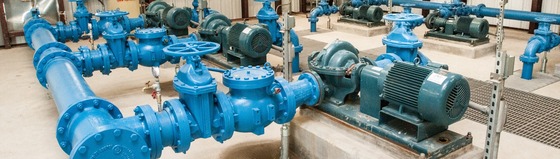 Resources to help you get started with your first waterworks license or upgrading to a higher level
Working on getting your first or upgraded Water Operator license? The first stop is with DPOR, the agency that handles licensing of waterworks operators. The Board for Waterworks and Wastewater Works Operators and Onsite Sewage System Professionals (WWWOOSSP) oversees the licensing process:
Standard Waterworks License:
- Go to the website’s Forms + Applications section and locate the Waterworks and Wastewater Works Operators table.
- Complete the Waterworks Operator License Application.
- Submit your completed application to DPOR.
- After DPOR approves your application, schedule and take the licensing exam.
Universal Licensure Recognition:
DPOR accepts out-of-state Waterworks Operator licenses under a “Universal Licensure Recognition” policy. To qualify, applicants must:
- Hold a current, valid out‑of‑state license with a similar scope that required an exam and specific training or experience.
- Have held the license for at least three years.
- Be in good standing with no investigations or complaints.
- Have no disqualifying criminal record.
- Have no discipline in another state except minor financial penalties.
Eligible applicants must submit an application to DPOR.
- Go to the website’s Forms + Applications section and locate the Waterworks and Wastewater Works Operators table.
- Complete the form: Waterworks Operator - Universal License Recognition.
- Submit your completed application to DPOR.
If you have questions, reach out to DPOR directly:
Licensing Section: (804) 367-8595
WWWOOSSP Board Office: (804) 367-0362
WWWOOSSP Board Email: Online Email Form
Math Tutoring Available
SERCAP is providing free math tutoring for individuals interested in becoming Water Operators. If you are interested, please contact Lisha McCargo at lmccargo@sercap.org.
|
|

 VDH Office of Drinking Water is pleased to present this year's series of in-person and online courses offered through a contract with Virginia Tech. These courses are designed to prepare individuals to take initial or advanced licensing exams as well as learn more about owning and operating a public waterworks.
Hands-on Training at a Full-Scale Water Plant
November 9 - 10, 2026
Abingdon, Virginia
Cost: $150 (includes lodging) or $100 (commuter)
Registration Deadline: October 30, 2026
This program focuses on hands-on exercises at a full-scale plant in Virginia. Designed to demonstrate and supplement lessons learned in the annual summer short courses at Virginia Tech, this course is perfect for any water operator, Class I-VI. The goal is to offer training that will help operators understand the function of treatment systems, operate their systems optimally, and produce safe water. Course fee includes all course materials, daily breakfast and lunch, and one networking dinner.
Participants will receive 1.35 CEUs (13.5 contact hours) for successful completion of this course.
Water Broadcasts - free, online
Pumps: An Application Guide
October 14, 2026
This course will cover the fundamentals of pumps, pump types, pump applications for each type, and pump components. The course will cover how pumps are selected and how the calculations used to determine total dynamic head, total suction head, pump efficiency are used to select the proper pump. The course will also cover pump troubleshooting and some lessons learned.
Utility Management Fundamentals
November 18, 2026
This course introduces the fundamental principles of utility management through a practical, operations focused lens, demonstrating how utility management, asset management, and business process optimization work together to improve utility performance. Using real world examples, participants will learn how effective planning, standardized processes, meaningful performance measures, and data driven decision-making can reduce reactive work, improve communication, and support more efficient day-to-day operations. The course will also discuss how operational activities influence budgeting, capital improvement planning, regulatory compliance, customer service, and the long-term sustainability of a utility.
This course counts toward the DPOR management credit requirement.
|
|
ODW is Hiring!
The Office of Drinking Water provides regulatory oversight and technical assistance to public waterworks across the state. Our team is made up of staff with broad experiences and background including biology, engineering, geology, administrative support, water operations, and laboratory experience. Check out our open positions at:
|
|
Office of Drinking Water using GovDelivery for Communication
You are receiving this email because your email address is associated with a regulated waterworks in Virginia or you signed up to receive the newsletter. Please add this email to your "Safe Senders" list so they land in your in-box and not your spam-box.
If you need to update your contact information, please reach out to:
Julie Floyd, Operator Certification & Training Manager, at julie.floyd@vdh.virginia.gov
Know someone who would like to receive this newsletter? They can sign up here:
|
|
|
VDH Office of Drinking Water
Contact Us | Website
Waterworks After-Hours Emergency Call Center: 1-866-531-3068
|
|
|
|
|