|
Section 2
May 2026 Newsletter
Timely Information for Virginia's Waterworks
|
|
Section 4
 Now is the Time to Think About Rates
by Julie M. Floyd
As many waterworks prepare to close one fiscal year and begin another, this might seem to be an unusual time to think about rates. The budget for this year is set, rates are set, projects are being scheduled. Why think about rates now?
Water rates often obscured on customer bills
I overheard someone recently say, "Our water bill was over $150 this month!" This seemed a bit high for their area, so I asked them if that cost was just for water or if it included sewer. "I don't really know, I just pay the bill, but I'm pretty sure it's just for water." Turns out that the $150 was for both water and sewer.
Customers see the number on the paper that lands in their mailbox. Often the water bill is wrapped in with wastewater costs or is on the same bill as trash pick up or town electrical service. Your billing software might print codes on the bill, but do your customers know what they are? What this can mean is that the actual cost of their piped drinking water is obscured.
An uphill battle to adjust water rates
The utility is at a disadvantage when the actual cost of water is obscured on customer bills. If the customer believes that the total amount of a composite bill is "for water" and that is how they talk about "how the cost of everything is going up", your utility has some work to do.
How to Move the Needle - Short Term
- Look at what the billing department is sending out
- Poll your customers: Ask if they understand everything on the bill
- Update your bill to be more clear - Avoid acronyms and codes
- Always include current gallons used and water rates on every bill
- Add in a "Water Usage Over Time" chart
How to Move the Needle - Long Term
- Promote the work that your utility does - leverage social media
- Use the annual Consumer Confidence Report to share successes and challenges
- Let your customers know what infrastructure upgrades are needed and why.
- Use your Asset Management Plan to identify projects in the 3 - 5 years range that will need community support and start talking about them now
- Emphasize customer service at all levels within your organization
- Conduct a rate study
You can position your utility to go into budget season prepared to address rates. You might not be able to adjust them this year, but if you start the conversations now, you will be in a better place when the next cycle comes.
Looking for resources to help with your rates? Check these out:
Looking for someone to talk through options who also understands the regulations your utility has to follow? Reach out to the ODW Capacity Development Team.
|
|
Section 7
Weather Impacts on Water Utilities
Drought Conditions Continue Across Commonwealth
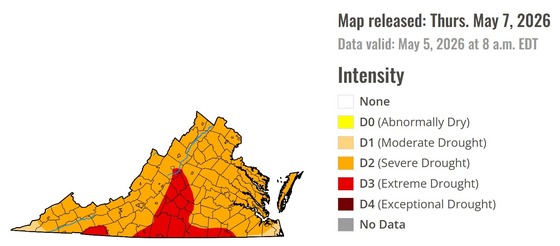 Drought Map from the US Drought Monitor -
navigate to Virginia Drought Map by clicking the interactive map
According to the National Weather Service, drought conditions are expected to continue across the state this week despite the potential for some rainfall Wednesday into Thursday. Check out the Virginia DEQ Drought Website for the most recent reports from the Drought Monitoring Task Force and other essential information.
Review Drought Plans
Now is the time to review plans that your utility has to address impacts from drought. If the plans are out of date, take time now to brush them off and update them. Consider a proactive communications plan to keep your stakeholders and customers informed as we move into the summer.
Develop a Drought Plan
If you don't have a drought plan, now is the time to develop one. Here are resources to get you started:
Hurricane Season Starts June 1st
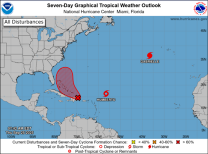
Hurricane season in Virginia runs from
June 1 through November 30.
Impacts from these storms can include heavy rainfall, flooding, power outages, and supply chain disruptions that affect water operations.
Now is the time to start reviewing and updating emergency plans, confirming staffing and communication procedures, and ensuring that backup power systems and chemical supplies are ready.
|
Key reminders:
-
Check fuel and generator readiness for extended power loss.
-
Verify emergency contact lists for local emergency management, VDH ODW field offices, and mutual aid partners.
-
Join the VAWARN - Virginia Water and Wastewater Agency Response Network, a Mutual Aid Response Network for Virginia water and wastewater Systems. Membership in VAWARN is free.
-
Secure critical infrastructure and chemical storage areas to ensure they can withstand high winds or flooding.
-
Monitor weather updates through the National Weather Service and coordinate with local emergency managers as needed.
Proactive preparation helps ensure continued safe drinking water and operational resilience during and after severe weather.
|
|
Section 10
|
Question of the Day: PFAS & UCMR5
Question: Our waterworks has heard that we can use our UCMR5 data for initial monitoring under the PFAS Rule. How do we do this?
Answer: Thanks for asking! We have developed the following checklist for you to follow so that the waterworks' UCMR5 data can be used to meet Initial Monitoring Requirements of the PFAS Rule. As always, if you run into any problems or have questions, just contact us!
Using UCMR5 Data for Initial Monitoring under PFAS Rule
Waterworks that plan to use UCMR5 data to meet the initial monitoring requirements under the PFAS Rule should follow these steps:
-
Check your data: Visit the Drinking Water Viewer to confirm if ODW already has your results.
- For systems serving more than 10,000 people: Your waterworks paid for the laboratory analysis. Please contact your laboratory to request reprocessing of the results using a minimum reporting level of 1/3 the Practical Quantitation Limit (PQL).
- For systems serving fewer than 10,000 people: The EPA paid for your laboratory analysis and is coordinating with the labs to reprocess results and share them with the states. ODW has already received some reprocessed results which are now available for viewing in Drinking Water Viewer.
-
Share your reports: If you have laboratory reports, please submit them along with the completed PFAS Initial Monitoring Data Evaluation Tool, available on ODW’s website.
-
Need help? If you have data, questions, or need more information, contact your ODW field office for assistance.
|
|
Section 13
No-Cost PFAS Sampling & Testing Program
Update
|
|
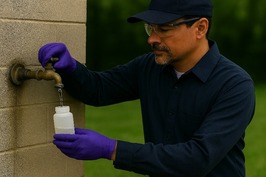 |
PFAS Sampling Now in Progress
The VDH Office of Drinking Water (ODW) and TruePani PFAS monitoring program is now actively underway. Field teams began sampling entry points in late April to support eligible groundwater Community Water Systems (CWSs) and NonTransient NonCommunity Water Systems (NTNCWSs) serving 10,000 or fewer. All collected samples are analyzed by Pace Laboratories using EPA Method 533, helping waterworks meet Initial Monitoring requirements under the PFAS Rule in the National Primary Drinking Water Regulations.
Critical Monitoring Requirements
To remain compliant, waterworks under this program must meet the following criteria:
- Two-sample Protocol: Systems are required to collect two PFAS samples, taken 5 to 7 months apart.
- Early October Milestone: To satisfy the timing requirement, the first sample must be collected no later than October 10, 2026.
- Final Deadline: All Initial Monitoring results are due to ODW by April 26, 2027.
Not Enrolled Yet? Contact TruePani or ODW Immediately
If your waterworks is eligible and has not yet enrolled or completed your testing requirements, sign up at:
www. truepani.com/vapfas
or contact TruePani as soon as possible using the information below. You may also reach out to your ODW field office for eligibility confirmation, enrollment support, or questions.

|
|
Section 16
Working with Contract Operators and Engineers
May 13, 2026 | 9:30 am – 12:15 pm ET *This Wednesday*
Format: Webinar
Cost: Free
Register for Webinar
Description: Utilities often rely on contract operators, consulting engineers, and other technical consultants to support compliance, operations, and infrastructure planning. In this training, instructors will explore practical strategies for building productive working relationships with contract operators, engineers, and other consultants. Participants will learn how to define responsibilities, develop effective contracts and scopes of work, and maintain oversight of outsourced services while protecting their utility’s operational and regulatory interests. Through real-world examples and discussion, attendees will gain tools to strengthen accountability, improve communication, and ensure that contracted services support long-term system sustainability.
Iranian APT Actors Targeting PLCs: Impacts and Mitigations for Water and Wastewater Systems
May 14, 2026 2:00 PM *This Thursday*
Format: Webinar
Cost: Free
Audience: Water and wastewater utility personnel and stakeholders only
Description: EPA will address the active cyber threat posed by Iranian affiliated advanced persistent threat (APT) actors targeting internet exposed programmable logic controllers (PLCs) across U.S. critical infrastructure, including water and wastewater systems. As detailed in the April 2026 Joint Cybersecurity Advisory (AA26 097A), these actors have been exploiting internet connected PLCs and impacting operational technology (OT) systems. EPA will provide an overview of this threat activity, including actor tactics, techniques, and indicators of compromise, and discuss the real-world impacts to critical infrastructure sectors. EPA will then walk through the recommended mitigations to reduce risk and highlight the resources and no cost services available to help water and wastewater utilities implement these protections and strengthen their cyber resilience against this ongoing threat.
Note: Per EPA, this webinar is intended for water and wastewater utility personnel and stakeholders only and is not intended for media or press.
Understanding and Communicating about Community Water Fluoridation
May 20, 2026 from 12:00 - 1:00 pm
Format: Webinar
Cost: Free
Register for Webinar
Description: Community water fluoridation has been a cornerstone of public health for decades, yet many utilities are facing increasing questions related to its use. Now is the time to build knowledge and strengthen communication, so you are prepared to engage effectively in these conversations. Join Virginia Health Catalyst, together with the Virginia Department of Health, on Wednesday May 20th from 12-1 pm for a webinar focused on the public health of water fluoridation and strategies for communicating its role and purpose.
In the webinar, you will learn:
-
Why community water fluoridation is important from a public health perspective
-
A refresher on fluoride options, safety, and handling within water systems
-
Strategies for communicating about fluoridation with community members and decision-makers
-
Resources from the Virginia Department of Health and Virginia Health Catalyst to support your fluoridation efforts
This webinar is intended for water utility professionals and other partners who support or communicate about community water systems. There will be time for questions during the presentation.
The webinar will be recorded and made available following the session. Attendees are eligible to earn 1 Contact Hour.

 VDH Office of Drinking Water is pleased to present this year's series of in-person and online courses offered through a contract with Virginia Tech. These courses are designed to prepare individuals to take initial or advanced licensing exams as well as learn more about owning and operating a public waterworks.
Applied Math and Basic Science for Waterworks Operators (In-person)
June 1 - 5, 2026, Roanoke, VA *Register by May 22nd*
This course covers the math and science of real-world, water treatment applications. It is an intensive course that builds from introductory, basic skills to the application of many important principles. Topics include the calculation of chemical feed rates, interpreting pump curves, interpreting water quality data, selecting the best coagulant dosage, calculating filter rates, interpreting water treatment regulations, and much more. This course is recommended for new and experienced operators and individuals preparing for licensure.
Participants will receive 3.5 CEUs (35 contact hours) for successful completion of this course.
Registration Deadline: May 22, 2026
Course Info: Applied Math and Basic Science
Management, Methods, and Money: Understanding Concepts in Capacity Development (In-person)
July 21 - 23, 2026, Henrico, VA
This course focuses on the issues associated with capacity development (CD) in the waterworks industry. CD is a broad term, encompassing many areas, including the managerial, technical, regulatory, and financial aspects of operating and maintaining a waterworks. The goal of this course is to help the decision-makers for a waterworks and those who influence the decision-makers establish appropriate management and financial systems for maintaining and improving their waterworks. This course is recommended for waterworks owners, utility directors and managers, board members, and senior operators and financial staff.
Participants will receive 22 contact hours for successful completion of this course.
Registration Deadline: July 11, 2026
Course Info: Management, Methods & Money
|
|
Section 19
ODW is Hiring!
The Office of Drinking Water provides regulatory oversight and technical assistance to public waterworks across the state. Our team is made up of staff with broad experiences and background including biology, engineering, geology, administrative support, water operations, and laboratory experience. Check out our open positions at:
|
|
Section 22
Office of Drinking Water using GovDelivery for Communication
You are receiving this email because your email address is associated with a regulated waterworks in Virginia or you signed up to receive the newsletter. Please add this email to your "Safe Senders" list so they land in your in-box and not your spam-box.
If you need to update your contact information, please reach out to:
Julie Floyd, Operator Certification & Training Manager, at julie.floyd@vdh.virginia.gov
Know someone who would like to receive this newsletter? They can sign up here:
|
|
Section 24
|
VDH Office of Drinking Water
Contact Us | Website
Waterworks After-Hours Emergency Call Center: 1-866-531-3068
|
|
|
|
|