|
Welcome Message
from the VDH Stroke Team
Welcome to the first Stroke Smart Virginia newsletter! The VDH Stroke Team is proud to share real-world stroke stories, information you can use, announcements, resources and more.
Do you know somebody else who would like to receive this newsletter? Please share it with them so they can subscribe.
|
|
Stroke Smart Stories
Earl Taylor Helps Two Stroke Victims
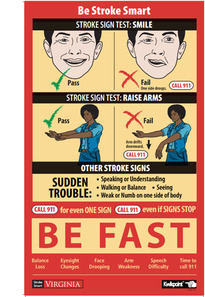
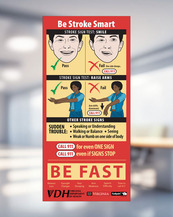
Earl Taylor is a Dental Assistant at the Virginia Department of Health and works on the same floor as the Stroke Program. He credits a Stroke Smart poster near his desk helping him identify and respond to two stroke events! He recently shared his stories with the VDH Stroke Team.
Story one: “One morning my doorbell rang and I opened the door to find one of my neighbors, a gentleman in his mid-70’s. He was very upset, telling me his sister had fallen and was unable to get up. I went to see what was going on. When I arrived, I helped her to her feet and sat her in a chair. I asked what happened and as she was telling me about it, I noticed her speech was slurred and she was leaning to her left side. I immediately remembered what I had read about people having a stroke. I asked if she could lift her left arm, she barely could. I called 911 and kept her talking as much as I could until the paramedics arrived.”
Story two: “One evening my sister, brother and I were going into the hospital when I noticed an elderly lady in the parking lot crying uncontrollably. She said that she and her husband were out for a Sunday drive and he just stopped talking to her. When I went to talk to the gentleman, I noticed he was slumped over in the seat of the car and was drooling and his face was sagging on his left side. I knew this was a sign of a stroke. I kept him talking as best I could until we got help.”
“I just want to say if I had not seen that poster about stroke, I would not have been able to respond positively to a bad situation.”
Earl’s heroic story shows how important it is to have educational materials posted in places for other people to see. You can order free materials or download posters to print on the Stroke Smart website.
|
|
|
 Property Tax Insert
Reaching 150,000 People at Zero Postage Cost
(Stafford County)
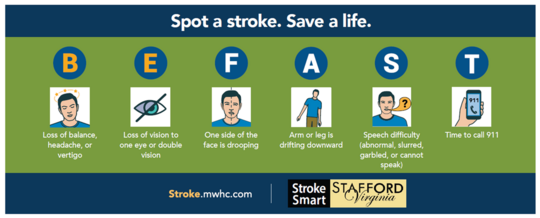
Stafford County became a Stroke Smart County in 2025 and took action right away to educate the public. Stafford County designed and sent a stroke education insert to households that receive a yearly real estate tax mailing. That’s more than 150,000 people. This simple piece of paper added no weight to the mailing so there was no added postage cost.
Since most people do not see the property tax mail as “junk mail”, they usually open and review it. This creates a rare moment of guaranteed engagement. It’s an ideal opportunity to include brief, life-saving health education.
The insert is the size of a standard business envelope. It includes stroke symptom information and the 911 call-to-action. This strategy is a low-cost, effective way to share Stroke Smart education in your county.
|
|
“Stroke Champion” Certificates
Turning One Training into Five More
(Lake of the Woods Example)
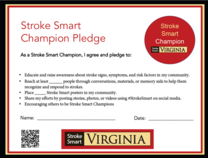
At community events and health fairs, Stroke Smart volunteers can invite people to become Stroke Champions. Stroke Champions commit to teaching others how to recognize a stroke and call 911. The first thing they learn is a key insight: Most stroke victims do not call 911 themselves. An observer usually does, just like CPR. This creates a strong personal motivation to educate family and friends.
 |
|
|
|
|
|
|
Next, participants are asked to think concretely about who they will train:
• “I can teach my Bible study group of 7.”
• “My book club has 6 people.”
• “My son’s scout troop has 4 people.”
• “My coworkers or neighbors…”
|
|
|
|
|
|
|
They then receive that exact number of magnets or wallet cards, along with posters. They put them in specific locations such as churches, coffee shops, and grocery stores.
When they make this pledge, they receive a Stroke Champion Certificate with their name and commitment written on it. This simple step dramatically increases follow-through. Find the Stroke Champion materials under Resources.
At Lake of the Woods, 20 people were trained and on average each committed to training 5 more. Thus, that single event reached 100 people instead of 20.
|
|
|
|
|
|
|
Phone System Messaging:
Passive Education Every Time Someone Calls a Medical Office
|
|
|
|
|
|
|
Another powerful best practice is adding a short Stroke Smart message to a medical practice’s phone greeting or voicemail system.
This message is available on the Virginia Department of Health website under the Stroke Medical Practice section. It can be inserted anywhere in the phone tree. See a Phone Script example here.
For example, if someone is calling a medical office because they think a patient may be having a stroke, the message encourages them not to wait for a callback but to call 911 immediately.
Even more powerful: Most callers are not calling about stroke at all. They are calling to make appointments, refill prescriptions, or ask routine questions. Yet every caller hears a brief message on how to recognize stroke symptoms and what to do.
This is like how 911 became universally known through repeated exposure in phone recordings over time. The message adds only about 12–15 seconds, but it passively educates thousands of patients and families every month. It can be placed: (1) At the initial greeting, (2) Within the voicemail system, or (3) In after-hours messages.
Access an example of a script and a recording from the Medical Society of Virginia.
This is one of the lowest-cost, highest-reach education tools available.
|
|
Announcements
 |
|
|
|
|
|
|
Congratulations to the New Stroke Smart Medical Practices
The following medical practices have received 2026 Stroke Smart Medical Practice recognition!
• Augusta Health Diabetes and Endocrinology: Platinum
• Augusta Health Neighborhood Primary Care: Platinum
• Augusta Health Neurology: Gold
• Bon Secours Neurology Clinic- Westchester: Gold
• VCU Health Primary Care at Callao: Gold
• VCU Health Family Medicine at Warsaw: Gold
Stroke Smart Medical Practices educate the public and medical office staff to recognize patient stroke signs and actions to take. Through adopting (5) actions, they can save lives and reduce disability from strokes.
1. Train office staff to spot strokes and follow practice protocol if a stroke is suspected.
2. Ensure Stroke Smart education and materials are accessible to all patients.
3. Identify high risk patients and provide individualized Stroke Smart education.
4. Incorporate Stroke Smart script in phone system recordings.
5. Track metrics on Stroke Smart program activities.
Learn more about Stroke Smart Medical Practice.
|
|
|
|
|
|
|
 |
|
|
|
|
|
|
Become a Stroke Smart Partner!
The Stroke Smart Virginia Partner program is a way to be recognized for your Stroke Smart efforts. Any organization or business can apply!
Once your application is approved, you will receive:
• A framed certificate plus 50 Stroke Smart magnets
• 100 Stroke Smart wallet cards
• 10 posters
• Stroke Smart cling to display
Apply to be a Stroke Smart Partner.
|
|
|
|
|
|
|
 |
|
|
|
|
|
|
Stroke Smart Virginia Work Group
This group meets on the 1st Friday of every month at 1:00 p.m. The purpose is to share information about Stroke Smart materials and efforts.
Contact stroke@vdh.virginia.gov for more information.
|
|
|
|
|
|
|
 |
|
|
|
|
|
|
Share Your Stroke
Educational Materials
VDH is planning to create a stroke educational resource library.
If you have something you would like to have included, please send it to stroke@vdh.virginia.gov.
|
|
|
|
|
|
|
|
|
|
|