|
BRHD’s FY25 Annual Report
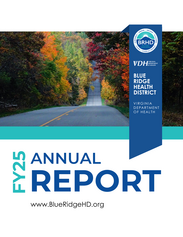
It's that time of the year - our Fiscal Year 2025 (FY25) Annual Report is live!
Published each year, our annual report provides a snapshot of the hard work and accomplishments achieved by our staff. From environmental health to clinical services, harm reduction to population health, this report highlights our different programs through data metrics and written narratives.
Download the full FY25 report or visit our Annual Report webpage to read previous editions.
|
Free Food & Formula Resource Guides
With the federal shutdown still ongoing, many people are worried about getting enough food for themselves and their families. To help meet this need, BRHD has published Free Food & Formula Resource Guides on our website. These handouts list available food banks and pantries in each locality and include:
- Hours of operation
- Physical address
- Eligibility requirements (if any)
- Contact information and website link
-
Details on the type(s) of resources available
Each locality’s resource guide is available in English, Spanish, Dari, and Pashto. Visit our Community Resources webpage to view and download the PDFs. Questions about specific offerings or requirements should be directed to the agency in question
|
Change to BRHD Hours of Operation
 |
|
Beginning in November, BRHD will be opening late at 12:30 PM on the 3rd Friday of each month. This is part of a new initiative to drive staff development and make time for our programs to collaborate on a more consistent basis. We will open at 12:30 PM on Friday, November 21 and December 19. |
Grant Opportunity for Perinatal Health Hubs
The Virginia Department of Health’s (VDH) Perinatal Health Hubs Pilot Program is a new initiative focused on reducing maternal and infant mortality and morbidity in the Commonwealth. Perinatal health hubs provide community-based, wraparound supports and services to pregnant and postpartum people and their infants. For the purpose of this funding opportunity, a perinatal health hub is defined as:
- Community-based, located in the area it serves
- Caring for the birthing parent-baby duo during pregnancy and through at least 1 year postpartum
-
Providing multiple services for families (see online application for specific services)
-
Focused on reducing maternal and infant morbidities and mortalities
This new program will be awarding $2.5 million in grant funding over the course of two years for organizations to expand perinatal health hubs across Virginia. The deadline to apply for funding is December 1st at 5 PM. Eligibility guidelines apply. For more details, visit VDH’s Perinatal Health Hubs Pilot Program website. There will also be a virtual, informational webinar hosted on November 10th at 10 AM via Microsoft Teams to discuss details and answer questions.

|
|
 |

Why are we concerned about cooling food properly?
When cooked food is stored and cooled improperly, bacteria can start to grow and survive at cold temperatures. Cooling properly helps ensure food safety which prevents illness and helps keep people healthy.
How to cool food properly using the two stage cooling process:
- Divide large portions - Split soups, stews, or casseroles into shallow containers so they cool faster.
- Use shallow containers - Food should be no more than 2 inches deep when cooling.
- Stir and uncover - Stir occasionally to release heat and leave uncovered until the food stops steaming.
- Use an ice wand - This will help to cool large quantities of soup and other foods from the inside of the food product out.
- Use an ice bath - Place the pot or container in a larger bowl of ice water and stir to bring the temperature down quickly.
- Put in the refrigerator or freezer to drop the temperature quickly.
- Take temperatures of cooling food and start timer when the food reaches 135°F, write down the time, use several of the above methods together for the best results on how to cool the food. Ensure food is at 70°F within a maximum of 2 hours. Write down the time when 70°F was achieved then after a maximum of 4 more hours ensure the cooled food reached 41°F.
For more information see: https://www.cdc.gov/food-safety/prevention/index.html
|
To read past publications, visit the BRHD Health Whys webpage.
|
|
|
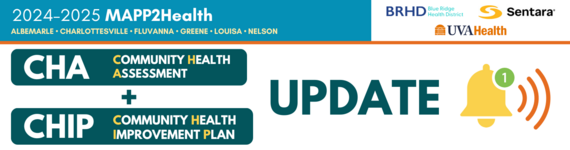
We’re excited to share two big moments from this month!
First, Albemarle County hosted the Our Community, Our Wellbeing event, where we presented the new MAPP2Health Community Health Assessment alongside partners Ridge Schuyler from PVCC’s Network2Work and Michele Claibourn from UVA’s Center for Community Partnerships. Together, we shared what we’re seeing in local data about health, wellness, and economic conditions. Community Advisory Committees, Board of Supervisors members, and residents joined us to learn how this information can guide better decisions for a healthier community.
Second, we held our second Community Health Improvement Plan (CHIP) workgroup meetings. Both returning members and new partners learned how they can help reduce obesity, improve mental health, increase access to healthcare and healthy foods, strengthen economic stability, and support transportation across the district. This CHIP cycle runs through 2028 and focuses on working together to support neighbors most at risk for poor health outcomes.
If you or your organization is working to improve community health—especially in Nelson or Louisa County—we’d love for you to join us!
Please reach out to CHA/CHIP Program Officer, Jen Fleisher, to get connected.
|
|
- Tuesday, November 11 – BRHD closed for Veterans Day
- Friday, November 21 – BRHD opening late at 12:30 PM
- Wednesday, November 26 – BRHD closing at 12 PM
-
Thursday, November 27 + Friday, November 28 – BRHD closed for Thanksgiving
|
|

Monthly Rapid REVIVE! Naloxone Trainings
Free trainings and dispensing of Naloxone nasal spray used to treat suspected opioid overdoses. All are welcome. Visit the Harm Reduction webpage for more information.
-
3rd Monday of the month: November 17 from 3 to 4 PM at the Charlottesville/Albemarle Health Department (1138 Rose Hill Dr., Charlottesville, VA)
-
3rd Wednesday of the month: November 19 from 1 to 3 PM at the Nelson County Health Department (1645 Thomas Nelson Hwy., Arrington, VA) and from 3 to 4 PM at the Louisa County Health Department (101 Woolfolk Ave. Suite 202, Louisa, VA)
Monthly Test & Go Event
Free walk-in STI testing on a first come, first served basis until we reach capacity. No insurance needed. Call 434-972-6269 for more information.
-
3rd Tuesday of the month: November 18 from 4:30 to 6 PM at the Charlottesville/Albemarle Health Department (1138 Rose Hill Dr., Charlottesville, VA)
Monthly Community Health Worker (CHW) Office Hours
Walk-in one-on-one sessions hosted in Albemarle County. All are welcome. Visit the Community Health Worker webpage for more information or call 434-270-3216.
- Thursday, November 13 from 10 AM to 2 PM at the Yancey Community Health Center (7625 Porters Rd., Esmont, VA)
|
|
|
|
|