|
Healthcare Professionals Newsletter
|
|
Emerging Issues in Public Health
More to Know
Mark Your Calendars
Resources
|
|

New World Screwworm Reemergence in Central America and a Recent Travel-Related Human Case in Maryland
Additional travel-associated cases might be detected if they have been in areas where the flies are present. There are currently no reported human or animal cases of locally acquired NWS myiasis in the United States.
NWS myiasis is typically a disease of livestock, but can also affect other animals, including people. The hallmark of NWS myiasis is that fly larvae feed on live tissue.
If you suspect your patient has NWS myiasis:
-
Report it immediately to your local health department
-
Remove all of the NWS larvae from the affected site.
-
Kill and preserve the larvae by placing them directly into concentrated (70%) ethyl or isopropyl alcohol.
-
Do not discard any live larvae into the trash or outdoors.
-
Healthcare providers should consult with local local health department or state health department personnel regarding guidance for proper larvae preservation for confirmatory diagnosis.
-
Local and state health department personnel can help facilitate clinical information and diagnostic support from CDC.
For more information visit CDC’s Clinical Overview of New World Screwworm
2025-26 Respiratory Season Updates
The respiratory virus season is quickly approaching. Here are the latest updates for you to stay informed to keep your patients and communities healthy.
Vaccine Updates
Influenza
-
Everyone aged 6 months and older, with rare exceptions, should get a flu vaccine every season.
-
All flu vaccines in the U.S. for the 2025-2026 season are anticipated to be trivalent, formulated to protect against three influenza viruses (an A(H1N1) virus, an A(H3N2) virus, and a B/Victoria virus).
-
New this season is FluMist, a nasal spray flu vaccine for self or caregiver administration, approved for people 2-49 years of age.
RSV
-
Immunizations are available to protect infants and older adults from severe RSV.
-
Infants less than 8 months of age born during or entering their first RSV season who are not protected by maternal vaccination should receive one dose of nirsevirmab or clesrovimab.
- There is no preferential recommendation between nirsevimab and clesrovimab.
-
The maternal RSV vaccine should be given to pregnant women between 32 and 36 weeks of pregnancy from September through January.
-
If pregnant women are vaccinated within this window and more than 14 days before delivery, infants do not need RSV immunization.
-
Currently, the RSV vaccine is not recommended during subsequent pregnancies for pregnant women who have already received one maternal RSV vaccine during pregnancy.
-
Everyone aged 75 and older should get a single dose of RSV vaccine.
-
Adults 50-74 who are at increased risk of severe disease should get a single dose of RSV vaccine.
-
Repeated RSV vaccines are not currently recommended.
-
Pharmacists in Virginia may administer the 2025-26 vaccine without a prescription to certain people 18 and older under the statewide standing order.
-
Healthcare providers in Virginia may administer the 2025-2026 vaccine to patients 6 months of age and older under their own medical discretion.
- CDC recommendations for the 2025-2026 season are still pending. At this time, vaccine availability for the local health departments and Vaccines for Children program are dependent on final CDC recommendations.
|
|

Updates to Neonatal Abstinence Syndrome Reporting
Neonatal abstinence syndrome (NAS) is a reportable condition in Virginia. Healthcare providers are responsible for submitting cases to the Virginia Department of Health (VDH) using the Epi-1 Form (also called the Confidential Morbidity Report Portal).
On Monday, August 25, 2025, VDH made changes to the ‘NAS Supplemental Questions’ section of the form. These updates changed the language in the ‘NAS Supplemental Questions’ section. This section collects information about the mother’s substance use and the baby’s health. The changes will help VDH follow national recommendations for classifying NAS cases.
What are the updates?
-
All questions in the ‘NAS Supplemental Questions’ section are now required. You can still choose ‘Yes’, ‘No’, or ‘Unknown’ when answering, if those apply.
-
Some questions were rewritten to make them clearer. Others have updated examples.
Will this affect how reporters do their job?
-
No. The updates do not change how cases are reported. VDH expects that any extra time needed to complete the form will be minimal.
Why is VDH making these changes?
-
It’s important to use a standard national case definition. These updates will help improve tracking and reporting of NAS across the state.
-
VDH’s previous case definition did not match current national recommendations. Updating the Epi-1 Form will help classify NAS cases correctly.
VDH Invites Providers to Join the Influenza Sentinel Surveillance Program
-
This program helps monitor influenza and other respiratory viruses circulating in Virginia.
-
Participation involves submitting respiratory specimens to the state laboratory for virus testing and typing. There is no cost to your practice or your patients.
-
All providers that see patients with acute respiratory illnesses are welcome to participate. This includes outpatient primary and urgent care practices, and university health systems.
-
Providers serving rural communities are especially encouraged to participate.
-
To learn more about the program, please visit the VDH's Sentinel Surveillance website.
Prepare Your Staff for Measles: Discussion Guide and Job Aid
Prepare staff in your facility for measles exposures with CDC’s Measles Infection Control Micro-Learn. Healthcare providers are encouraged to use the discussion guide and job aid to engage their team in a short, focused discussion about measles.
-
Quickly recognize and isolate a person who might have measles
-
Take action to prevent measles spread in your facility
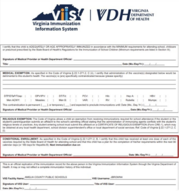
Conditional Enrollment for Schools Reminder
 |
|
-
Conditional enrollment requires parents to submit documentation to the school for a student.
-
VIIS statements provide healthcare providers with a place to document the details of conditional enrollment, including the date for the next immunization due.
|
Reporting Animal Bites
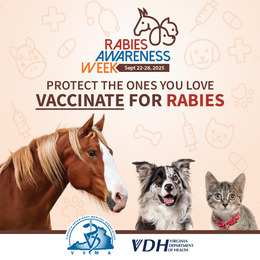
Please remember to report animal bites and other potential rabies exposures to your local health department.
Reporting potential exposures helps trigger response activities like:
-
Observation of dogs or cats that have bitten people
-
Rabies exposure assessments
-
Assistance with rabies post-exposure vaccination recommendations
This means any animal bite or other exposure (such as saliva from a rabid animal entering a patient’s eyes, nose, mouth or open wound) must be reported to the local health department. A “Rabies Response and Vaccination Decision Toolkit for Physicians” and other great resources can be found at VDH Rabies Control.
Also report any animal that is suspected to be rabid and that may have exposed a person, companion animal, or livestock to rabies shall report immediately to the local health department, per Code of Virginia section § 3.2-6522.
|
|
New CME Training Opportunity: Syphilis and Congenital Syphilis on the Rise – How to Protect Your Patients
A new training is available for the following audiences located in the U.S.:
-
Obstetricians/gynecologists
-
Primary care providers
-
Nurse practitioners/physician assistants
-
Pediatricians
-
Nurses
- Pharmacists
Celebrate International Infection Prevention Week, October 19 to 25!
 |
|
Use tools from the Association for Professionals in Infection Control and Epidemiology (APIC), like posters and quick tips to help stop germs from spreading. Follow VDH on Facebook to find out what’s happening in Virginia and how you can help keep people safe. |
|
|

Infection Prevention Training Power Tools
 |
|
Explore the Healthcare-Associated Infections & Antimicrobial Resistance Program's new Infection Prevention Training Power Tools!
You will find Training Step-By-Step Guides to help you lead sessions with confidence. There are also Hands-On Learning Tools like games, puzzles, and coloring pages to make team training easy and fun.
|
|
|

Did someone forward this email to you?
Subscribe here to get future updates straight to your inbox!
|
|
|
|
|