|
Tobacco Control Program Newsletter |
|
Although not fully understood, it is well established that women who smoke compared to male smokers have a higher risk of lung cancer, stroke, Alzheimer’s, osteoporosis and auto-immune disorders such as rheumatoid arthritis. The Surgeon General has concluded that smoking is a risk factor for these diseases. While quitting smoking can improve a woman’s health at any stage of life, it is especially important for pregnant moms. Quitting smoking before or during early pregnancy can reduce the risk of adverse health outcomes such as preterm delivery and low birth weight.
Studies show that there are gender differences in smoking cessation. Women smokers become dependent on smoking sooner than male smokers and have a greater difficulty quitting and maintaining abstinence. This can be explained in part by looking at the reasons that men and women have for smoking. Research indicates that the primary reason why men smoke is for nicotine reinforcement, while women smoke to manage stress, mood, and weight gain. This suggests that supportive counseling is a critical component of any cessation plan for women.
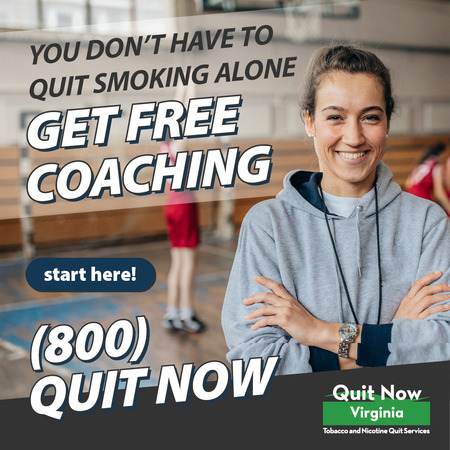
At Quit Now Virginia (QNV), quit coaches are trained to help women quit smoking at any stage of life by developing a quit plan to address a woman’s reasons for smoking. Additionally, QNV has developed specialized quit coaching for pregnant and postpartum women and for callers experiencing depression or an anxiety disorder. If you smoke or vape, Women’s Health Month may be the perfect time to empower yourself and take control over your addiction to nicotine. Join thousands of women who have successfully quit smoking by calling QNV at 1-800-Quit Now or visiting QuitNowVirginia.org
|
|
Meet Our TCP Partner: Jason Stradone
Mark Boldt, Program Manager; Nicole Mayaen, Cessation Coordinator; and Jason Stradone, all smiling and standing in front of three sets of gray metal shelves. The shelves have all the boxes of materials.
Jason Stradone is the Production Supervisor at the Virginia Industries for the Blind (VIB) Richmond facility. VIB offers products to federal, state, and local government customers as well as the general public. VIB works with the Tobacco Control Program (TCP) to store and send Quit Now Virginia materials, like brochures, flyers, and posters to various community partners.
Jason has been with the company for 26 years. Jason and his Inventory Specialist, Nancy Davis, ensure the TCP products are organized, orders are mailed out in a timely manner, and send inventory reports. They play a valuable part of sharing information throughout the state.
Jason recently gave some of the TCP team a tour of the Richmond facility. The featured picture includes Mark Boldt, Program Manager; Nicole Mayaen, Cessation Coordinator; and Jason Stradone standing in front of shelves of TCP materials. Sarah Birckhead, Policy and Outreach Coordinator, was the photographer.
|
|
Share The Air Takes Action
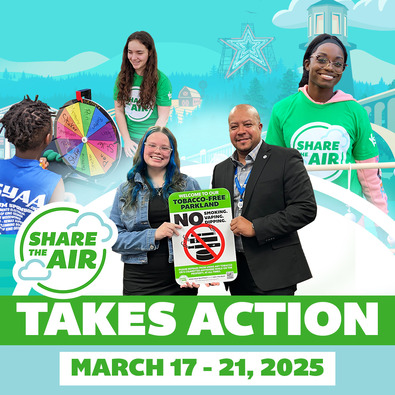
Join us in championing the Share The Air campaign as it launches its 4th annual Share The Air Takes Action from March 17-21, 2025! A tobacco prevention initiative led by Y Street, the Virginia Foundation of Healthy Youth's largest youth-led program, Share The Air is on a mission to create 100% tobacco-free and e-cigarette-free parklands across the Commonwealth by supporting parks and recreation departments in adopting a voluntary tobacco-free outdoor policy.
Thanks to Y Street members' advocacy efforts, 27 localities have partnered with the campaign, helping to protect over 2.5 million Virginians from the exposure of secondhand smoke and vape aerosol and keep parklands free from tobacco litter. For the week of action, Y Street members are organizing events to encourage more localities to commit to designating their parklands as 100% tobacco- and e-cigarette-free, joining the growing movement for healthier communities. The Share The Air campaign offers a wealth of free resources, including tobacco-free signage, to help departments implement a voluntary policy effortlessly and remind visitors of their commitment to creating a cleaner and safer environment.
You can get involved too during Share The Air Takes Action by making your voice heard! Visit ShareTheAirVA.com to complete a survey and express your thoughts on the importance of tobacco- and e-cigarette-free outdoor spaces. Together, we can ensure everyone has equal access to clean, healthy outdoor spaces and keep Virginia beautiful and vibrant for generations to come!
|
|
Data Highlight
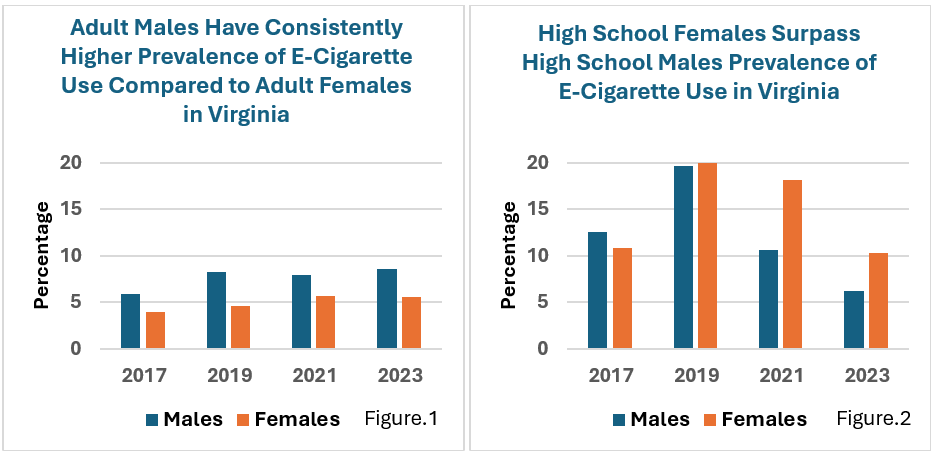
Data Note: Adult data are sourced from the Behavioral Risk Factor Surveillance System (BRFSS) 2023 data release (Fig.1). Youth data are sourced from the Virginia Youth Survey (VYS)(Fig.2). Precautions should be used when interpreting e-cigarette BRFSS data as modifications to this question have occurred between collection years making direct comparisons more difficult.
E-cigarette use among adults in Virginia has steadily increased from 2017 to 2023, with consistently higher prevalence among males compared to females (Figure 1). In contrast, high school students in Virginia have seen more dramatic shifts in e-cigarette use, with both males and females peaking in 2019 at 19.7% and 20.2%, respectively (Figure 2). Interestingly, female high school students did not show the same sharp decline in e-cigarette use seen among male high school students in 2021. Instead, the percentage of female high school students with e-cigarette use was nearly double that of male high school students in 2021 and 2023. It will be important to continue monitoring these trends as research shows it is more difficult for women than men to quit nicotine (Yale Medicine). In 2023, the most common reason female high school students reported using electronic vapor products was due to anxiety and stress (7.6%) while the most common reason for male high school students was curiosity (3.9%). Visit Vape Free VA and Quit Now Virginia website to learn about options to help you or someone you love quit nicotine.
|
|
News and Resources
Nicotine-free products that mimic commercial tobacco products are gaining popularity. Public Health Law Center released a new fact sheet which provides an overview of these products by describing the most popular brands and examining their safety and potential regulation by the FDA.
In this cohort study, neither daily nor nondaily vaping among US smokers was associated with increased smoking cessation; however, each was associated with reduced tobacco abstinence, suggesting that vaping may prolong both smoking and nicotine dependence among US smokers.
North American Quitline Consortium brings you a free accredited lung cancer screening course for tobacco treatment specialists through Project ENGAGE. This course is designed to empower you with the knowledge and strategies needed to effectively educate your clients about lung cancer screening.
A recent American Nonsmokers’ Rights Foundation article shares that cruising is evolving to meet growing demand for healthier travel experiences and smokefree policies are a part of the picture. Progress is being made, but passengers have a vital role in driving change by voicing their preference for 100% smokefree environments.
|
|
|
Free help to quit tobacco.
Quit Coaches available for support.
- www.QuitNowVirginia.org
- 1-800-QUIT NOW (1-800-784-8669) or text READY to 34191
- A free 24/7 service for all Virginians, 13 and older for all types of tobacco/nicotine.
|
|
Free Vaping Resources for Teens, Young Adults, & their Support Circles.
- VapeFreeVA.org
- Find vaping prevention and cessation facts & tips
- Support Circle tips are for any adult concerned about vaping -- parents, guardians, educators, physicians, etc.
|
|
|
Click the "Order Now" button below to request
brochures and other free resource materials!
|
|
- Becoming a Tobacco Free Worksite,
- Referring your patients and clients proactively to Quit Now Virginia,
- Finding your local tobacco and nicotine coalition, or
- Scheduling a tobacco and nicotine related training for your staff or community.
|
|
|
|
|