|
This month’s Found in the Archives highlights the courageous story of Leslie R. Coates, who brought about the desegregation of the Fairfax Courthouse cafeteria. This month’s Found in the Archives was researched and written by HRC’s summer intern Carina Mezheritsky, a University of Virginia student studying history and psychology.
Before we get to his story, it is important to set the stage. In 1896, the U.S. Supreme Court case Plessy v. Ferguson utilized the “separate but equal” doctrine to establish racial segregation under the Constitution. As a result, Virginia’s Constitution of 1902 instated literacy tests, poll taxes, and segregated public schools to separate white and black residents. In the 1930s, black plaintiffs attempted to fight segregation in higher level education. They also worked to create Black elementary and high schools that were comparable to their white counterparts.
The 1950s Civil Rights Movement slowly made progress toward desegregation, and the Brown v. Board of Education decision in 1954 overturned Plessy, establishing public school segregation unconstitutional. However, although Brown was a landmark Supreme Court decision, it took many more years of effort throughout the 1960s and 1970s to successfully implement the ruling. For example, it was not until August of 1959 that the Fairfax County School Board passed a desegregation plan due to pressure from lawsuits, and schools were not completely integrated until 1971.
While Brown v. Board exclusively made segregation in public schools unconstitutional, it failed to address segregation in other spaces. Ultimately, it took local and individual efforts of noncooperation and active resistance to finally pass the Civil Rights Act of 1964, which outlawed discrimination based on race.
Leslie R. Coates was one of those individuals.
Leslie R. Coates, along with six others, was summoned on August 28th, 1959, to serve as a Grand Juror on the Special Grand Jury of Inquest in the Fairfax County Court. On September 14th, Coates, and the rest of the Grand Jury, arrived to hear evidence of twenty-five cases of the July Term and decide whether to issue indictments.
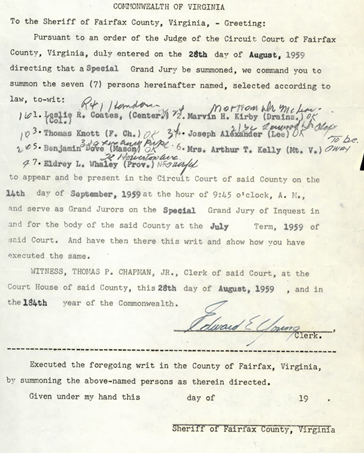 Figure 1 - The Grand Jury Summons for Leslie R. Coates. He is listed first. Found in Common Law Order Book No. 44 at page 555.
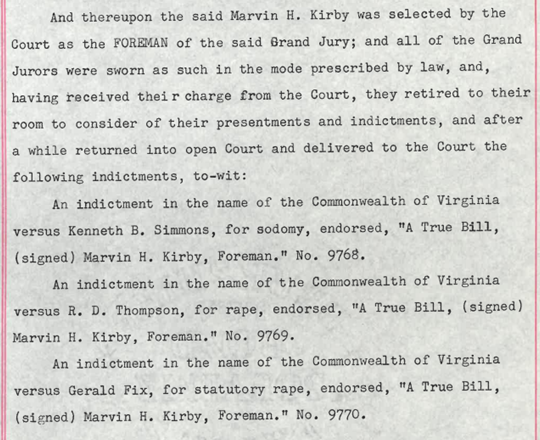 Figure 2 - The indictments the Grand Jury delivered to the Court.
The Grand Jury heard the evidence of each case and decided if each established probable cause. Only a few cases are listed above. All cases can be found in Common Law Order Book No. 44 at page 645.
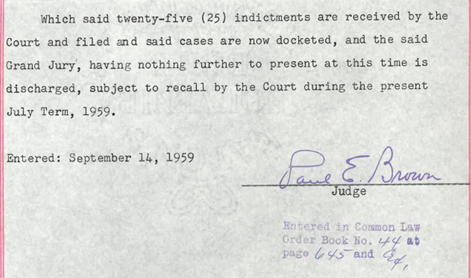 Figure 3 - The Grand Jury is discharged but subject to recall.
Once the Grand Jury was dismissed for lunch break, Coates went to the cafeteria with the other jurors and purchased a hamburger with fries. When Coates sat down, the cafeteria manager said he could not sit or eat in the dining area due to his race. Coates asked for a refund on his lunch, but the server behind the counter refused him.
A policeman then went upstairs to get a ruling from a jurist, who concluded that the cafeteria “must provide equal facilities for Blacks and Whites”. When it was suggested that he eat down the hall in the coat room or boiler room, Coates refused. A judge then got involved and issued a court order to give Coates a refund. Coates spoke with the judge and stated if he could not eat with the jury, he should not serve with them. The judge excused him from jury duty.
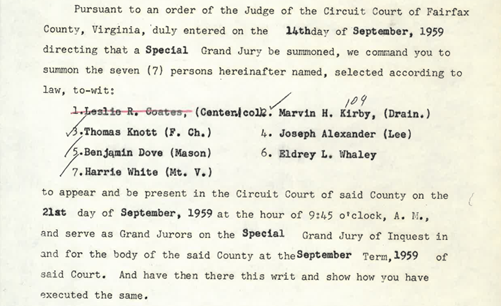 Figure 4 - The Court order for a Special Grand Jury on September 21st. Leslie R. Coates’ name is crossed out in red.
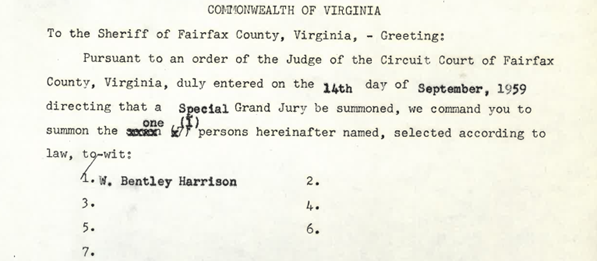 Figure 5 - Coates replaced on the Special Grand Jury by W. Bentley Harrison.
The story received wide coverage from the press and became a sensation. Coates received many letters of support from local citizens, and his decision inspired other acts of resistance such as sit-ins at local restaurants. He then went before the Fairfax County Board of Supervisors where they heard his case and voted to reverse the current segregation laws. Coates was proud to declare that this was the beginning of the process of integration in Fairfax County. The Fairfax County Courthouse cafeteria was officially desegregated June 29th, 1960, by Francis M. Rathwick. Rathwick, who leased the cafeteria, made the decision. Other Northern Virginia dining counters had started to integrate the previous week.
The Court’s records reveal how the jury duty of one man was a major step in the fight for equality for African Americans in Northern Virginia. While today we might focus on the major milestones of the Civil Rights Movement, it is equally important to study the achievements of grassroots activism. The backbone of success for any social justice movement is communities coming together to make change.
If you would like to learn more about Leslie R. Coates, keep reading!
Leslie R. Coates was born in a farmhouse in Chantilly, Virginia in 1907 and was a lifelong Northern Virginia resident. He attended a one-room “colored grade school” called Floris School through 7th grade, but there were no high schools he could attend in his area. Using a brothers-in-law’s address, he attended Dunbar High School in Washington D.C. and then went to Howard University before he ran out of money and dropped out. Coates then served in the army during WWII and was commissioned as a second lieutenant. He went on to serve the Virginia National Guard for 36 years and retired as a captain. Coates also worked as a dairy farmer for his family’s farm, which was eventually sold for the construction of Dulles International Airport. Along with this, he was a school bus driver, machinist, in the church choir, and treasurer of the Chantilly Baptist Church. He married Lutie Lewis Coates in April of 1935, who served as a principal and teacher for numerous “colored schools” in Fairfax County from 1935- 1963; Lutie Lewis Coates Elementary School is named after her.

Bibliography
“Coates House Site · Fairfax County African American History Inventory.” 2025. Centerformasonslegacies.com. 2025. https://fairfaxaahi.centerformasonslegacies.com/items/show/187.
Cornell Law School. 2019. “Grand Jury.” LII / Legal Information Institute. 2019. https://www.law.cornell.edu/wex/grand_jury.
“Courthouse Cafeteria Desegregated.” 1960. The Washington Post, Times Herald. ProQuest Historical Newspapers: The Washington Post pg. D1. June 30, 1960.
“Desegregation: In the News | Fairfax County Public Schools.” n.d. Www.fcps.edu. https://www.fcps.edu/about-fcps/history/records/desegregation/newspapers.
“Jim Crow to Civil Rights in Virginia.” 2024. Virginia Museum of History & Culture. 2024. https://virginiahistory.org/learn/jim-crow-civil-rights-virginia.
“LESLIE R. COATES, 90, DIES.” 1997. The Washington Post. October 13, 1997. https://www.washingtonpost.com/archive/local/1997/10/13/leslie-r-coates-90-dies/8298dc60-8a2b-44ea-899a-4f7d4230afab/.
Reed, Betty. 1982. “The Coates Family Is Rich in History.” Reston Times. February 18, 1982.
“The Role of Grassroots Movements in Shaping Civil Rights.” 2017. Usahistorytimeline.com. 2017. https://www.usahistorytimeline.com/pages/the-role-of-grassroots-movements-in-shaping-civil-rights-1ff0056b.php.
“The Role of Nonviolent Resistance in Civil Rights Strategies.” 2025. Usahistorytimeline.com. 2025. https://www.usahistorytimeline.com/pages/the-role-of-nonviolent-resistance-in-civil-rights-strategies-eb954497.php.
Schoolrooms & Courtrooms: Late 19th Century Educational Expansion in Fairfax County is now on view at the Historic Records Center. This exhibit highlights how Fairfax residents and those interested in school history can use court documents and the Historic Record Center to learn about local school history.
|