|
The Circuit Court Historic Record Center’s Fairfax Slavery Index project, started in 2015, now indexes over 40,000 references to individuals involved in slavery recorded in court documents and is accessible digitally on HRC's website. Prior to 2025, researchers wanting to access this project would have had to do so in person at Historic Records Center. This index documents the court related experiences of those enslaved, enslavers, freed individuals, hirers, patrollers, and other individuals involved with slavery in Fairfax County. The digitization of these records makes them more accessible as they can be viewed at HRC’s website anytime and anywhere.
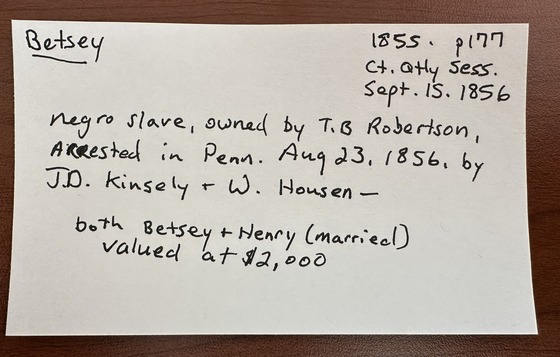 Digitization is not at an end. Court records yet to be explored for the slavery index project include chancery cases, term papers and Sheriff’s executions. The index will be updated as HRC reviews more records and uploads other indexes to the internal searchable database created by Circuit Court IT called Itrackfiles. Physical index cards and records can and should be consulted if there are questions or to view any additional information.
Since the Slavery Index Project's beginning it has been used to conduct genealogical and historical research and can be used at any point during the research process. It can provide that last piece of information or a starting point for a new project. While it is focused on Fairfax County, sometimes events from nearby counties show up in the Court Minute Books. Such was the case with Henry and Betsey, an enslaved married couple that ran away from a farm near Dumfries in Prince William County. They slipped away from their overseer one night during the first week of July 1856.
Descriptions of the couple were provided by their owner, T. B. Robertson, in a reward advertisement in the Alexandria Gazette regarding Betsey and Henry. At the time of their escape, Betsey was about 24 years old. She was described by Roberston as a humble, petite woman who usually wore something covering her hair. Henry was about 27 years old, medium height, muscular, and usually had a 5 o’clock shadow style beard. Despite his enslaved status, Henry was viewed as keeping a good disposition.[1] It is important to keep in mind that these descriptions are how they were perceived by white individuals. It is likely they would have described themselves differently.
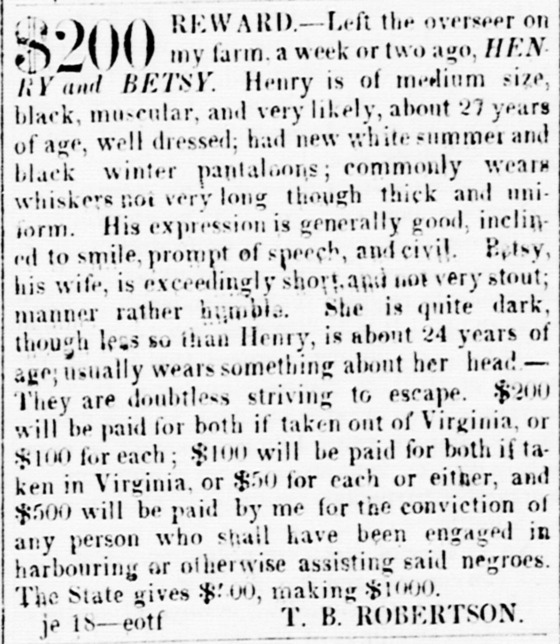 $200 Reward.,” Alexandria Gazette, July 14, 1856, 3, Virginia Chronicle; “$1000 Reward.,” Alexandria Gazette, August 6, 1856, 1, Virginia Chronicle.
A month later, five other enslaved people from the same farm escaped in the first week of August 1856. The reward advertisement purports that the seven “are most probably all now together.”[2]
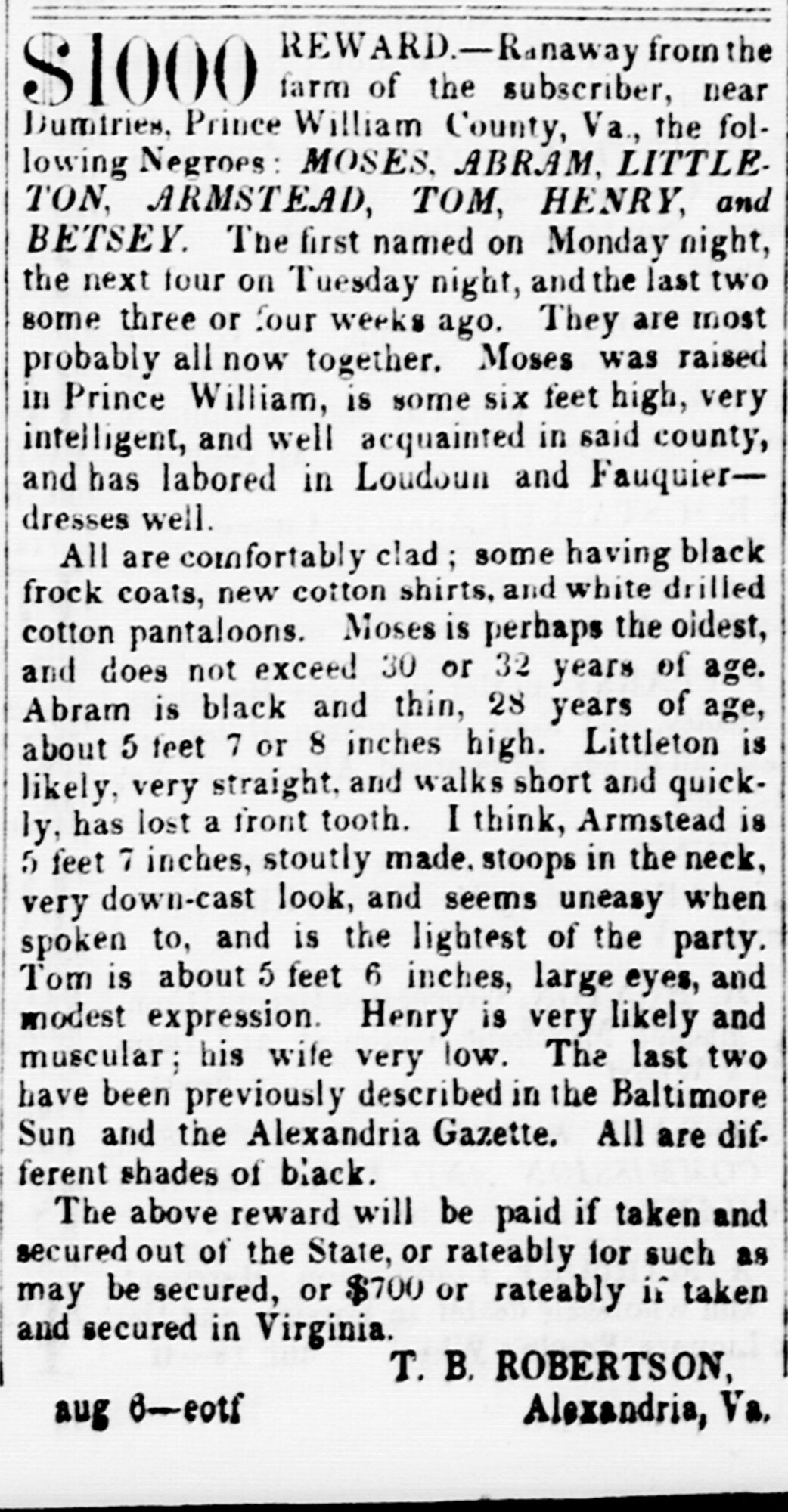 “$1000 Reward.,” Alexandria Gazette, August 6, 1856, 1, Virginia Chronicle.
After almost two months on the run, and almost making it to freedom, Henry and Betsey show up in Fairfax’s Court of Quarterly Sessions book after being arrested in Pennsylvania on August 23rd, 1856.[3] It is not clear when Henry and Betsey made it to Pennsylvania, if they ever met up with the others that escaped, or why this was brought to court here in Fairfax because their owner appears to reside in Alexandria. With the nature of this event being out of the jurisdiction of Fairfax County, it is unknown what happened to Moses, Abram, Littleton, Armstead, and Tom. It goes without saying that seven runaways from the same farm during a one-month period would have been cause for alarm by the slaveholder. Robertson paid two hundred dollars for the return of the married couple who had together been valued at two thousand dollars.
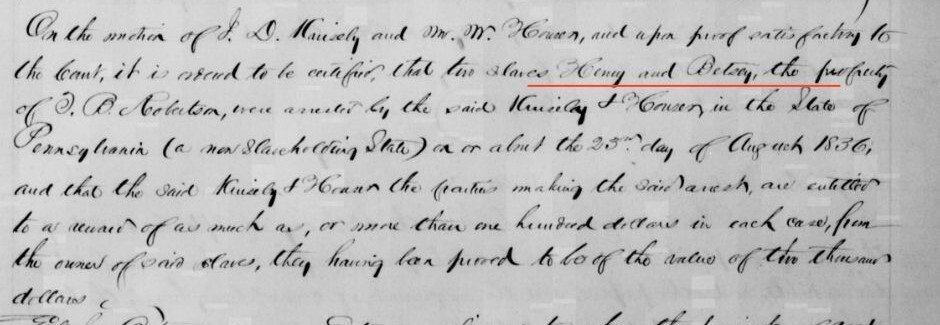 September Court 1856, September 15, 1865, Court Minute Book of Quarterly Sessions 1855-1858, Fairfax County Court Historic Records Center, 177.
By identifying individuals such as Betsey and Henry in the slavery index researchers can then conduct further research using primary sources from the Fairfax Circuit Court and other repositories to learn more about the lives of these individuals. Betsey and Henry resisted slavery and perhaps inspired other enslaved individuals to pursue freedom as well. Despite being “humble” and of “good disposition” they defied their owners. Is this all we can learn about Betsey and Henry? Perhaps. Or maybe further research will reveal more about their lives. This example shows how just a few references in court documents can be utilized to learn about individuals like Betsey and Henry. We encourage you to visit to see what you can learn about individuals of Fairfax’s past like Betsey and Henry.
[1] $200 Reward.,” Alexandria Gazette, July 14, 1856, 3, Virginia Chronicle; “$1000 Reward.,” Alexandria Gazette, August 6, 1856, 1, Virginia Chronicle.
[2] “$1000 Reward.,” Alexandria Gazette, August 6, 1856, 1, Virginia Chronicle.
[3] September Court 1856, September 15, 1865, Court Minute Book of Quarterly Sessions 1855-1858, Fairfax County Court Historic Records Center, 177.

Read More Articles
|