|
Across the United States during the 19th and 20th centuries, regional differences allowed women to sit on juries in some states much earlier than in others. The first American jurywomen ever selected served in Wyoming in 1870, over 80 years before Virginia would allow women to sit on juries. In 1911, the first all-female jury was convened in Washington State, prompting criticism from Virginians.[1]
As early as 1946, the case of Ballard v. United States secured federal approval for women to serve on juries, and in many states having female jurors was mandatory to have a representative “cross-section of the community.”[2] However, Virginia was not one of these states, and many in Virginia continued to hold onto the belief that women were not ready to be included in mandatory jury service. As more states allowed for jurywomen, Virginians published articles defending their decision to remain all-male, for example stating that “the idea of jury service for women has always been repugnant to the feelings of Southern people,” and that “no refined Southern woman wants to bear” the heavy topics of the courtroom.[3]
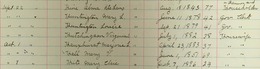
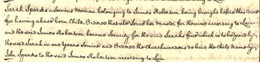
In the 1930s, L. Louise Carpenter, a black woman, was accused of burning down her house and was set to be tried by an all-white male jury when she invoked the 14th Amendment to the U.S. Constitution to argue that she was being denied the right to be tried by a jury of her peers based on race and gender. When the court ruled in favor of L. Louise Carpenter during Commonwealth v. L. Louise Carpenter, the Fairfax court defined exactly what a “jury of peers” consisted of in Fairfax Courts. In 1935, Louise was provided with an all-black male jury, even though she fought for a representative jury on both the basis of race and gender.[4] The precedent regarding sex was set in Fairfax in 1935, and the Virginia Code of Law reflected this, as it was updated to explicitly state that all jurors were to be “male citizens” during the 1936 General Assembly.[5]
As the case above demonstrates, Virginia women of the 20th century did start to push for their right to serve on juries. In the 1940s, women’s professional clubs led the fight for this right. Due to the rapidly changing legal status of women in surrounding states, many Virginia women refused to accept their disenfranchisement and kept fighting for the right to sit on juries.
The mid-20th century pushback still prevailed against female jurors, with one author asking: “Now ladies, why not leave well enough alone?”[6] Many were also nervous as they were unfamiliar with how women would act when confronted with moral and legal decisions. Anxiety over this change was so prevalent during this time that even Norman Rockwell depicted these tensions in his painting entitled “The Holdout” (1959), showcasing an unwavering jurywoman surrounded by desperately shouting men.[7] The famous 1950s teleplay and film “12 Angry Men” also loudly declares the norm of an all-male jury in the title.
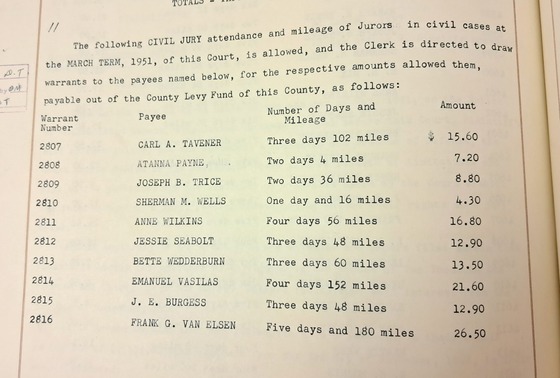 Figure 1: Anne Wilkins and Bette Wedderburn listed as jurors.
During the 1950-1951 Virginia General Assembly, legislators finally changed the Virginia Code of Law to allow women to serve on trial juries, and grand juries shortly after that. [8] The very first jurywomen listed in the Historic Records Center were Anne Wilkins and Bette Wedderburn for the March 1951 term.[9] The Fairfax Herald shows that these two women served as community pillars in Northern Virginia in their own rights outside of this pivotal judicial first. Bette, for example, served as Vice President and Chairman of the Creative Arts Club of Arlington.[10]
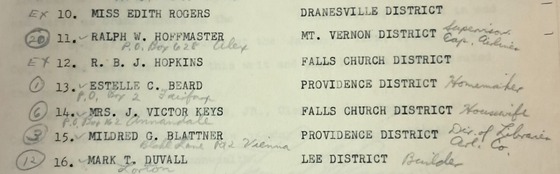 Figure 2: Homemakers
By the rise of the second-wave feminist movement, women consistently served on Fairfax County juries (although in lower numbers than men) for years. In term papers by 1952, many jurywomen were dignifiedly noted as “homemakers” or “housewives” and were equally compensated for their travel to and from the court session.[11] These jurywomen were found to be as “qualified and competent” as the men alongside them and were granted the right to serve on both grand and trial juries.[12] However, not all women embraced this new civil right. According to Thomas Chapman, clerk of the court in 1960, Fairfax County women were “asked by letter whether or not they are willing to serve before their names are included on the list of 750” possible jurors, and that “around 50 percent of women decline” their opportunity to serve heavily due to their domestic responsibilities. [13]
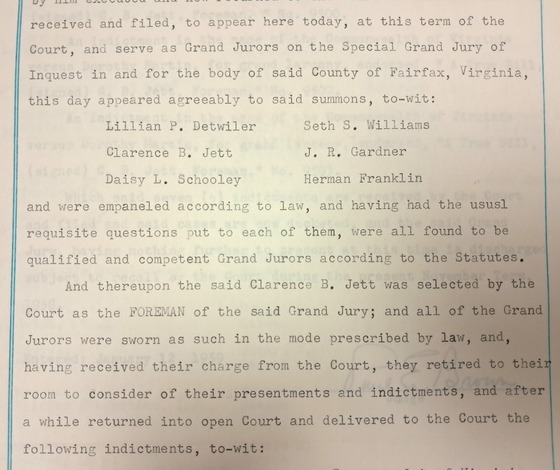 Figure 3: Jurors listed as Qualified and competent
Despite Virginia allowing women to serve on juries in 1951, this right was not nationally guaranteed by the Supreme Court until 1994, when it was ruled to be protected under the Fourteenth Amendment.[14] Today, both men and women have an equal chance of being called in for jury service, so long as they are registered to vote or have a driver’s license, making the idea of women serving on juries a nationally accepted practice.[15]
This Found in the Archives was brought to you by the Circuit Court Historic Record Center’s Fall 2024 intern Alexa Koeckritz. Read about her experience interning with us here.

[1] "The First Jury of Women in the United States" Virginia Law Register 16, no. 9 (January 1911): 700-708.
[2] Ballard et Al. V. United States (1946).
[3] Fairfax Herald, Volume 55, Number 13, 18 September 1936.
[4] Commonwealth v. Louise Carpenter (1935).
[5] Fairfax Herald, Volume 55, Number 13, 18 September 1936.
[6] Fairfax Herald, Volume 58, Number 36, 22 March 1940.
[7] Jeff Nilsson, “The Rockwell Files: The Holdout.” The Saturday Evening Post. June 10, 2019.
[8] "Judicial Administration Legislative Summary" Journal of the American Judicature Society 35, no. 5 (February 1952): 148-149.
[9] Circuit Court of Fairfax County, Common Law Order Book 27, May 1951, p.328.
[10] The Sun, Arlington, Virginia. Volume 13, Number 52, 19 November 1948.
[11] Circuit Court of Fairfax County Term Papers, November 1952.
[12] Circuit Court of Fairfax County Term Papers, June 1958.
[13] Fairfax Herald, Volume 77, Number 33, 5 February 1960.
[14] Equal Justice Initiative, “Gender-Based Jury Exclusion” (2021).
[15] Supreme Court of Virginia, “THE ANSWER BOOK for JURY SERVICE for JURORS in the CIRCUIT COURTS of the COMMONWEALTH.” n.d.
Read More Articles celebrating
Women's History Month Below
|