|
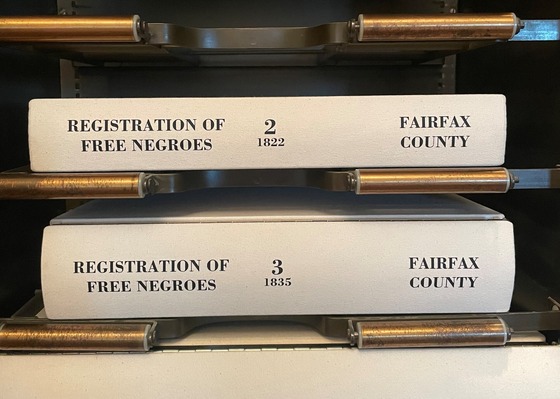
The Historic Records Center has two, bound volumes of Registrations of Free Negroes, but we know a third one is missing because the two in our possession are titled as Volume 2 and Volume 3. In 1793, the Virginia General Assembly passed a law the required free people of color to register with their County Court Clerk. In this registration, they had to provide the means by which they were freed, as well as identifying information including age, eye color, and approximate height. The Clerk would write a physical description of the person into the ledger, noting any distinguishing, visible characteristics like scars or marks.
Because we do not have a Registration for the first 20 years after this law went into effect at the end of the 18th Century, we infer that Volume 1 of the Fairfax Registry of Freed Negroes is missing. Importantly, however, Vol. 2 begins in the year 1822, which marks the beginning of the antebellum era.
Most often in our Court record groups, Fairfax residents could be freed by a Deed of Manumission or could be freed in the Will of their Enslaver; these were the primary legal instrument which served to free a slave. Because of a 1662 Virginia General Assembly act titled “Negro womens children to serve according to the condition of the mother,” freedom status followed maternal lineage, so people of color born to a free mother were also free. If the mother’s status was the reason for freedom, individuals would have to provide the means by which their mother was free in their registration.
 Fairfax County Registration of Free Negros, Volume 2 Registration no. 1
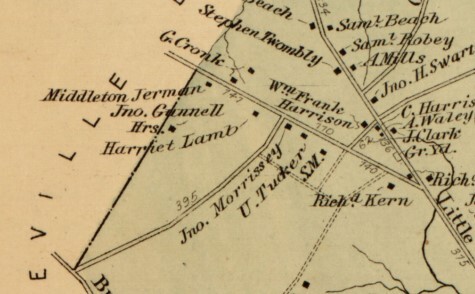
One example of some of the interesting history surrounding free people of color in antebellum Fairfax County is Harriet Hall, a free woman who owned land in modern day Fairfax City. Harriet Hall, who also went by Harriet Lamb, can be seen on the 1879 Hopkins Atlas. Although the Hopkins Atlas is from 1879, Harriet purchased her land as a free woman in 1844, twenty years before the Civil War.
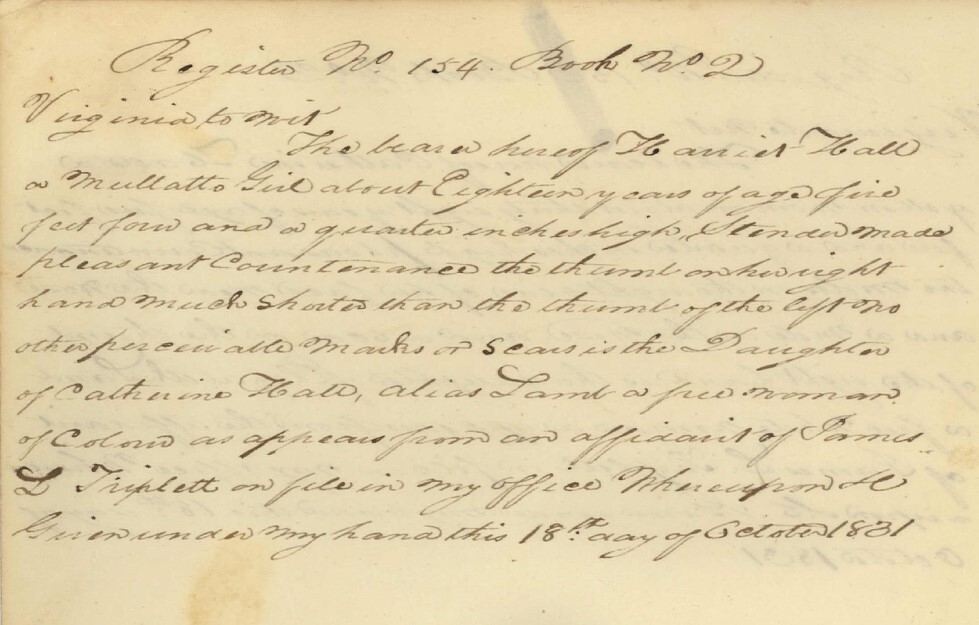 Fairfax County Registration of Free Negroes, Volume 2 Registration no. 154
Hopkins Atlas, page 79 Providence District
The Registration of Free Negroes, Volume 2 also has the registration of West Ford, a man who was enslaved by the Washington family and went on to purchase the property that became Gum Springs, the historic, free Black community in Fairfax County.
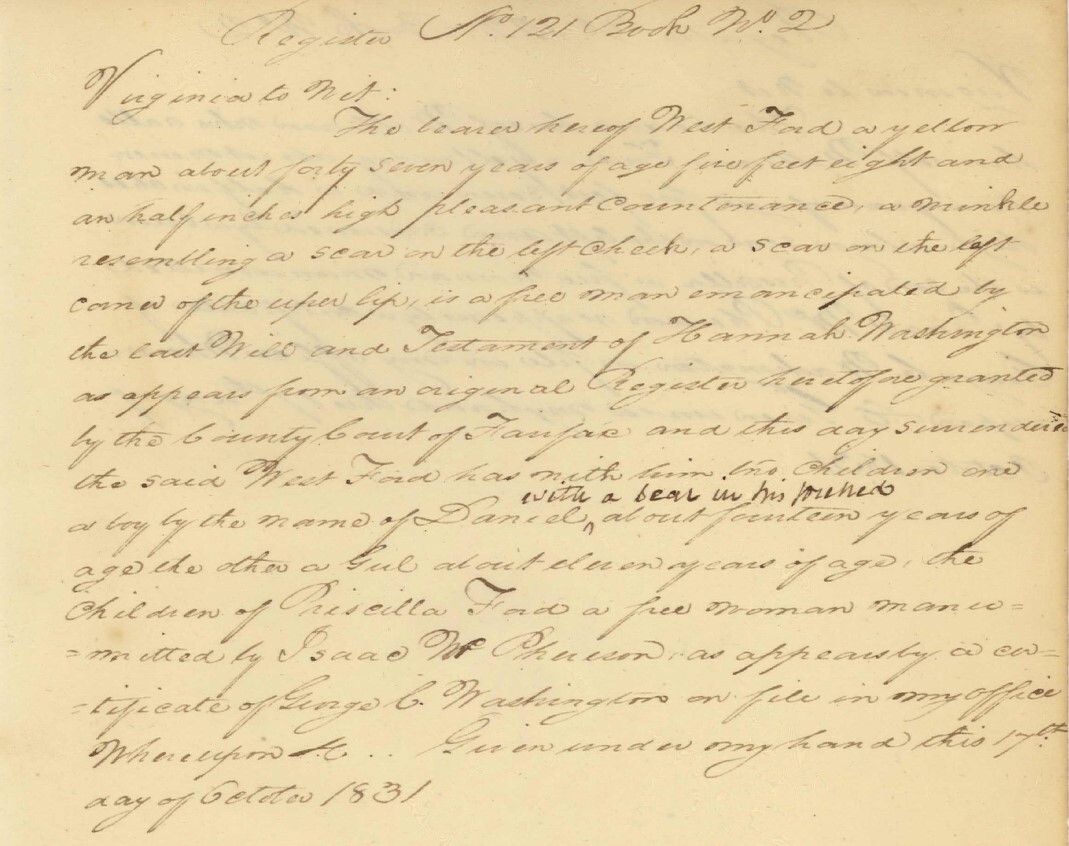 Fairfax County Registration of Free Negroes, Volume 2 Registration no. 121
While the physical copies of the Registration of Free Negroes have always been available for use by researchers at the Historic Records Center, we are pleased to report that both volumes are now available digitally with our colleagues at the Library of Virginia’s Virginia Untold: The African American Narrative project. Through this initiative with the Library of Virginia, the project “provides digital access to records that document some of the lived experiences of enslaved and free Black and multiracial people in the Library of Virginia’s Collections.” With this digital access, pages of our bound Registry records are now available for use by researchers everywhere, and they provide valuable information for genealogy research, students, and people researching the free Black community here in Fairfax. Once you’ve examined our Registrations online by clicking below, feel free to come see the original, bound books themselves at our office Monday-Friday from 8am-4pm daily, or by appointment. For more information on individuals in the Registrations, we welcome research requests and appointments
|