|
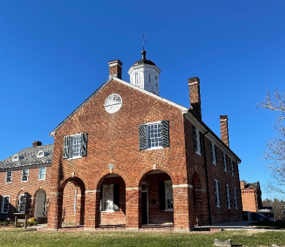
Happy July, and welcome back to Found in the Archives, a publication of The Clerk of the Fairfax Circuit Court, 19th Judicial Circuit, who proudly serves The City of Fairfax & Fairfax County. Thank you for reading our newsletter! If you would like to reach out with questions or for more information, please email us at CCRhistoricrecords@fairfaxcounty.gov
In honor of the Independence Day holiday in July and given the outsized role Fairfax residents like George Washington and George Mason played in the Revolution, we look at some of the documents at the Historic Records Center that predate the American Revolution.
As the archives of the Circuit Court, we retain all original court records from the founding of Fairfax County in 1742. As such, we have over three decades of official records that were generated when Fairfax was part of the Colony of Virginia, before the Revolutionary War and the establishment of the United States as an independent nation. While many 18th Century records are missing, we do still have a collection of records from the early years of Fairfax. These colonial-era records are particularly fascinating because they formally refer to being under the rule of the King. For example, we have a subpoena summoning two men in Fairfax County to come to court to testify on behalf of King George II.
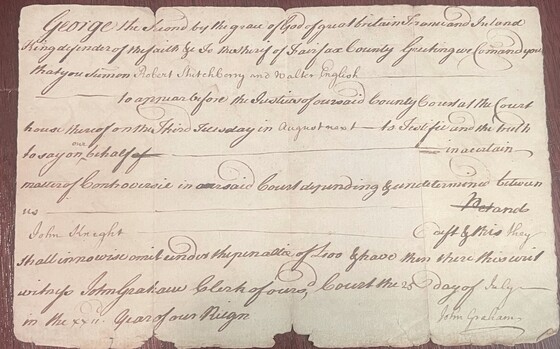 Fairfax County Drawer X, X-I-0888
In the case styled Rex vs John Knight from 1749, a subpoena directs the attendance of Robert Shutchberry and Walter English. "George the Second by the grace of God of great Britain France and ireland King defender of the faith...we command you that you sumon [sic] Robert Shutchberry and Walter English...to testifie [sic] and the truth to say." Note the word Rex is Latin for "King" and, in 1749, the then-ruling King of England was King George II. By the time of the Declaration of Independence just 27 years later, his son, King George III, ruled as the colonists complained of taxation by him, without representation before him.
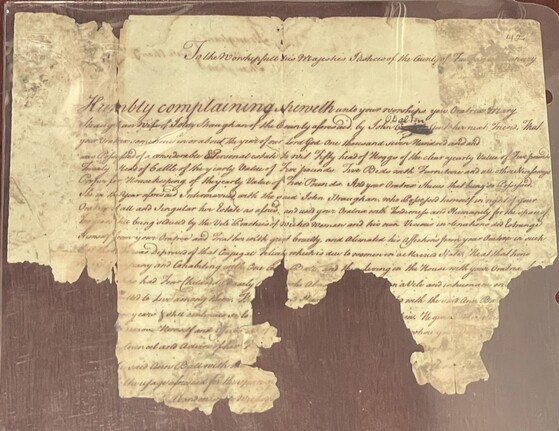 Fairfax County Drawer X, X-I-1031
Another Pre-Revolutionary document in our collections is from 1752, and the subject matter is highly unusual for the time: a domestic case, in which the wife sough relief from the court in her failed marriage. As one of our Chancery Cases, Mary Straughan complained that her husband, John, had begun cohabitating with another woman, estranged himself from her, and had treated her with "great cruelty." In our records, divorces are extremely rare until the early 20th Century. While this record is incomplete and we do not know if a divorce was eventually granted, this is the earliest record in our collection in which a woman made a complaint that she had legal grounds for release from the marriage to her husband based on his adultery.
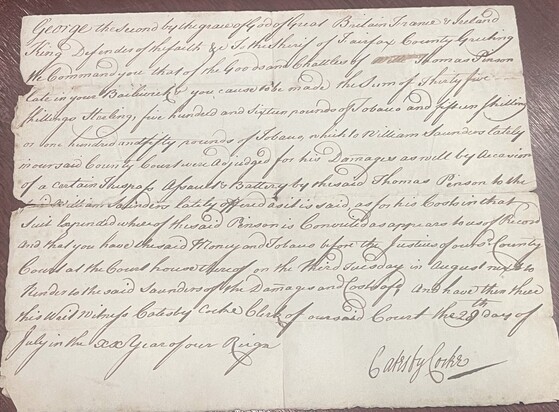 Fairfax County Drawer X, X-I-1031
Another example of a case type in our archives is the 1747 case of William Saunders vs Thomas Pinson, a case for trespassing and assault and battery. Thomas Pinson was ordered to pay "thirty five shillings sterling, five hundred and sixteen pounds of Tobacco and fifteen shillings, or one hundred and fifty pounds of tobacco" in damages to Saunders, for the affront. This award of 'damages' is interesting because the Court ordered payment in both cash and in crops. In the 18th century, there was a heavy non-cash element to the local Fairfax commerce, because the King's coinage, legal tender, was only minted in England, so it was scares in the Colonies. The easiest alternative was to exchange crops by their value, in lieu of coinage.
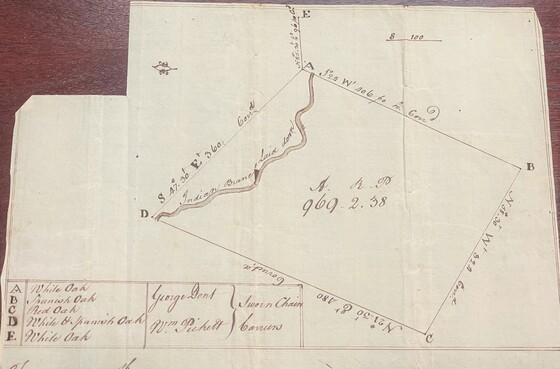 Fairfax County Drawer X, X-I-0406
One of our records from 1753 is especially fascinating because it includes an original, drawn plat for real estate in Fairfax. The case, styled as Benjamin Grayson vs John Pagan, arose over trespassing and illegally cutting down trees. The plat was drawn to outline the property in question, with Indian Branch clearly featured through the plat. The drawing also noted the types of trees that were used to mark the boundaries of the land.
These records are some of the oldest documents in the Fairfax Circuit Court's collection. Many of them have been conserved, and they are stored in a climate-controlled area in acid-free folders and boxes, so that future generations can examine what court cases looked like when Virginia existed as a colony.
|