|
English | Español | አማርኛ | 中文 | 한국어 | Tiếng Việt | العربية | فارسی | اردو
Click or scan QR code to subscribe to The Dunne Dispatch
The Dunne Dispatch (School Calendar Edition) - March 25, 2026
Friends and Neighbors,
I share your disappointment and frustration with the fragmented school calendar. In recent years, early release days have multiplied, and days off have proliferated. Short weeks have become the norm rather than the exception.
Fragmented school calendars are detrimental and disruptive. Frequent early release days and days off reduce instruction time, make it hard for children to establish consistent routines, upend parents' work schedules, and increase childcare costs.
I believe in data-driven decision-making, so I asked my staff to compare the FCPS school calendar against those of other school districts. They discovered that the FCPS school calendar is a clear outlier regionally and nationally. Compared to school districts in the DMV region and the largest school districts across the country, FCPS has:
- the longest school year (303 days);
- the shortest summer (62 days);
- the lowest percentage of five-day weeks (52%);
- the highest number of days off (40); and
- the largest number of cultural and religious holidays (9 days).
These issues are structural and self-inflicted, not the result of special elections and weather events.
Beyond the structural issues, the FCPS school calendar reflects a broken promise. In the United States, public schools generally operate from August to May or from September to June. Historically, FCPS operated from September to June, and families enjoyed nearly 80 days of summer. In 2021, FCPS changed the school calendar to start two weeks before Labor Day. FCPS was expected to shift its end date, but it did not. Instead, families lost two weeks of summer permanently.
I have been working closely with colleagues Melanie Meren (Hunter Mill District) and Ricardy Anderson (Mason District) to develop proposals that restore consistency and sanity to the school calendar. My immediate focus is next year's calendar, which has not yet been approved by the School Board as required by state law.
I want to hear from you, so please reach out and share your views on the school calendar. You can contact my office at MountVernon@fcps.edu.
Very Respectfully,
 Mateo Dunne, Mount Vernon Representative
The FCPS School Calendar: A Historical Perspective
Virginia law requires 180 school days or 990 instructional hours. School districts have broad discretion to determine how to meet these minimum requirements.
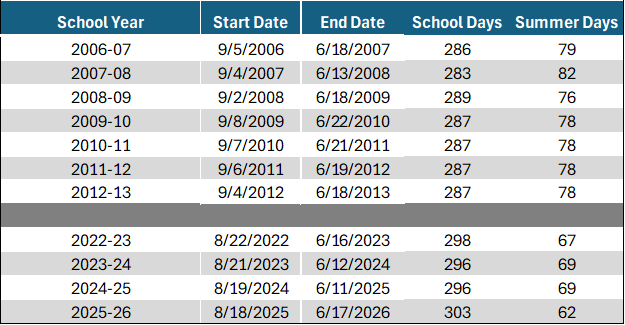
It is important to understand the evolution of the FCPS school calendar over time. Every year, the school year grows longer at the expense of summer vacation. Historically, the school year began after Labor Day, but FCPS has shifted the start date to be earlier every year for the past 6 years. This year is the earliest start date on record–August 18. By contrast, the end date has remained fairly constant, with a median end date of June 18 (± 5 days).
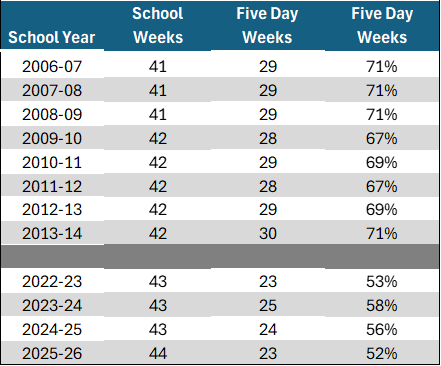
From 2006 to 2013, the school year averaged 286 days, but since 2022, FCPS has averaged 298 days. This year is the longest school year on record–303 days. As the school year has lengthened, the number of summer days has shrunk from an average of 78 days in 2006-2013 to an average of 66 days since 2022. The upcoming summer is the shortest on record–62 days.
The extension of the school year has been accompanied by the fragmentation of school weeks. From 2006 to 2013, nearly 70% of the school year consisted of five-day weeks, but since 2022, the percentage of five-day weeks has declined precipitously to barely half. This year is the lowest percentage of five-day weeks on record—52%. I believe at least 80% of school weeks should consist of five-day weeks in order to ensure a consistent routine and promote academic achievement.
The fragmentation has resulted from the increasing number of early release days and days off, whether they are cultural and religious holidays, professional development days, or teacher workdays. Since 2023, the number of early release days in elementary schools has increased by 300% from 3 days to 12 days. (For comparison, FCPS had approximately 30 early release days every year before Early Release Mondays were abolished in 2014.)
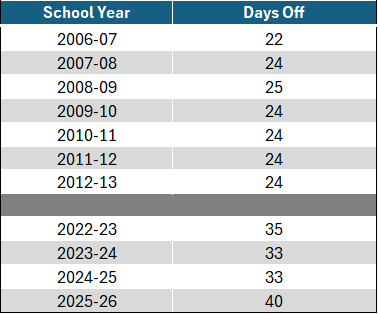
From 2006 to 2013, the school year averaged 23 days off (including Thanksgiving, Winter Break, and Spring Break), but since 2022, FCPS has averaged 35 days off. This year is the most days off of any school year on record–40 days.
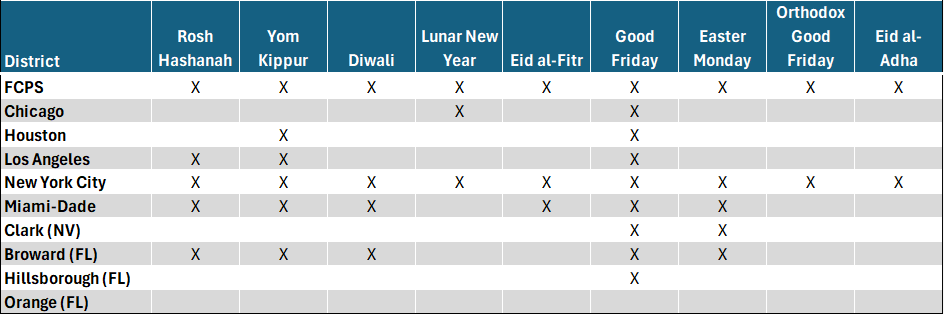
From 2006 to 2013, FCPS observed up to 2 cultural and religious holidays–Good Friday and Easter Monday. Since 2022, FCPS has observed up to 9 cultural and religious holidays: Rosh Hashanah, Yom Kippur, Diwali, Lunar New Year, Eid al-Fitr, Good Friday, Easter Monday, Orthodox Good Friday, and Eid Al-Adha. (Holidays are not observed if they fall on a weekend.)
The FCPS School Calendar: A Comparative Perspective
The FCPS school calendar is a clear outlier, though some neighboring districts (such as Loudoun and Prince William) also have bloated school calendars. Most school districts with similar start dates have end dates in late May or early June. For example, FCPS has the same start date (August 18) as Chicago, Falls Church City, and Richmond, but those school districts end two weeks earlier (June 4, June 5, and May 29, respectively).
Compared to peer school districts, FCPS has the longest school year–303 days. In the DMV region, school years tend to be long, with an average of 295 days. Outside of the DMV region, school years are shorter. The largest school districts across the country average 292 days, and large school districts in the Commonwealth (Richmond, Roanoke, and Virginia Beach) average 289 days.
FCPS has the shortest summer relative to its peers–62 days. In the DMV region, school districts average 69 summer days. Summers are longer outside of the DMV region. The largest school districts average 72 days, and Commonwealth school districts average 75 days.
FCPS has the most fragmented school calendar regionally and nationally–only 52% of school weeks consist of five-day weeks. In the DMV region, the percentage of five-day weeks varies from 56% to 67%, with an average of 59%. The range is the same in the Commonwealth, though the average is greater at 62%. Nationally, the range is greater from 53% to 74%, but the average is on par at 62%.
Compared to its peer school districts, FCPS has the highest number of days off (40 days), to include the largest number of cultural and religious holidays (9 days). (Only New York City observes as many cultural and religious holidays.) In the DMV region, school districts averaged 33 days off with 5 cultural and religious holidays, though DC and Falls Church City observe only one. Commonwealth school districts averaged 30 days off with 4 cultural and religious holidays. Nationally, the largest school districts averaged 32 days off with 3 cultural and religious holidays, though Chicago, Houston, and Las Vegas observe only two, Tampa observes only one, and Orlando does not observe any.
Excessive Early Release Days
Early release days require special attention by the School Board. Since 2023, the number of early release days in elementary schools has skyrocketed 300% from 3 days to 12 days. When early release days were introduced for the 2024-25 school year, FCPS explained that they were intended to facilitate training required by the Virginia Literacy Act. However, FCPS increased the number of early release days for the 2025-26 school year and moved them to Wednesdays, which disrupts learning and routines in the middle of the school week.
The scheduling of early release days often coincides with days off, which causes maximum disruption to students and staff. For example, some schools had an early release on November 12 after a day off. Similarly, there was an early release on February 18, after schools were closed on February 16 for President’s Day and February 17 for Lunar New Year. Elementary school students in the Lewis, Mount Vernon, South County, and West Potomac pyramids have a 3-hour early release on March 25 and a 2-hour early release on March 27, followed by Spring Break on March 30-April 3, a day off (Easter Monday) on April 6, and a day off on April 10 (Orthodox Good Friday). How can FCPS expect to delivery on the promise of a world-class education for every child with such a chaotic and erratic schedule?
Early release days are administratively burdensome to schools. Schools are required to provide supervised activities to students who stay at school on early release days. I conducted an informal survey of school administrators, and the consensus was clear: the added work of providing supervised activities outweighed any potential benefits. One administrator called it a “horrible waste of time.” Schools with large populations of low-income students tend to have at least one-third of students remain on site, which limits the number of teachers and staff who can participate in training activities.
Beyond childcare, early release days are costly for FCPS. Buses must run twice on every early release day - once at the early dismissal and again at the regular dismissal time. Many of these runs carry only a handful of students. This is wasteful.
Next year, FCPS is considering a plan to send all students home on early release days, which is somewhat problematic.
Impact on Students and Families
Every fragmented school week imposes substantial costs on families. Parents and guardians must repeatedly scramble to arrange and pay for alternative childcare, take paid or unpaid leave, or leave children in unsafe or unsupervised situations. Even parents with flexible work arrangements find the relentless churn of short weeks unmanageable. Working families, particularly those with hourly jobs or limited leave, face impossible choices every time there is a day off or an early release during the middle of a week. This is an equity issue, not just a scheduling inconvenience.
The equity implications of the current calendar are profound and demand urgent action. Younger students are especially harmed by the cascade of days off in the fall. Partial weeks undermine the stable, predictable routines that research consistently links to academic achievement and healthy social-emotional development. The opening months of school when children form habits, build relationships, and establish foundational skills are the worst time for repeated interruptions. FCPS is squandering this critical window year after year.
For students from low-income families, the harm is compounded. School is not merely a place of academic instruction, it is also a reliable source of meals, adult supervision, mental health support, and a structured daily routine. Every truncated week removes access to these critical resources.
For students with Individualized Education Programs (IEPs) or other support needs, calendar fragmentation compounds existing challenges. Interrupted service delivery can trigger compensatory obligations and additional costs for the district. More fundamentally, teachers cannot build the instructional momentum needed to serve their highest-need students when the calendar is in constant disarray. A reformed calendar built around consistent five-day weeks and a shorter school year is essential to fulfilling FCPS’s commitment to every student.
My Position and Next Steps
At the April 23 School Board meeting I am working with my colleagues Melanie Meren, Ricardy Anderson, and Ryan McElveen to introduce motions to revise the 2026-27 school calendar by making Indigenous People's Day and Veterans Day school days and limiting the number of early releases at the elementary, middle, and high school level to no more than 4 per year.
This is an important first step, but more work is needed. The School Board must act decisively. I am calling for adoption of a revised school calendar that prioritizes five-day school weeks as the norm, reduces early release days and days off, and ends the school year earlier. Incremental adjustments are not enough. A comprehensive revision is the only solution equal to the scale of this problem.
The views contained within this newsletter reflect the views of the individual school board member who is the publisher of this newsletter and may not reflect the views of the Fairfax County School Board.
© Fairfax County Public Schools, Fairfax County, Virginia
|