 |
|
Audit Buzz Newsletter
November 2025
|
Engagement and Office Updates
In this issue, we provide an update on current engagements, an article on Auditor Independence, a highlight on Office of Auditor General (OAG) recent event; and a training opportunity.
Prior editions of Audit Buzz are archived here on OAG website.
As always, we appreciate the cooperation and courtesies extended to our staff by Fairfax County Public Schools (FCPS) management and staff during all past, current, and future audit engagements.
Here is a challenge to test your audit knowledge, before we begin this issue:
Say What You See
*Hint: This is one of the OAG pillars of work.
Current Engagement Update
At the November 17 Audit Committee meeting, OAG presented the following items:
-
FY26 OAG Internal Audit Status – All approved audits are on schedule. In addition, OAG is in the process of conducting the fiscal year (FY) 2027 risk assessment and audit topics.
-
OAG Internal Inquiry Updates – From July 1 to October 23, 2025, OAG received 28 inquiries. OAG included the “reportable” category to provide more information regarding the inquiries reviewed.
-
FY25 Quarter 3 and Quarter 4 Continuous Monitoring Results and FY25 Local School Activity Funds (LSAF) Audit – OAG presented the results of the continuous monitoring procedures conducted for appropriated and non-appropriated transactions. During FY25, out of 202 sites, 103 sites had no exceptions noted; 55 sites had exceptions noted in three or fewer areas; and 44 sites did not have any transactions appear in the sample of transactions. OAG visited a total of 68 sites in person. Exceptions were related to non-bank reconciliations, purchasing process, bank reconciliations and activity gate receipt procedures.
The FY25 LSAF Audit was conducted at 202 sites with no findings and three observations. The first observation was related to noncompliance with regulations at 73 total sites regarding LSAF accounting procedures, cash disbursements, and cash receipts. The second observation identified risks related to the collection of cash receipts at schools and school-hosted events, which exist due to the manual nature of the current control activities. The third observation identified risks in the Great Plains
accounting system because users can backdate cash receipt entries. These observations did not have material effect on the FY 2025 Statement of Cash Receipts and Disbursements for FCPS as a division.
OAG also conducted a LSAF Audit Results Year-Over-Year Comparison that presents the year over year comparison of LSAF results for FY23, FY24 and FY25.
-
FY26 West Springfield HS Business Process Audit Report – The audit identified one high risk and one low risk finding. These findings related timely entry and the purchasing process.
-
FY26 Healthcare Claims Management Audit – OAG completed this audit, and the results are exempt from disclosure under Virginia Code Sections §2.2-3711(A)(7) and (A)(8).
Knowledge Hive
Auditor Independence
What Is Auditor Independence?
Auditor independence refers to the auditor's ability to conduct work with impartiality, objectivity, and freedom from conflicts of interest or bias. Independence increases public confidence in financial reporting and ensures that audit conclusions are reliable and unbiased.
For auditors—internal or external—independence is essential in providing stakeholders with credible information. Independence requires auditors to avoid financial or personal ties that could compromise or appear to compromise their judgment.
Key Elements of Auditor Independence
Ethical Standards
Auditors must follow established professional ethical standards (e.g., international ethics standards or government auditing standards) to maintain objectivity and integrity.
Independence in Fact
Auditors must be free from financial interests, relationships, or situations that compromise their impartiality.
Independence in Appearance
Auditors must also avoid situations that appear to compromise objectivity, even if no actual conflict exists. Public confidence depends on perceived impartiality.
Audit Firm (or Audit Office) Policies
Policies such as rotation of assignments, restrictions on non-audit roles, and limits on personal or business relationships help safeguard independence.
Regulatory Oversight
For external auditors, regulators (e.g., SEC in the private sector) enforce independence standards; in the public sector, oversight bodies and audit committees fulfill this role.
Professional Judgment
Auditors must continually assess whether their objectivity might be impaired and take corrective actions when necessary.
Threats to Auditor Independence
Threats to independence fall into several categories. These threats apply both to external auditors and to internal auditors working in a public-sector environment such as FCPS. The main threats include:
1. Self-Review Threat
Occurs when auditors are asked to evaluate work that they themselves performed or influenced.
Example: If auditors participated in designing a financial process and later audit that same process.
2. Self-Interest Threat
Arises when auditors have a financial or personal interest that could influence their judgment.
Examples: Gifts, favors, close financial relationships, or career incentives.
3. Familiarity (Advocacy or Multiple-Referral) Threat
Develops when auditors become too close to personnel being audited or rely on them excessively.
Examples: Long-term assignments with the same staff, over-reliance on specific individuals for information.
4. Ex-Staff or Former Partner Threat
Occurs when former employees of the audit office join the audited entity—or vice versa—creating the appearance of bias or undue influence.
5. Advocacy Threat
Happens when auditors appear to advocate for or support management decisions, policies, or outcomes rather than remaining neutral.
6. Intimidation Threat
Arises when auditors feel pressured by management, leadership, or other stakeholders to alter findings, tone down reports, or avoid certain issues.
7. Management Participation Threat
Occurs when auditors take on roles that are the responsibility of management.
Example: Making decisions for the school, approving transactions, or providing direction over financial processes.
OAG Recent Events
Peer Review - Virginia Beach City Public Schools
Esther Ko, auditor general, led a peer review at the Virginia Beach City Public Schools (VBCPS) Audit Department during the week of October 13. Peer review is made up of an independent team of auditors from outside the organization to assess whether the internal audit function is adhering to professional standards and has a system to ensure quality audits.
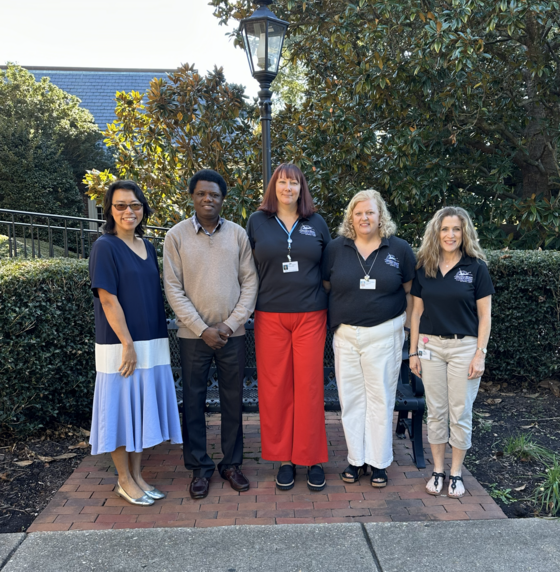 Esther Ko, Yemi Ogunsanya (Auditor from City of Baltimore), and VBCPS Audit Department
Did You Know?
OAG Outreach and Education: Continuing Professional Education (CPE) Opportunity - Guardians of the Public Trust: Integrity in Procurement and Audit Relationships
OAG aims at providing quarterly online training to all staff members, covering topics related to mitigating financial and process risks to FCPS. Scenarios will be provided during the training where staff members can take what they learn back to work. OAG is a certified National Association of State Boards of Accountancy (NASBA) Continuing Professional Education (CPE) provider, on behalf of FCPS. FCPS can award employees with CPE credits required to maintain professional certification status.
Course Details: This is a continuation of our training series, “if you want to go fast, go alone; if you want to go far, go together”. This topic addresses the unique ethical considerations in the procurement process: how do procurement and school system professionals manage relationships with vendors, deal with potential conflicts of interest, and ensure a fair and transparent process when they might know the business owners personally? The auditors serve as the guardians of public funds, including topics like fraud detection, reviewing vendor relationships for potential impropriety, and ensuring that purchasing decisions serve the public interest.
Format and Date/Time: Synchronous online training via Zoom, on January 9, 2026 (Friday), from 9am to 12pm. Three CPE credits will be awarded for the entire training.
FCPS employees may sign-up here January 9, 2026 Training.
Upcoming Events
Next Audit Committee Meeting
The next Audit Committee meeting is scheduled for January 5, 2026 at 4:00 PM. Please refer to BoardDocs for meeting information once it becomes available.
Fraud, Waste & Abuse Hotline:
(571) 423-1333 (anonymous voicemail)
InternalAudit@fcps.edu (email is not anonymous)
Online Submission Form
[Answer: Internal Audit]
|