Dr. Reid's Visit to Cameron
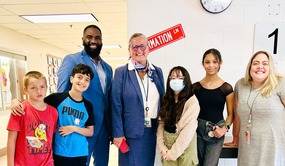
We were thrilled to host Superintendent Dr. Reid last week! She wrote about her visit to Cameron in her weekly reflection to all FCPS staff afterwards.
|
Thursday morning, I received a warm welcome from several student ambassadors, Principal Eric Johnson, and Assistant Principal Amanda Snyder at Cameron Elementary School.
We headed to Cameron alum Colleen Kocalcik's first grade class, where students were hard at work practicing the short “i” sound and reading aloud. These literacy fundamentals are critical for our youngest learners in order for them to be reading on grade level by the end of third grade — a key part of our new strategic plan.

Next was Meredith Cosier's STEAM class, where students created their own playable board games. Students used their Portrait of a Graduate (POG) skills of collaboration and communication to build their board games before they began the coding process. Very cool!
My final stop was Ashley Mitchell's third grade class, where students were in small group math stations. It was wonderful to see this collaborative hands-on approach to learning! Go Cheetahs!
|
Social and Emotional Learning
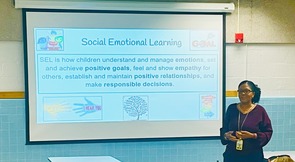
Ms. Heath, our School Counselor supports learning for families during the PTA meeting by explaining Social and Emotional Learning and providing grade level samples of the Second Step curriculum we are using with students.
|
Seeking Coaches and Students (grades 1-5) interested in participating in Odyssey of the Mind
Odyssey of the Mind is a yearlong commitment that includes a creative problem-solving competition for students. Teams of (5-7) students select a problem, create a solution by incorporating art, music, creative writing, acting, and just about whatever else that interests students into their long-term problem solution., then present their solution in a competition against other teams in the same problem and division later in the spring. Teams need to be supported by one or two coaches. Students will be supported by an FCPS sponsor, but we also need parent coaches to volunteer for each team. Teams will meet afterschool on Tuesdays and/or Thursday, and may also meet evenings/weekends as coaches are available. Please contact Tiffany Reed at tlreed@fcps.edu or 703-329-4896 if interested. For more information about Odyssey of the Mind, please visit https://www.odysseyofthemind.com/
 Tuesday was Pajama Day to celebrate our learning of being a Positive Role Model. Each week, we'll be learning about and celebrating one of the values of Cameron P.R.I.D.E.

September 22 - Ice Cream Party
We continue to celebrate our learning of the Cameron P.R.I.D.E values! Next week, we will focus on learning about how to show integrity in common spaces throughout the school. You might help us by asking your child what they have already learned about being a person of integrity in the classroom. To end the week of learning about integrity, we will have an ice cream party on Friday, September 22!
|
 RSVP
Family Liaison Corner
by Susana Trupo
“My dear child, my mornings wouldn’t be the same without seeing your face when I rise.”
Dear Families.
Nothing symbolizes new beginnings and fresh starts than our daily morning wake-up. It’s that glorious time of day when the sun rises over the horizon and energizes every living being within its realm. Powerful, right? While it’s a particular time of day that many people savor, not everyone is a fan of its crack-of-dawn radiance — however, how the early morning goes home can affect your child’s day at school. And because of that, I would like to share this information I found about the subject.
Morning routine for school: the whys and how’s
Staying calm and organized in the morning will help you and your child feel optimistic about the day ahead. It will also help you reduce stress, which improves everyone’s well-being.
One of the best ways to stay calm and organized is to have a morning school routine. A routine will help your child know what’s happening and remember what to do.
Planning a routine for school mornings
The first step in planning your morning routine for school could be to make a weekly schedule with reminders of what your child needs for school each day. For example, your child might need:
· a library bag on Monday
· sports clothes on Wednesday
· show and tell on Friday.
The next step is to list the regular activities and things you must do to prepare for school each day. You can split these activities into things you can do the night before and things that must be done in the morning.
Things you might do the night before including:
· checking what your child needs for the next day
· packing your child’s bag
· signing school notes
· laying out uniforms
· making lunches.
Things that have to be done in the morning include:
· getting out of bed
· having a healthy breakfast
· cleaning teeth, washing, and getting dressed
· leaving the house on time.
To get to work and school on time, you probably need to do your morning activities at certain times. So when you’re planning your routine, it’s a good idea to think about:
· how long morning activities take
· what time morning activities need to happen.
If you know some things might cause conflict in the morning, it can really help to deal with these the night before. For example, you might know that your child wants to wear sneakers to school rather than school shoes. You and your child might be able to come up with a solution together if you talk about the issue the night before.
Example routine for school mornings
Here’s an example of what a school morning routine might look like:
· 7.30 am: your child gets up.
· 7.40 am: your child eats breakfast.
· 8.00 am: your child washes their face, brushes their teeth, gets dressed, and puts on shoes.
· 8.20 am: your child puts lunch in their bag and looks at books while you prepare.
· 8.25 am: you help your child put on sunscreen.
· 8.30 am: you and your child leave for school. Your family will have its way of doing things. When you’ve worked out a morning routine to suit your family, write it up and display it where everyone can see it. You could include pictures to make the routine easier for your child to follow.
Tips to help your school morning routine work well
Once you’ve worked out your routine, these tips can help things go smoothly on school mornings:
Tips to help you organize your time
· Get your child to have a bath or shower the night before, so you don’t need to make time for this in the morning. · Make sure your child gets to bed with plenty of time for a good night’s sleep. This will help your child wake up refreshed.
· Get up 15-30 minutes earlier than you think you need to. This will give you more time in the morning.
· Think about an alarm for children who find it hard to wake up or don’t like getting out of bed.
Tips to encourage cooperation and good behavior
· Tackle the morning as positively as you can. Good moods can be infectious. You and your child could do this by sharing one thing that you’re each looking forward to during the day.
· Give your child calm, clear instructions about what you want them to do, and follow up with specific praise as soon as they start to cooperate. You might need to remind younger children more often about what they’re meant to be doing and when.
· Encourage children to do more for themselves as they get older and more independent. For example, a 5-year-old can do things like putting their lunch box in their bag. An 8-year-old can get dressed on their own, make their own breakfast, and tidy up after themselves.
· Cut down on distractions like television, tablets and other devices unless screen time is a special treat for being ready on time. · Give your child positive attention for good behaviour rather than attention for arguing, whining, or stalling. For example, say, ‘I love how you’re eating up your toast’ rather than ‘Stop playing with your toast’. This will encourage the behavior you want to see on school mornings. · Make it fun – for example, try our ‘Beat the buzzer’ game to encourage your child to be ready on time.
From Woman's Day
Attendance Awareness Month
At Cameron, we celebrate your student attendance every day! September is Attendance Awareness Month. Let's commit to a month of perfect attendance for your student!
|
Attendance and Health for Families
When students miss too many days of school, they fall behind and struggle to keep up with their classmates. Whether the days missed are due to illness, truancy or for any other reason, the result for the student is the same — learning time is lost. Children and adolescents will get sick at times and may need to stay at home, but we want to work with you to help minimize the number of days your student is absent from school.
Missed Days Add Up Quickly!
- Just a few missed days a month adds up to several school weeks missed in a year.
- Both excused and unexcused absences can make it more difficult for your child to keep up with other students, especially in math and reading.
- Kindergarten and first grade are critical for your child. Missing school during these early years makes it more difficult for children to learn in later years and they often have trouble reading by the end of third grade.
Work with Your Child and Your School
- Ensure that your child comes to school every day unless an absence is necessary. This will help your child succeed.
- Make sure that the school staff is aware if your child has a chronic illness so that assistance can be provided if needed. Each school year, include information about your child’s chronic illness on the care card and the school emergency health information form.
- If your child has asthma, FCPS requires an Asthma Action Plan completed by his or her doctor. If your child needs to carry an inhaler at school, permission should be noted on the Asthma Action Plan. Ensure that all supplies (inhaler, spacer, etc.) needed to manage your child’s asthma are at the school.
- If your child has diabetes, FCPS requires a Diabetes Medical Management Plan be completed by his or her doctor. Ensure that all supplies (insulin, blood sugar meter, test strips) needed to manage your child’s diabetes are at the school.
- Keep an open line of communication with your school public health nurse, school staff and teachers. The more the school knows about your child’s health needs, the better prepared everyone will be to work together to support your child.
Helpful Ideas:
- Make medical and dental appointments in the late afternoon so your child can attend as much of the school day as possible.
- If your child must miss school, make sure you get his or her homework assignments and ensure that the work is completed and turned in.
- Call the school as soon as you know your child will be absent and tell school staff why your child will be out and for how long.
- Be prepared to get a doctor’s note when requested by school personnel.
For additional information
🤒 When a Student Should Stay Home From School
Whether students miss school because of illness or any other reason, missing school leads to learning loss.
Help your student succeed by encouraging them to attend as many days as possible, but do make sure your student stays home if they are sick. Visit FCPS’ website for information on when you should keep your child at home.
If your child has a chronic illness, make sure to notify their teacher, so that assistance can be provided if needed. Please contact us as soon as you know your child will be absent.
Read more about how families can help form good attendance habits.
🤧 Tips to Stay Healthy
Flu season is quickly approaching and communicable diseases continue to be present in our schools. Families and staff are encouraged to follow the health practices below to prevent the spread of illnesses and help keep our schools safe:
- Make an appointment to get a flu vaccine as soon as possible. Everyone six months and older should get a flu vaccine (with rare exceptions). Flu vaccines are widely available at doctors’ and pediatricians’ offices, grocery stores, and pharmacies.
- Get vaccinated against COVID-19 if you have not done so already. As of Tuesday, September 12, updated COVID-19 vaccines are approved for use among those aged 6 months or older for the 2023-24 season. Find out where you can get a COVID-19 vaccine or booster in your community by visiting Vaccinate Virginia, or calling 877-VAX-IN-VA or 877-829-4682. Note: Flu vaccines and COVID vaccines can be provided in the same appointment.
- Check with your student’s healthcare provider to make sure they are up to date on their required school entrance immunizations. Immunization records can now be updated in SIS ParentVUE through the Online Verification Update form.
- Check for mild, cold-like symptoms each day, such as fever, runny nose, cough, or shortness of breath. If a child is sick, please keep them home and get them tested for COVID-19 to stop further spread from occurring. Additional guidance on when to keep your child home due to symptoms and illness is available on the FCPS Attendance webpage. FCPS employees are also advised to stay home and get tested when feeling sick.
- Don’t forget to wash hands regularly, avoid touching the face with unwashed hands, cover the mouth when coughing or sneezing, and limit the time children spend in large group settings with contagious individuals whenever possible.
The most up-to-date information regarding COVID-19 school health practices is available on the Health and Safety Guidance webpage.
Thank you for your continued partnership in keeping our schools safe and healthy.
Advanced Academic Programs (AAP) Elementary Continuum of Services
Fairfax County Public Schools (FCPS) is committed to challenging all students through talent development efforts and differentiated instruction to meet the needs of advanced learners.
FCPS offers a continuum of advanced academic services for all students in Grades K-12. The continuum of services approach recognizes unique student needs and focuses on matching services, not labeling students. Through the continuum, students have:
- Multiple entry points for deeper learning opportunities in specific areas of need as they develop.
- A cluster group of students with similar academic needs to continue growing in their learning.
Teachers, Advanced Academic Resource Teachers (AARTs), and school administrators work together to provide the following levels of service at the elementary level:
Access to Rigor, Grades K-6 (Level I)
All students have opportunities to think critically, reason, and problem-solve.
- All teachers use critical and creative thinking strategies in their lessons.
- Classroom teachers provide opportunities using materials from the AAP Curriculum Framework a minimum of once per quarter.
Because Access to Rigor is for all FCPS students, there is not a screening process.
Subject Specific Advanced Differentiation, Grades K-6 (Level II)
Some students are strong in a specific subject area. Classroom teachers may adjust instruction for students in these area(s) by:
- Providing different assignments and resources in those subjects,
- Grouping students by their strengths, interests, and readiness, and
- Providing additional challenges using materials from the AAP Curriculum Framework.
Student needs for subject specific differentiation are re-evaluated each year at the local school.
Part-Time Services, Grades 3-6 (Level III)
Some students have advanced academic needs in multiple subject areas in addition to specific subject differentiation. They need part-time AAP services.
- Students work with other students that have similar academic needs through weekly pull-out classes or weekly co-taught lessons with the AART and classroom teacher.
- Teachers provide frequent opportunities to use materials from the AAP Curriculum Framework in Language Arts, science, social studies, and/or mathematics.
Part-time services continue through Grade 6. Students do not need to be evaluated each year.
Full-Time Services, Grades 3-8 (Level IV)
Some advanced learners need a full-time advanced academic program with differentiated instruction in all four core content areas (Language Arts, mathematics, social studies, and science).
Students eligible for full-time AAP services are cluster grouped on a full-time basis and receive:
- Full-time use of materials from the AAP Curriculum Framework in Language Arts, mathematics, science, and social studies, and
- Curriculum that is differentiated through acceleration, depth, and complexity of content.
Full-time services continue through Grade 8. Students do not need to be evaluated each year.
Screening for Advanced Academic Program Services
Multiple data points are reviewed holistically to determine eligibility for all FCPS advanced academic services. Committees consider student work from opportunities with AAP lessons, examples of student reasoning or gifted behaviors from class discussions and activities, progress reports, achievement and ability scores, and parent input. Committees consider whether students have access to a group of students with similar academic needs to support academic conversations and growth in the classroom. No pieces of the data are weighted in the holistic screening process.
Eligibility decisions for subject-specific advanced differentiation and part-time services are made by a committee at the local school, and screening is ongoing throughout the school year. To refer for subject-specific advanced differentiation and part-time services, submit the AAP School-Based Referral Form to the AART at the local school.
Eligibility decisions for full-time services are made by the countywide central selection committee.
Screening for full-time services occurs during specific screening cycles:
- Fall screening is available for students who are new to FCPS since January.
- The fall screening referral window is from the first day of school - October 15.
- Spring screening is available for any Grade 2-7 FCPS-enrolled student.
- The spring screening referral window is from the first day of school - December 15.
Please do not wait for test scores before submitting a referral for your student in Grades 2-7. Referrals submitted after the full-time services referral windows noted above will not be accepted.
Referral forms for all advanced academic program services are found at https://www.fcps.edu/node/38893.
For more information, please visit the AAP website at: https://www.fcps.edu/registration/advanced-academics-identification-and-placement/current-fcps-students.
Ability Testing
FCPS uses ability testing as one consideration of the holistic screening process for advanced academic services. Test scores are not weighted or prioritized in the holistic screening process.
- All students in Grade 1 take the Naglieri Nonverbal Ability Test (NNAT).
- All students in Grade 2 take the Cognitive Abilities Test (CogAT).
- NNAT and/or CogAT may be administered to students in Grades 3-6 who do not have an ability test score during the regularly scheduled testing windows.
Parents or guardians may request a one-time retest of either the CogAT or the NNAT in grades 3-6. Requests must be made during the fall testing windows. Please contact the school testing coordinator Amanda Snyder (ajsnyder@fcps.edu), no later than September 22 to request the CogAT or October 15 for the NNAT.
Elementary Parent Information Meeting
A parent information meeting will be held at Cameron Elementary School on Wednesday, September 27, 2023 at 3:00 PM. The AART will provide information about levels of service, explain the screening processes, and answer questions about advanced academic services. A second meeting will be held virtually on Wednesday, October 18, 2023 at 6:00 PM to provide information about the AAP screening process. If interested in attending please email Tiffany Reed, for a Zoom link to this meeting.
Young Scholars
The FCPS Young Scholars model seeks to identify and affirm, from an early age, students with high academic potential from groups historically underrepresented in advanced academic programming. The goal of the model is to eliminate barriers for Young Scholars’ access to and success in advanced academic opportunities in elementary, middle, and high school.
Twice-Exceptional (2e)
Some gifted students with advanced learning needs may also have a learning disability. Twice-exceptional (or “2e”) students need strengths-based instruction while receiving advanced programming. The FCPS continuum of AAP services provides multiple entry points to meet student needs while also supporting their learning challenges. FCPS has created a 2e handbook to help schools and families understand how to identify and serve 2e students. You can find these resources by going to www.fcps.edu and searching “2e.”
Information Session for Substitute Teachers and Instructional Assistants
Learn more about becoming a substitute teacher or instructional assistant at a virtual information session on Wednesday, September 20, from 2 to 3 p.m. Register for this session.
Visit the Recruitment Events calendar for a list of all FCPS job fairs.

🏗️ School Bonds Benefit Students
A bond referendum to benefit Fairfax County Public Schools will be on the ballot this election season. The building and renovation of schools are not financed through the school system’s operating funds, but through bonds.
Similar to an individual or a family obtaining a mortgage on a residence to spread the cost of home buying over several years, bonds spread the cost of major capital improvements over a number of years. This ensures that current and future residents and users share in the payment. The county’s bonded debt is not likely to be a contributing factor to any increase in local taxes.
Hear from teachers how FCPS prioritizes safety with bond funding.
Read more about the FCPS 2023 Bond Referendum. Learn about registering to vote. Vote on Tuesday, November 7.
|

✨ 2023-30 Strategic Plan — Goal 4: Equitable Access and Opportunity
The 2023-30 strategic plan sets five main goals to create positive change in FCPS. These five goals show where we should focus our attention and will help us align our efforts. Our equity commitment and a set of measures in each goal will monitor our progress toward these goals.
Under Goal 4, high-quality academics will be available to all students. They will have access to excellent resources that support their success. Visit the Strategic Plan webpage to learn more about how we will measure the success of Goal 4.
|

Preparing for a Parent-Teacher Conference
- Share with your child's teacher your hopes and dreams for your child.
- Talk to your child to find out what he or she thinks are his or her best and least favorite subjects.
- Ask your child if there is anything that he or she would like you to discuss with the teacher(s)
- Write down questions to ask at the conference. For example: How long should my child be spending on homework? Does my child participate in classroom discussions and activities? What is my child like during the day? How can I support learning at home?
- Ask questions relating to grades, behavior, curricula, assignments, homework and assessments.
- Request an interpreter, if needed, by contacting the school in advance.
|
Substance Abuse Prevention Specialist (SAPS) Introduction
Each school pyramid has a Substance Abuse Prevention Specialist (SAPS) to provide substance abuse prevention, education, and intervention services. Substance Abuse Prevention Specialists are part of the FCPS Office of Student Safety and Wellness. Like other members of the mental health team (school social workers, school psychologists, and school counselors), SAPS do not provide treatment services, but we support students while they are in the buildings.
Key roles of a Substance Abuse Prevention Specialist:
● Alcohol, Tobacco, and Other Drug education for students, parents, staff, and Fairfax County community stakeholders.
● Intervention services upon violation of the Student Rights and Responsibilities handbook or referral for suspected substance use involvement.
● Assessment of a student’s level of substance use and, if appropriate, subsequent referrals to the Fairfax-Falls Church Community Services Board for additional services or other community resources as appropriate.
● Individual and group interventions for students. Prevention services for students, staff, parents, and Fairfax County community stakeholders.
● Most importantly, building and maintaining positive relationships with students to provide support and encouragement.
Resources: Free Virtual Parent Support Group Free Online Narcan Training for Opioid Overdoses (English & Spanish) Free Lock Boxes for Medications & Firearms Spiritual Support by Phone for Adults Spanish Podcast: Tips on How Parents Play an Important Role in Substance Abuse Prevention Juvenile Court Parent Support Group
For general questions about the FCPS Substance Abuse Prevention Program, please contact the Office of Student Safety & Wellness at: (571) 423-4270.
For further Information & support:
Shawn Elliott, BS, QMHP-C
sbelliott@fcps.edu
Substance Abuse Prevention Specialist
National Hispanic Heritage Month
From September 15 to October 15, FCPS recognizes and celebrates the histories and cultures of the members of our community who trace their heritage to Mexico, the Caribbean, and Central and South America. Learn more about the heritage months, celebrations, and traditions celebrated in FCPS. Learn more about National Hispanic Heritage Month.
Fairfax FiestaFairfax County's inaugural Hispanic Heritage Celebration, the Fairfax Fiesta, is taking place on Saturday, Sept. 23, from noon to 5 p.m., at the PARC at Tysons (8508 Leesburg Pike). The free event, presented by the Fairfax County Government and Celebrate Fairfax!, aims to provide an extraordinary experience for all ages and backgrounds. Learn more about Fairfax Fiesta.
|

September 15 - Rosh Hashanah
Friday, September 15, is a half-O day in recognition of Rosh Hashanah, which begins at sundown. Half-O days are full school days, but important events will not be held after school on those days. See the complete school year calendar.
|
September 17 - Constitution Day
Constitution Day, also known as Citizenship Day, is a holiday that recognizes the adoption of the U.S. Constitution and honors all of those who are citizens, as well as those who have become citizens of the United States. It is observed on September 17, the day on which the constitution was adopted in 1787.

September 22-October 1 - Blue Star Welcome Week
Every year, approximately 600,000 military-connected families relocate. Most of these families move to new duty stations, while some transition out of the military and others transition in. Most of these moves take place over the summer, and Fairfax County Public Schools is committed to ensuring our military families feel welcomed and a sense of belonging to their local community.
Blue Star Welcome Week is an opportunity for our community to welcome our military-connected families and show them our appreciation for their service and sacrifices. Throughout the week, FCPS will help ease their transition through events, messages, actions of welcome, and opportunities to make meaningful connections. Please help us welcome our military families during Blue Star Welcome Week, September 23 - October 1, 2023, and throughout the year! #BlueStarWelcomeWeekFCPS
Cameron Elementary will be welcoming our military-connected families in a variety of ways throughout that week…stay tuned! If you have any questions, please reach out to Lisa Heath, Cameron’s Liaison to Military-Connected Families (and a military family member) at lpheath@fcps.edu or 703 329-2112.
|
Important Dates
Sept 15 - Half O-Day, Rosh Hashanah
Sept 22 - Ice Cream Party for Integrity!
Sept 22-Oct 1 - Blue Star Welcome Week
Sept 25 - No School, Yom Kippur
Sept 27 - Advanced Academics Informational Meeting, 3pm, Library
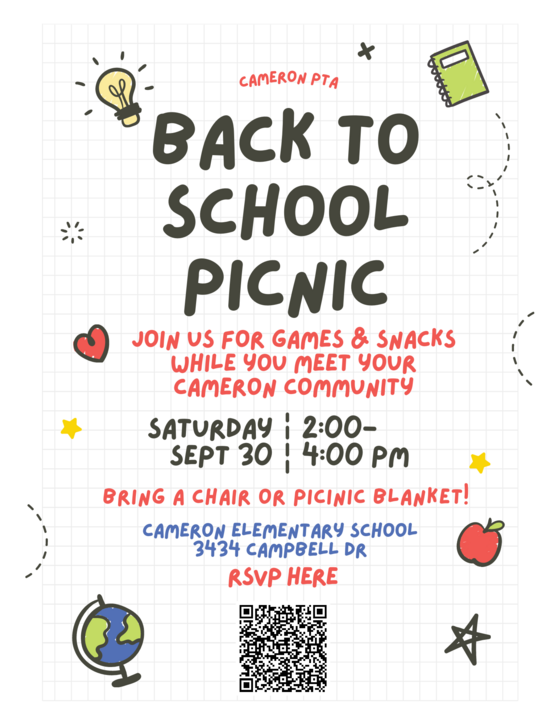
Sept 30 - PTA Back to School Picnic, 2pm, Cameron
Oct 3 - PTA General Meeting, 7pm, Cafeteria
Oct 6 - Chuck E Cheese Night, 6pm
Oct 18 - Advanced Academic Screening Process Meeting, 6pm, Zoom
|

|