Reminder: After School Activities
All winter after school activities are off and running! Below are just a couple of reminders to help us keep the check in and check out process running smoothly.
Check in process: Please remind your student that they must check-in with the parent volunteer waiting under the tv in the main lobby. Additionally, all participants (with the exception of kindergarteners) should wait to come to the lobby until the After School Activities students are officially dismissed by the school’s patrol team..
Check out process: Classes end at 5:15 p.m. and parents must pick up their students in person. Please ensure you check your students our with the vendor representative.
The pick up location varies and can be found below:
Monday: OTA sports (K-3), Gym, door 7
Tuesday: OTA sports (4-6), Gym, door 7
Acting for Young People, Main entrance
Wednesday: Mad Science, Main entrance
Thursday: Magnus Chess, Main entrance
Friday: Glowlight dance party, Gym, door 7
If you have any questions, please reach out to info@huntvalleypta.org.
The HVES Book Swap is coming!
Each student is invited to bring in school-aged books in good condition to donate Feb. 3-7. Students will be able to take a book or two home the following week. Bins will be placed outside the school doors for all donations.
More information will be available later this week. Check out the Hunt Valley PTA website for updates!
Hunt Valley Health Corner: Managing the 3Ss
A New Year is full of new possibilities and opportunities to focus on your and your family's mental and physical health. This month, focus on Managing the 3Ss–stress, sleep, and self-care!
Stress
Stress is a normal part of life, and while it can't be avoided altogether (and you wouldn't necessarily want it to be), you can find ways to make sure it doesn't get out of control.
Stress can be categorized into:
-
Physical (stress on your body when sick or after an intense workout) versus mental (worry or anxiety over something going on in your life)
-
Real (body's reaction when you feel threatened) versus perceived (feelings or thoughts you have about how much stress you are under)
-
Acute (short-term, situational) versus chronic (long-term, ongoing)
And while acute stress can be helpful (think of that nervous feeling you get before speaking in front of a group or your class), it’s important that you don’t find yourself in a state of chronic stress which can really impact your overall health. There are many physical, mental, and emotional symptoms of stress, including but not limited to:
- Loss of appetite, overeating/binge-eating, or stress eating
- Fatigue
- Feeling overwhelmed or guilty
- Headaches or upset stomach
- Constant worrying
- Increase in drug, alcohol, or tobacco use
Managing stress is a really important component to maintaining good health. There are many strategies you can use to help manage stress including:
- Diaphragmatic or belly breathing
- Meditation or a spiritual practice
- Expressing gratitude
- Journaling
- Gentle movements like yoga
Sometimes your stress is too much for you to handle on your own. In these situations, don't be afraid to ask for help. Talk to your spouse, a friend, or family member about how you are feeling and if that’s not enough seek out a professional counselor so that you can get the tools you need to stress less. The biggest thing is to not stress about managing your stress. Start small by implementing one technique and grow from there.
Sleep
Never underestimate the value of a good night’s sleep. Sleep is essential to allow your mind and body time to rest and recharge so that you can feel refreshed and alert for the next day. Sleep plays such an important role in your overall mental and physical health, from regulating your hunger and satiety hormones, to clearing out toxins in the brain. Getting the proper amount of sleep helps keep the body healthy and fight off diseases. Without sufficient sleep, the brain does not function properly and your ability to focus and think clearly is compromised.
The National Sleep Foundation guidelines recommend that healthy adults get between 7 and 9 hours of sleep per night, while the American Academy of Sleep Medicine recommends children ages 6-12 years get 9-12 hours of sleep per night. Try making small shifts to prioritize sleep. You’ll be amazed at the amount of energy and clarity you’ll have after getting a few nights of some good Zzzzzs.
Prioritizing sleep is very beneficial to your health. Here are some strategies you can begin implementing to improve your sleep:
- Establish a consistent and realistic bedtime and wake time every day, even on weekends. If you are nowhere near the recommended hours of sleep per night currently, begin by adjusting your sleep and/or wake time in 15-minute increments until you reach the sufficient amount of sleep.
- Exercise in the morning or as early in the day as possible. Regular physical activity can promote more restful sleep.
- Get some fresh air and sunshine in the afternoon either via a walk outside or another leisure activity.
- Create a wind-down routine to include relaxing activities such as drinking some chamomile tea, taking a warm bath, practicing some deep breathing or calming meditation, or reading for leisure. Apps like Calm and Headspace have guided sleep meditations that can help you unwind.
- Avoid naps during the day as much as possible to reduce interference with nighttime sleep. If you need to nap, try limiting your nap to 30 minutes.
- Set a comfortable sleeping environment in a cool (optimal temperature around 65 degrees), quiet, and dark room.
- Ensure you have the best mattress, pillows, and sheets that fit your preferences and support your body.
- Turn off screens at least 45-60 minutes before bed and consider removing all electronics from your bedroom including TV, computers/laptops, tablets, cell phones, and any other electronic device that you may use while lying in bed.
- Avoid eating or drinking, especially anything heavy, caffeinated, or containing alcohol a few hours before bed.
- If needed, consider holistic sleep supplements, such as melatonin, lemon balm, magnesium, or L theanine (after consulting with your doctor of course).
Self-care
What is self-care? While it means different things to different people, self-care is essentially anything that you do just for you that brings you joy and relaxation. Self-care is a very trendy word right now, and there’s no one “right” way to practice self-care.
Have you ever heard the saying: You can’t pour from an empty cup? It’s the idea that if you are constantly “pouring out” and taking care of others, and never “pouring in” and investing in yourself, that eventually you’ll have nothing left. To be the best version of yourself and continue to pour into others around you, you need time to rest and recharge.
Striking the balance between selfish and selfless can be tricky, especially if you are a parent or an educator where you are constantly providing care to others and likely putting their needs in front of your own. When it comes down to it, self-care doesn't have to be a big elaborate or time-consuming activity. It's practicing small activities on a regular basis that allow you to prioritize yourself. If you are not sure where to start, sit down and brainstorm a Self-Care Activity List. Some items you can consider putting on your self-care list include:
- Spending some time reading for pleasure
- Getting a massage, facial, or pedicure
- Drinking a cup of your favorite tea
- Going to your favorite yoga or exercise class
- Preparing a nourishing snack
- Taking a warm bath
These are just a few examples; the possibilities are endless, and the key is to identify activities that you truly enjoy and that will help you feel recharged.
Upcoming events
Feb. 3 | Teacher treats collection
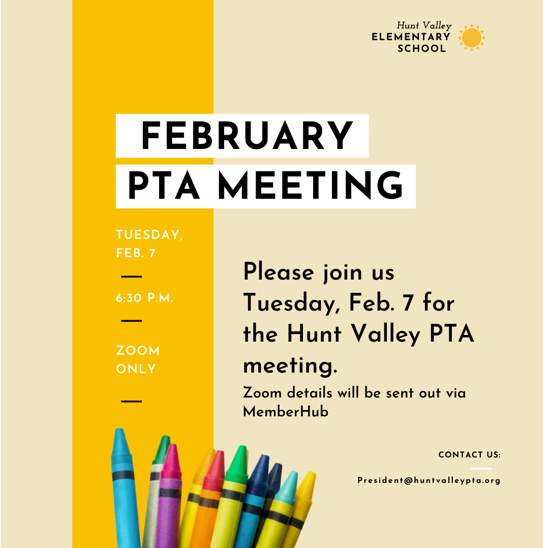
Feb. 7 | PTA meeting, 6:30 p.m. via Zoom
Feb. 20 | Holiday [Presidents Day]
Feb. 22 | Bus Driver Appreciation Day
Feb. 22 | Ledo Pizza Spirit Night
Join the Hunt Valley PTA today!
For only $10, you can support activities like the Fall Festival, Family Movie Nights, Field Trips, Teacher Reimbursements, Book Fairs, and Appreciation Days.
Become a member of Hunt Valley’s PTA today! Being a PTA member gives you a voice into how we support the Hunt Valley community and it does NOT require you to volunteer, although we’d love to have your help because, we can’t do this without you!.
For questions, contact Sierra Jones, president@huntvalleypta.org.
Connect with us!

|