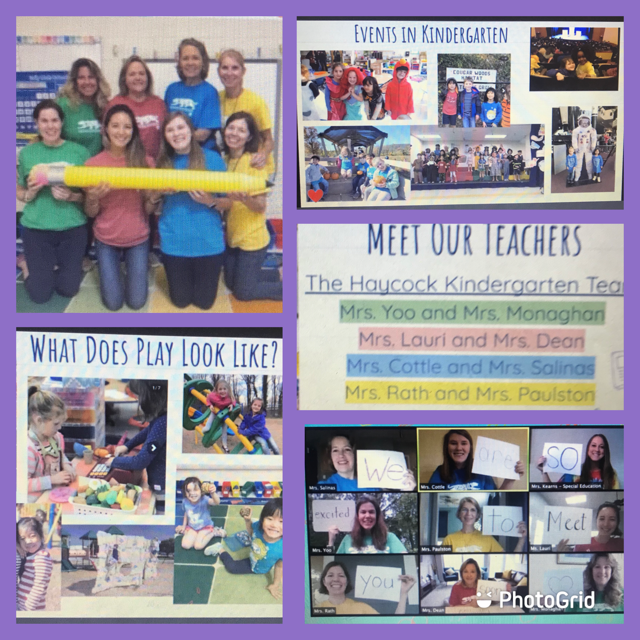
2020-21 Kindergarten Registration
Welcome to Haycock Elementary School!
We're excited to welcome our newest Cougars for the 2020-21 school year!
To join us, first determine if your student lives in the Haycock ES boundary by viewing the FCPS boundary locator.
If your student does live in the Haycock ES boundary, please fill out the new student registration form below. This form will be submitted to Christine LaVallee, our school registrar, who will be able to assist you with the new student registration process.
Kindergarten Forms
First through Sixth Grade Forms
Specialist/Resource Teacher Activities
Week 6: May 18 - May 22
Art
* Lessons are on blackboard or you can go to this google document.
- Grades K & 1: RAINBOW FUN
- Grades 2 - 4: ARCHITECTURE and 3D Box Fun
- Grades 5 & 6: BIRDS EYE VIEW
- You may use this google form, or email us (smbaumgartne@fcps.edu, gmproctor@fcps.edu) to submit the artwork or ask questions.
- Stay creative and have fun!
Advanced Academics Resource Teachers
Band
- New videos and Exit Ticket are posted in Google Classroom.
- Performance contest in Flipgrid this week! Your chance to win!
ESOL
- Select two or more activities from Mrs. Kelly's Activities
- Email abkelly1@fcps.edu to schedule office hours or with any questions.
Library
- Please email Mrs. Farrell with any questions or comments. Parents may email a request to have me call them and she is happy to call any day, even weekends.
- Please visit Mrs. Farrell's Library Corner in the Literacy Folder on the Specialists’ BlackBoard site for a list of robust resources and fun activities.
- To gain access to these activity eBook links below, please use the following Username: fairfax Password: Fcps20!
Music
- Listed below are various activity options for K-2, 3rd & 4th, and 5th & 6th. Please remember that you must be logged into your child’s fcpsschools.net email to access the links. If you have any questions, don’t hesitate to email Mrs. Albornoz (gfalbornoz@fcps.edu) or Ms. Clark (bclark@fcps.edu). Please also encourage your child(ren) to share their experiences and creations in the Haycock Music Flipgrid!
Physical Education
- Please access the YouTube Videos. It is in our PE Google Site. Please remember that you must be logged into your child’s fcpsschools.net email to access the links.
- Find some exercise videos that interest you and your family, and when you have time during the week, be active with some of the videos.
- Take a picture of you doing an activity and post it on Twitter (with parent permission) and tag @HaycockES_PE
- Haycock PE has a PE Flipgrid. Please log on and post a response in our Favorite Activity FlipGrid
- Write us a letter and we will write you one back. E-mail Mrs. Hecht: nphecht@fcps.edu and Mrs. Callsen: drcallsen@fcps.edu for our home address :-)
Spanish
- Please use the following link for this week’s Spanish activities. The google doc contains an activity for each grade level.
- Please remember that you must be logged into your child’s fcpsschools.net email to access the links.
Strings
- Etudes
- What’s your favorite concerto?
Our Mental Health Team has these options
Short videos for thinking about kindness to self and others
Since the COVID-19 pandemic began, demand for food has increased dramatically. Help fight hunger and feed hope by participating in Stuff the Bus. Fastran buses will be parked at locations throughout Fairfax County and the City of Fairfax to collect food donations on Saturday, May 16, and Tuesday, May 19. Visit Fairfax County's website for locations, times, and tips on how to donate safely.
5th/6th Essay Finalists
The topic of the contest this year was, “What the Library Means to Me”, which was the focus of an essay contest won by New York Times best-selling author Amy Tan when she was young. Amy Tan was awarded a transistor radio for winning her essay contest in Sonoma County, California! The winning Haycock students will be sent gift cards from a local independent book store, Bard’s Alley.
Many congratulations to Haycock’s essay contest winners:
Sixth Grade:
1st – Michelle Liu
2nd – Akshara Kambam
Fifth Grade:
1st– Sydney Walker
2nd – Audrey Li
3rd – Chris Thames
Exercise boosts motor skill learning via changes in brain’s transmitters
Summary: Neurons in the caudal pedunculopontine nucleus, an area of the brain that regulates motor coordination, switch neurotransmitters from acetylcholine to GABA as a result of exercise. The switch appears to provide feedback control that regulates motor coordination and skill learning.
Source: UCSD
Doctors have relentlessly impressed upon us the many benefits of exercise. Energy, mood, sleep and motor skills all improve with a regular fitness regimen that includes activities such as running. This has become of particular interest in the time of the COVID-19 pandemic.
But what happens in the brain during these improved states of health? The underlying neurological changes that open the door to these benefits have been unclear.
Now, Assistant Project Scientist Hui-quan Li and Distinguished Professor Nick Spitzer of the University of California San Diego have identified key neurological modifications following sustained exercise. Comparing the brains of mice that exercised with those that did not, Li and Spitzer found that specific neurons switched their chemical signals, called neurotransmitters, following exercise, leading to improved learning for motor-skill acquisition.
“This study provides new insight into how we get good at things that require motor skills and provides information about how these skills are actually learned,” said Spitzer, the Atkinson Family Chair in the Biological Sciences Section of Neurobiology and a director of the Kavli Institute for Brain and Mind.
The study’s results are published May 4 in Nature Communications.
Spitzer’s laboratory discovered neurotransmitter switching in the adult mammalian brain and has led groundbreaking research on the ability of neurons to change their transmitter identity in response to sustained stimuli, typically leading to changes in behavior. After carrying out research that described neurotransmitter switching in depression, Spitzer and his colleagues began to turn their attention to how such switching might be involved in healthy conditions.
Li says the results underscore the importance of exercise, even at home during the current pandemic quarantine situation.
“This study shows that it’s good for the brain to add more plasticity,” said Li. “For people who would like to enhance their motor skill learning, it may be useful to do some exercise to promote this form of plasticity to benefit the brain. For example, if you hope to learn and enjoy challenging sports such as surfing or rock climbing when we’re no longer sheltering at home, it can be good to routinely run on a treadmill or maintain a yoga practice at home now.”
During the new study, Li and Spitzer compared mice that completed a week’s worth of exercise on running wheels with mice that had no access to running wheels. They found that the exercised group acquired several demanding motor skills such as staying on a rotating rod or crossing a balance beam more rapidly than the non-exercised group.
When the brains of the running mice were examined, a group of neurons in the brain region known as the caudal pedunculopontine nucleus (cPPN) that regulates motor coordination was discovered to have switched neurotransmitters from acetylcholine to GABA.
To confirm their findings, the researchers used molecular tools to block the newly identified transmitter switch resulting from exercise. They found that the enhancement of motor skill learning in these mice was prevented. Based on their findings, the researchers propose a new model in which conversion of cPPN excitatory cholinergic neurons to inhibitory GABAergic neurons provides feedback control regulating motor coordination and skill learning.
The researchers say the discovery could lead to further findings where neurotransmitter switching leads to key motor skill changes. The researchers say they’d like to test ideas such as whether neurotransmitters could be deliberately switched to benefit motor skills, even without exercise. They also plan to conduct research on whether exercise similarly triggers benefits of motor skill learning in those with neurological disorders.
“We suggest that neurotransmitter switching provides the basis by which sustained running benefits motor skill learning, presenting a target for clinical treatment of movement disorders,” the authors conclude in the paper.
Says Spitzer: “With an understanding of this mechanism comes the opportunity to manipulate and to harness it for further beneficial purposes. In the injured or diseased individual, it could be a way of turning things around… to give the nervous system a further boost.”
|