
Dear Parents and Guardians,
Hurray for a full week! We had a more normal week except Valentine’s Day added a bit of excitement from the students. We like to thank all the volunteers that assisted the teachers in some of the classroom activities and all the parents that honored the staff with emails, flowers, and notes. They greatly appreciate the recognition.
We hope everybody is able to join us for BINGO this evening. We are anticipating a large crowd and it will be a wonderful community event for the students and parents.
As parents we all want the best for our children. Opportunities for education or growth should not depend on the gender of a child. Stereotypes in our society are still prevalent in our everyday lives. How do we raise children who recognize gender equality? Below is an article that provides guidance in changing some of our behaviors that see each child for who they are, not what they are.
How to Teach Gender Equality
Ask a group of New Jersey fifth- and sixth-graders about the differences between girls and boys, and at first it gets a tad uncomfortable.
"That would be kind of awkward," said Tyler Schlegel, who is in his last year at Lincoln Elementary School in Caldwell, New Jersey.
Once I clarified that I wasn't interested in the physical contrasts but wanted to know whether he and his classmates thought there were other differences between boys and girls, he relaxed quite a bit.
"Oh, that makes more sense," he said.
I asked gender questions such as: Who is smarter? Who raise their hands more? Who is better at sports: girls or boys?
Read More
"Boys get in trouble more, but it depends who it is," Tyler said.
"Girls, I know, like to wear makeup, a lot of them, and boys don't," said Toniann Garruto, a fifth-grader.
"In the classroom, there is definitely more gossip with the girls," said Casey Wescott, who just started middle school.
"Boys are usually stronger or faster; that's what my brother likes to say," added Fiona Laddey, another fifth-grader.
As they answered, you could hear stereotypes already forming, even in elementary school, which was not a surprise to Katie Hurley, a child and adolescent psychotherapist, writer, speaker and author.
Children are internalizing the messages they hear from their parents and teachers and what they see on television and in video games, movies and music, she said.
"The best thing parents can do is really poke holes in all those things," said Hurley, whose books include "The Happy Kid Handbook: How to Raise Joyful Children in a Stressful World." "Instead of hiding all the magazines with the ads that make you shake your head and think 'that's not what women look like,' open those magazines, point out those ads and say, 'can you believe this? Tell me what you think is wrong with this picture. What do women really look like?' "
Stereotypes set in at an early age
According to a recent report by Common Sense Media, "Watching Gender: How Stereotypes in Movies and on TV Impact Kids' Development," gender stereotypes play a big role in teaching boys and girls what the culture expects of them.
Children between the ages of 2 and 6 learn stereotypes about toys, skills and activities that are typically associated with each gender, according to the analysis of more than 150 articles, interviews, books and other research. Kids between the ages of 7 and 10 start to attribute certain qualities to women and men, such as that men are aggressive, and women are emotional.
"Sadly, the stereotypes that we see in media are very problematic and as big business continues to market specifically for girls and boys, gender-based norms are only becoming more ingrained," Jayneen Sanders, an author, publisher and advocate for gender equality education at home and in schools, said in an email. "Our girls see little choice other than pink and 'cute' in (the) girl's section and our boys see no other choice than blue or grey and 'rough and tumble' in the boy's section," said Sanders, author of several books for children including "No Difference Between Us."
This gender stereotyping continues to be reinforced "every hour of every day" online, on television and in games, songs and books. "And because the adults in these children's lives see and perpetuate the same messages, gender stereotyping continues to be reinforced in our homes and classrooms," Sanders said.
Hurley, the psychotherapist, said she regularly tears out ads from magazines and uses them as a discussion point in her groups focusing on girls and their empowerment. Her daughter once came to her laughing after she saw a woman in skinny jeans and stilettos mopping the floor.
"We always say this for girls, it's becoming somewhat commonplace with girls: 'Let's break apart the media. Let's poke the holes. Let's say princesses aren't real,' " Hurley said. "But we have to do it with boys too, because you see these male advertisements for power protein things and these impossibly muscled enormous men with no shirts on, and we have to see that for boys, too. We have to give them the same opportunity to say, 'hey, this is not what every man in the world looks like.' "
'Boys will be boys' and 'girls will be girls'
Parents can help teach their kids about gender equality by never using gender as an excuse for behavior, experts say.
"Do boys roughhouse? Sure, but so do girls," Hurley said. "I have a son and a daughter, and my daughter is way more a roughhouser than my son."
And just as we associate rough play and being aggressive with boys, we are quick to give girls the "mean girl" label, she said.
"I hear this all the time from girls: 'Well, my mom told me she's a mean girl' or 'she's one of the mean girls,' and we have to stop saying that," said Hurley, whose newest book, due out in the winter, "No More Mean Girls: The Secret to Raising Strong, Confident and Compassionate Girls," is all about the need to move away from the mean girl narrative to raise empathetic and compassionate young people.
"One of the biggest things we do is, we put kids in a box, girls in one box and boys in another ... and then the two boxes we create are negatively charged," she said. "We're kind of like challenging them to live up to it."
Then, when we get to the college level and we hear about sexual assaults on campus, we ask ourselves, "Why is this happening?" Hurley said. She argues that it's because children have been raised with a message that "boys will be boys." "They've been learning that since they were 5," she added.
Sanders said parents and teachers should make sure they are not reinforcing traditional gender roles. Girls can take out the garbage, and boys can do dishes, she said. Let both boys and girls know it's OK to express and discuss their feelings and emotions and to cry when they are sad.
Take advantage of teaching moments, such as when a child says a girl can't play with the boys because it's a "boy's game," Sanders said. "Never stereotype children's traits such as boys are loud and noisy, girls are calm and sweet, and call out relatives who do so. Monitor your own interactions with boys and girls and comfort a boy as you would a girl if they are sad or unhappy," she said.
Point to role models
Another way to really smash gender stereotypes, both Hurley and Sanders say, is to discuss traditional male and female employment roles and show kids the opposite, such as a woman who's a firefighter or a man who's a nurse.
Hurley said parents can talk with their kids about everyday heroes, such as the teacher down the street, male or female, and talk about what he or she is doing to raise and educate children, or the firefighters, police officers, nurses and doctors in their neighborhood. "How can we use those people as role models because then we can start describing boys and girls differently," Hurley said.
"If I were to describe you to my daughter as I'm getting off this phone from the interview, I would say, “Wow. You wouldn't believe how intelligent and empowering this woman is, what she is doing to help educate people." she said. "That's what you do. You have to shift your language, really, and think about it because girls still hear that girls are pretty, and girls are polite and girls are kind. And boys still hear that they are strong, and they are rambunctious and they like aliens. So, we have to be careful of that, but then we also have to break it down."
At what age can you start trying to teach your children about gender equality? Sanders says the education can begin as soon as they are born. "Once you see gender stereotyping in society, you can't unsee it," she said. From day one, parents should provide daughters and sons with toys and books where girls and boys are heroes and have adventures and select clothing for girls and boys that doesn't sync up with what society dictates.
Hurley agreed and said the "younger the better" as far as beginning conversations about gender. Often, when she leads her girl empowerment groups, some parents will say they don't want her to use certain words or cover certain subjects, fearing their daughters aren't ready for that discussion. "I always listen to their concerns, and then I say, 'listen, the more information we give kids and the more we bring it down to their level, the more empowered they are to make changes," Hurley said.
When you tell a group of 10-year-old girls that boys get dramatically more attention from teachers than girls, "they're horrified, but then they say, “Oh, yes, because I raise my hand and I don't get called on, or if I accidentally forget to raise my hand, I get in trouble. But if a boy next to me does that, he just gets a reminder," Hurley said. "So kids are feeling this from very young ages on up. They're already feeling it, so we might as well talk about it. I always say to parents: Just honest communication is the single best parenting tool out there in the universe."
Our kids do seem to get it -- at least when it comes to the messages they will give their own children -- as evidenced by the New Jersey elementary and middle school kids we interviewed for a video series, "If I Were a Parent." When I asked them whether they would tell their sons and daughters that girls and boys are different, they unanimously said they would tell their kids that girls and boys are equal.
Toniann Garruto said she would tell her children they can do anything they want to do. "Just because they're boys and girls doesn't mean they can't do the same things and they can't like the same things."
Lance Jenkins, a sixth-grader, said he would tell his sons and daughters to never doubt themselves. "Just because a man did this doesn't mean you can't do it too ... or a girl did this doesn't mean you can't do it," he said.
Sean Wescott, another sixth-grader, said he would tell his kids that "some girls are better at some things, and some boys are better than girls at other things."
Grace Szostak, who also just started middle school, said she would tell her kids that boys and girls are more alike than different.
"And so girls can be like a scientist or a brilliant writer," she said, agreeing that they can be anything they want to be. "They can even play football."
Added Sanders, "Children are not born thinking one gender is better and more powerful than another. They are born thinking there is no difference between us."
Have a great President’s Day weekend.
Augie, Heather, and Scott
Congratulations to the Haycock MATHCOUNTS Team!
On Saturday, February 2nd, Haycock participated in the Northern Virginia Regional MATHCOUNTS Competition held at George Mason University. The Haycock team ranked #1 among elementary schools, and #5 among all elementary and middle schools in the Northern VA Chapter. The team members included Patrick Shi, Hudson Keeler, Deven Hagen, and Victoria Zhang. Individual students who scored in the top 25% were Deven Hagen #30 (a Countdown Round Finalist), Andrew Mu #32, and Henrik Mills #37 for the entire chapter. The Head Coach is Tracy Yuan and the Assistant Coach is Mona Sehgal.
School Health Services Survey
The Fairfax County Health Department (FCHD) employs school health aides and public health nurses who provide school health services to the students in Fairfax County Public Schools (FCPS). To determine the quality of these services, a survey has been developed by the FCHD to be shared with all parents or guardians and school staff members who interact with the school health rooms. This may include principals, school counselors, and main office staff members. The survey has been approved for distribution by the FCPS’ Internal Survey Advisory Committee.
Electronic versions of the survey forms may be accessed at:
School Health Services Survey – Parents 2019: https://www.surveymonkey.com/r/85QGH7C
School Health Services Survey-Parents 2019 (Spanish): https://www.surveymonkey.com/r/LLSF55F
School Health Services Survey – STAFF 2019: https://www.surveymonkey.com/r/L87BPDZ
The survey will take less than five minutes to complete and will provide the FCHD with valuable information. Your participation in this important endeavor is appreciated.
Action required: To distribute the School Health Survey via electronic communication to school staff and community.
Deadline: 02/25/2019-03/11/2019
Contact
Lorraine Trouton ltrouton@fcps.edu
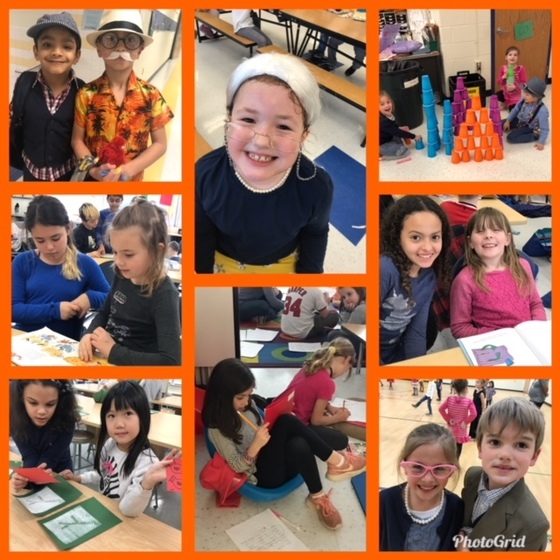
 100th Day of School
|