|
Chesterbrook Events: https://chesterbrookes.fcps.edu/events
Green Slip Information: https://chesterbrookes.fcps.edu/
Dear Parents and Guardians,
I hope you all enjoyed the winter holiday and were able to
spend some quality time with family and friends. Thank you to all of the music ensembles and
their teachers for providing us with beautiful music to celebrate the holiday
season.
January is a busy month for our students and staff. The students are currently taking the second
rendition of the i-Ready assessment and the teachers are strategically making
up the instructional time lost by the several snow days at the beginning of the
month. We are happy that the unusual
cold snap has eased allowing student to enjoy time outside for recess.
Parents with sixth graders will begin to see information and
transitional activities from the middle school.
It is important to turn in the necessary paperwork - such as the course
selection sheets, in order for your child to be enrolled in the appropriate
programs. Please let us know if you have
any questions as you move through the process.
The following article provides how students best learn and
process skills learned in the classroom.
Key Insights on Studying, Remembering, and Learning
In an appendix to his 2013 book, How We Learn, Benedict Carey answers
eleven essential questions that sum up the main insights he presents in the
book:
• How
important is routine, like having a dedicated study area? Not at all, says
Carey. “The more environments in which you rehearse, the sharper and more
lasting the memory of that material becomes… That is, knowledge becomes
increasingly independent of
surroundings the more changes you make.” Most people learn better by studying
in different locations, using different methods, at different times of the day,
constantly changing the way they store material in memory.
• Is
there an optimal amount of time to study or practice? “More important than
how long you study is how you distribute the study time you have,” says Carey.
Ideally, break up study time into chunks over two or three days, each time
reengaging with the material, retrieving it, and re-storing it in memory – “an
active mental step that reliably improves memory.”
• How
much does it help to review notes from a class or lesson? Very little, he
says. Looking over highlighted material is one of the least effective ways to
study; the same goes for verbatim copying. That’s because both are fairly
passive and don’t engage the brain in the kind of work that will make learning
sink in. What’s more, passive review can cause what cognitive scientists call
the “fluency illusion” – unwarranted confidence that you’ll remember it for
good.
• Is
cramming a bad idea? Now always. It’s okay if you’re behind and have no
choice. But the downside is that you won’t remember much after the test or
performance. That’s because the brain sharpens memories only after a little
forgetting has taken place.
• So
what does work? “Self-testing is one of the strongest study techniques
there is,” says Carey. “Old-fashioned flashcards work fine; so does a friend,
work colleague, or classmate putting you through the paces.” So does reciting a
passage from memory, or explaining a concept to yourself or a friend. Testing
yourself (or being tested) does two things: it forces you to retrieve
information from memory, and it gives you immediate feedback if you couldn’t
remember it so you know what you don’t know and need to work on some more.
• What’s
the most common reason for bombing a test after what felt like careful
preparation? It’s the fluency illusion – the erroneous belief “that you
‘knew’ something well just because it seemed so self-evident at the time you
studied it,” says Carey. Several passive, ineffective study methods feed this
illusion:
- Highlighting or rewriting notes;
- Working from a teacher’s outline;
-
Re-studying after you’ve just studied. Far better to test
yourself, space out the study, and find out what you actually don’t know.• Is it best to practice one skill at a time until it becomes automatic,
or to work on many things all at once? Working on just one thing (free
throws, a musical scale, the quadratic equation) improves skill. “But over
time, such focused practice actually limits our development of each skill,”
says Carey. “Mixing or ‘interleaving’ multiple skills in a practice session, by
contrast, sharpens our grasp of all of them.” Mixed practice helps review
material from several areas, sharpens differentiating among them, and trains
the brain to match the problem types with appropriate strategies. This is
especially helpful in a subject like mathematics.
• How
does sleep affect learning? The deep sleep that occurs in the first half of
the night is most important for consolidating and retaining hard facts – names,
dates, formulas, concepts. So if you need to remember that kind of information,
Carey recommends going to bed at your regular time to maximize deep sleep. But
the kind of sleep we have in the early morning hours helps consolidate motor
skills and creative thinking. If you need to perform creatively, whether it’s
in math, science, writing, or music, you might stay up later and sleep in to
maximize the effects of the second kind of sleep.
• How
about improving performance on longer-term creative projects? The proven
method for a big, complicated project like a term paper is getting started as
early as possible, chunking the work, and spreading it out over time. Doing
this “activates the project in your mind,” says Carey, “and you’ll begin to see
and hear all sorts of things in your daily life that are relevant. You’ll also be
more tuned into what you think about
those random, incoming clues.”
• Are
distractions from smartphones and social media a bad thing? Not unless
you’re trying to give continuous focus to a lecture or some other sequential,
connected learning experience. When you’re struggling to solve a problem, “a
short study break – five, ten, twenty minutes to check in on Facebook, respond
to a few e-mails, check sports scores – is the most effective technique
learning scientists know of…” says Carey. “Distracting yourself from the task
at hand allows you to let go of mistaken assumptions, reexamine the clues in a
new way, and come back fresh.” Your brain will keep working on the problem
offline, without your fixated, unproductive focus, and you’ll often have fresh
insights when you return to it.
How
We Learn by Benedict Carey (Random House, 2013, p. 223-228)
Thank you for your continued support of
Chesterbrook and our teachers.
Augie and Connie

January Classes at the Parent
Resource Center!
Identifying and Treating Anxiety in Children and Teens
At this
workshop, Dr. Krystal M. Lewis, from the National Institute of Mental Health,
Development and Affective Neuroscience Section, will present the science and
biological roots of anxiety in children and teens. Join us to learn
- How to identify anxious youth
- How to change anxious thinking through Cognitive Behavioral Therapy
- Strategies for treating specific anxiety disorders
REGISTRATION IS CLOSED. Disappointed? Check the Workshop Warehouse site for info on requesting copies of handouts from this and other PRC workshops! https://www.fcps.edu/node/28555
Friday, January 19, 2018
10 a.m. - 12 p.m.
Dunn Loring Center for Parent Services
2334 Gallows Road
Entrance 1 - Room 100
Dunn Loring, VA
You're Not the Boss of Me!
10 Secrets to Motivate Strong-Willed Toddlers, Tweens and Teens
Restore calm in your life and your home when you implement the concrete strategies presented at this workshop by Celebrate Calm Founder Kirk Martin and his son Casey. Perfect for parents of children ages 2-22! Register now at https://www.fcps.edu/node/28279
Wednesday,
January 24, 2018
7 - 8:30 p.m.
Dunn Loring Center for Parent Services
2334 Gallows Road
Entrance 1 - Room 100
Dunn Loring, VA
Screamfree Parenting -
Peace begins with Pause
Do your
children "push your buttons?" Do you "cave in" under
pressure? Do you tend to "lose it" when you are stressed or tired?
Screamfree Parenting gives you the tools to stay cool during life's challenging
moments. Join us for this first workshop in our series of 4 interactive
workshops to learn strategies to become the cool, calm, connected parent your
child really needs. Register now at https://www.fcps.edu/node/28279
Friday, February 23, 2018
10:00 a.m. - 12:30 p.m.
Dunn Loring Center for Parent Services
2334 Gallows Road
Entrance 1 - Room 100
Dunn Loring, VA
- When FCPS schools are closed, all Parent Resource Center workshops are canceled.
- When FCPS schools have a delayed opening, Parent Resource Center morning workshops are canceled.
- When FCPS schools have an early release, Parent Resource Center evening workshops are canceled.
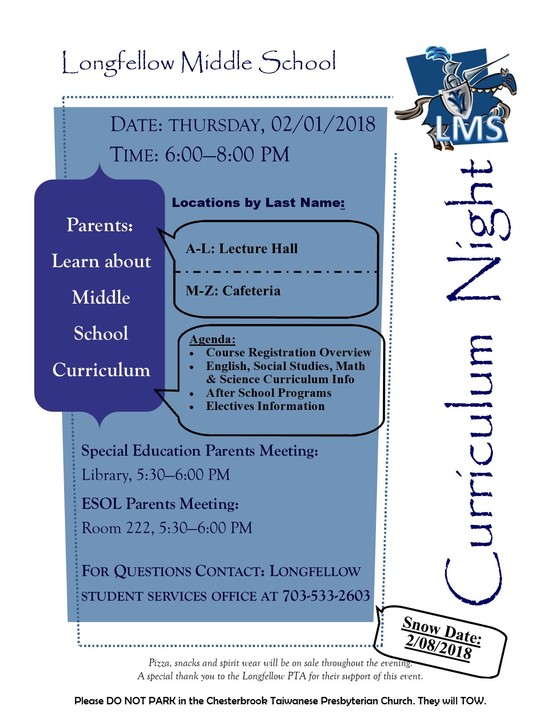
For Parents of Current 6th graders
(see flyer below)
Important Dates for Longfellow Middle School Registration:
CURRICULUM NIGHT Thursday, Feb. 1, 2018 6:00-8:00 PM (snow date Feb. 8)
Special Education parents meeting 5:30-6:00; ESOL parents meeting 5:30-6:00
LONGFELLOW VISIT Between early and mid-February, a Longfellow counselor will show 6th graders how to access the online Course Catalog for 2018-2019, and how to register for classes, including electives. Information will be sent home to parents.
Chesterbrook and Longfellow school counselors are available to help students and parents navigate the registration process!


1st grade:
We talked about twelve month in Chinese. We sang a 12 month song called “How
many month in a year” (一年有几个月yī
nián yǒu jǐ gè yuè) You
can find this song on the blackboard. We also practiced how to write the
twelve month in Chinese too. Check out the blackboard to review what we
learned.
2nd grade: The students learned to say four
seasons and talk about their favorite season using Chinese. Students also
learned to use热 rè (hot); 冷
lěng (cold); 暖和nuǎn
huo (warm); 凉快 liáng kuài
(cool) to describe different seasons.
3rd
grade: The students
learned to say human body parts in Chinese (including 头 tóu, head; 眼睛 yǎn jīng, eye; 鼻子 bí zi, nose; 嘴 zuǐ, mouth; 耳朵ěr duo, ear; 肩膀 jiān bǎng, shoulder; 手臂 shǒu bì, arm; 腿 tuǐ, leg; 脚 jiǎo, foot). We used a fun Chinese song to help remember these new words.
4th grade: We did a speaking assessment for
the four seasons. Students will be able to tell me which season they like and
do not like and why. We are also preparing for the writing assessment too. Check out the blackboard to review
what we learned.
5th grade: We continued to learn the buildings unit.
We learned the word 也
(ye) which mean “also” for connecting the adjectives: very tall很高hěn
gāo , very short很矮hěn ǎi, very wide很宽hěn
kuān and very narrow很窄hěn
zhǎi.
6th grade:
We did a speaking assessment for the solar system unit. Students had to talk
about their favorite planet with five reasons. Please use the blackboard to
learn how to say and write.
Chinese New Year events: Check out the website below
for more information about Washington, DC, Maryland & Northern Virginia
Chinese New Year events with a Chinese New Year Parade, Chinese Dragon Dances,
live musical performances, and more. https://www.tripsavvy.com/chinese-new-year-dc-1040052
How
to practice Chinese on Blackboard
(Log in to Blackboard 24/7 035-schoolinfo-1718-YR:
CES School Information -> LTC Chinese)
Blackboard
is a great learning tool for children to review what they learn in class. On
blackboard, each grade levels have their own folders. Children can click on the
folder to find the topic that they are learning right now. Besides, there are many learning resources
links, songs, videos and games. Please check out the LTC-Chinese on blackboard!
If you have any questions or concerns,
please feel free to contact us!
谢(xiè) 谢(xiè)!
Thank you for supporting the Chinese
program!
Pik
Kei (Peggy) Leung (1st, 4th, 5th
& 6th grades)
Yina
Chang (2nd
& 3rd grades)
|

Special End-Of Quarter Edition
In this edition, look for what your child did in class this month, and the expectations of what your child should be able to accomplish this quarter!
Sixth Grade
The Sixth grade is finishing up their projects. They composed a song for the words of a poem that they could play on the recorder. There were a lot of great compositions! We will do another composition project by the end of the quarter.
By the end of this quarter your child should:
- Play the recorder with proper technique and note reading skills.
- Compose 4 beat rhythms.
- Compose using pitches on the treble staff.
6th Grade All County Chorus
We had a fantastic first rehearsal here at Chesterbrook! We will continue to rehearse on our Tuesday-Wednesday plan. If we ever have a two hour delay, we will STILL hold rehearsals. If you ever have immediate questions about rehearsals or if anything comes up you can use the Remind app. We are working towards our first site rehearsal at Chesterbrook in February.
Fifth Grade
The Fifth grade is starting to learn about musicals. We learned about the variety in the genre and what makes musicals different from other stage productions. We will be choosing a song from a musical to perform for our Spring concert, date TBA.
By the end of this quarter your child should:
- Be able to play the recorder with appropriate technique and note reading skills.
- Be able to tell the difference between a musical, a play and an opera.
- Be able to describe music using appropriate musical vocabulary.
Fourth Grade
The Fourth grade is wrapping up their holiday unit. It may seem late, but we learned that the colonial Virginians did not celebrate the holidays in December, but on January 6 with singing, instruments and dancing. Because of the snow we postponing our celebration until late January. We learned a piece on the recorder to “Wassail” our office staff and will be able to dance like it’s 1775 with the Virginia Reel.
By the end of this quarter your child should:
- Play a recorder song in ensemble
- Know the steps to the Virginia Reel and be able to move on the beat.
Third Grade
We handed out the recorders and everyone is SO excited to play. We just learned our first few notes and will work on more by the time the quarter is over.
Please remember that when your child is playing the recorder, they may have practicing homework. The goal of the practicing is not to give them busy work. All they are asked to do is to look at the music a few minutes a week so that they remember what they are doing in class. Class morale is high when we can go through music at a steady pace. If you ever wonder if your child has an assignment, please check Blackboard (we keep music and practice records there too!) or you please ask us via email.
By the end of this quarter your child should:
- Be able to read the notes B-A-G on the staff with their rhythms
- Be able to finger the notes on the recorder according to the music.
- Attempt to “tongue” the notes on the recorder.
Second Grade
In Second grade we are learning about the instruments of the orchestra and how an orchestra works just like a neighborhood! We have been able to learn about the different families of instruments and how these instruments are able to make sounds.
By the end of this quarter your child should:
- Know the families of instruments and distinguish each by sight, sound and how they are played.
First Grade
In First Grade, we have been learning about the staff. We learned about the Treble clef (G clef) and its job to help us figure out the names of the lines and spaces. Ask your child how they can use their hand to help them figure out the names of the lines and spaces. You’ll be impressed!
By the end of this quarter your child should:
- Know the function of the Treble (G) clef.
- Be able to distinguish the G line and name the lines and spaces of the treble staff.
Kindergarten
In Kindergarten we are learning how to write music! We have learned about whole notes and how to write them (since writing notes is different from writing letters!). We will also start learning how to make our singing voices even better by learning “singer’s secrets”
- By the end of this quarter your child should:
- Sing using a singing voice
- Be able to tell the difference between notes on lines and notes on spaces and be able to draw them. Recognize the following notes by their length and be able to clap them: Whole, half quarter eighth (and many of their accompanying rests).
-
Be able to follow a repeating movement pattern.
5th and 6th Grade Choir
In Choir, we have been learning songs for the Pyramid concert on January 18.
Special points of interest:
- If your class is playing recorder, please check Blackboard for practicing assignments!
- The Pyramid concert is January 18th for chorus students!
Have a question?
mlzenk1@fcps.edu
skater@fcps.edu
|