|
Welcome to the Department of Rail and Public Transportation’s Data Stories, and thank you for signing up! This monthly series aims to find the narrative in data DRPT collects and uses, highlighting Virginia’s rail and transit community. This month, Data Stories is taking a closer look at one of our grant programs, the Rail Industrial Access program.
Building Virginia's Economy by Rail
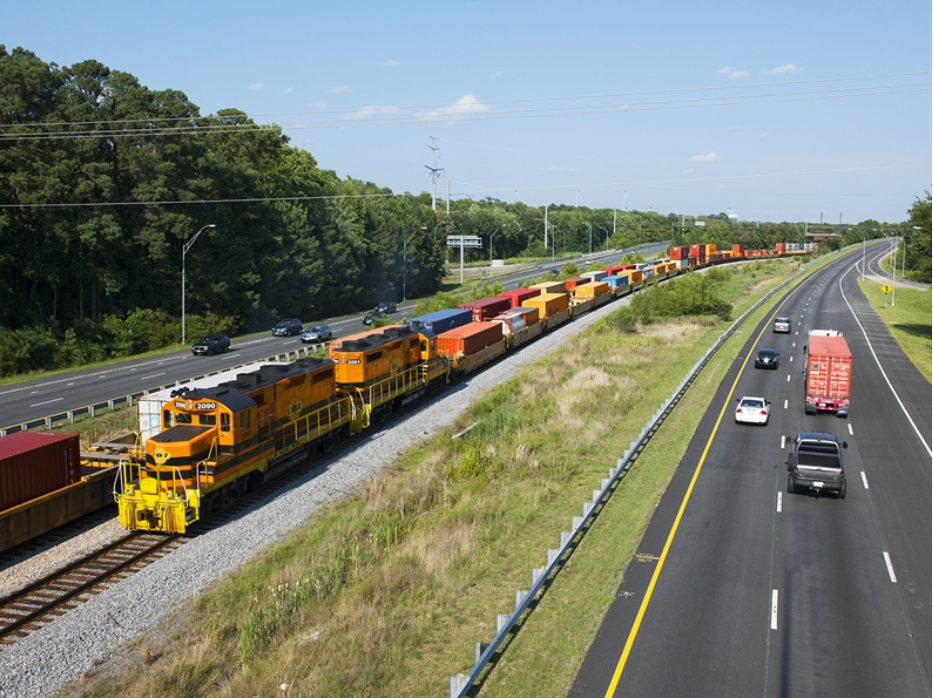 he Rail Industrial Access (RIA) grant program that partially funds the construction, engineering, rehabilitation, or preparation of a rail spur that connects a new or expanding business to Virginia’s rail network. RIA brings numerous benefits to Virginia, including by attracting new or expanding businesses, diverting trucks from our highways and to the rail network, and supporting job creation and capital investment. This Data Story reviews and highlights the impact of the Rail Industrial Access program.
Virginia Rail, at a Glance
Before getting into the impact of the RIA program, let’s review the state of rail in Virginia as a refresher. Virginia’s rail network has freight and passenger rail providers, covering some 3,000 routes miles all across the Commonwealth. Freight railroads consist of both Class-I and shortline railroads. Amtrak provides passenger rail service throughout Virginia while Virginia Railway Express provides weekday commuter rail in Northern Virginia. Passenger and freight trains operate on shared use rail corridors.
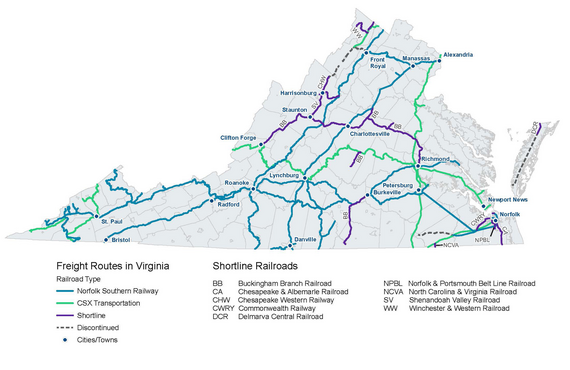
The US Surface Transportation Board defines railroad classes based on company revenue. In short, Class-I railroads are the large national carriers that operate in multiple states and provide long-distance freight movement. In contrast, shortlines are smaller railroad operators, often serving smaller local or regional markets. Shortline railroads frequently provide first- or last-mile connections between businesses and major railroad carriers; or they provide specialized services such as switching services. In total, Virginia has two Class-I railroads (CSX and Norfolk Southern) and nine shortline railroads.
The maps below show the freight rail providers in Virginia and where they operate
 If you want to read more about rail in Virginia, including a review of passenger rail, the July 2025 Data Stories provided an in-depth look at Virginia and its rail infrastructure.
Impact of the Rail Industrial Access Program
The Rail Industrial Access (RIA) Program, as mentioned in the intro, is one of the grant programs DRPT manages. RIA is unique in that, unlike most other DRPT grants, it is not funded through the Six-Year Improvement Program (which was reviewed in an earlier Data Story). Instead, RIA grants are reviewed, approved, and funded throughout the year, as applications are received.
Virginia’s economic development agency, the Virginia Economic Development Partnership, lists RIA as one of the incentive programs to attract new or substantially expanding companies to Virginia. RIA and its sister-grant program, the Economic Development Access program (managed by VDOT), support businesses that bring new jobs and capital investment to Virginia. In addition, RIA has the added benefit of incentivizing businesses to move goods by rail instead of by truck. By using rail, RIA helps mitigate truck traffic around businesses and on our roads and highways.
So, what is Virginia’s return on investment for the Rail Industrial Access program?
DRPT’s Open Data Portal reports the program’s performance and impact. Grant recipients report the number of jobs, total capital investment, and estimated number of rail carloads that the grant will help bring to Virginia. During the performance period, DRPT works to ensure that the jobs created and capital investment made are significant enough to be worth State public investment.
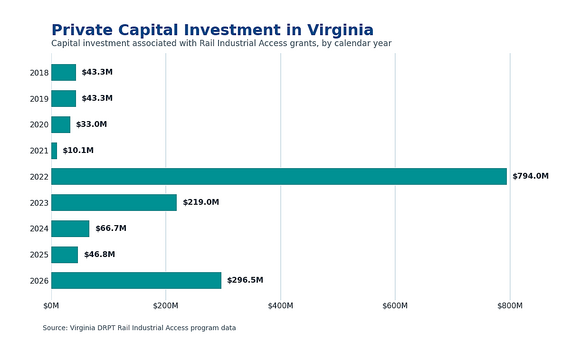
DRPT has awarded 30 RIA grants since 2018, for a total of $13.4 million in public funds. In return, the companies in receipt of an RIA grant have invested $1.55 billion in private capital in Virginia.
The chart below shows the capital investment made by RIA grant recipients in Virgina, per calendar year, since 2018:
Cumulatively, the businesses that move to or expand operations in Virginia with an RIA grant have added over 3,700 new jobs.
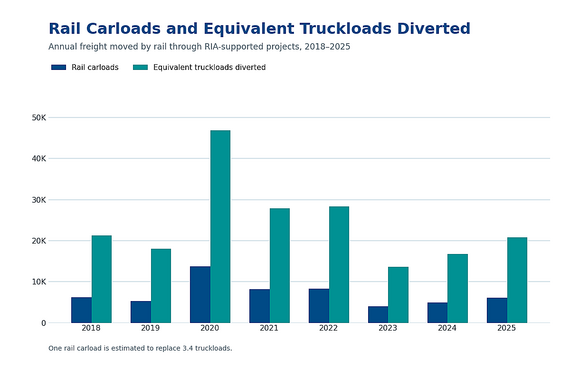
As noted above, RIA grants help remove trucks from Virginia’s roads and highways, mitigating congestion and emissions. Grant recipients report the number of rail carloads that are generated by the grants annually. DRPT calculates the equivalent number of truckloads it would have taken to move the same amount of goods. On average, one rail carload removes the equivalent of 3.4 truckloads from Virginia’s roads and highways.
The chart below shows the number of rail carloads generated by RIA grants and the equivalent number of truckloads by calendar year since 2018:
|