|
|
Welcome to the Department of Rail and Public Transportation’s Data Stories, and thank you for signing up! This monthly series aims to find the narrative in data DRPT collects and uses, highlighting Virginia’s rail and transit community. This month, Data Stories dives back into ridership data and reviews the successes of 2024!
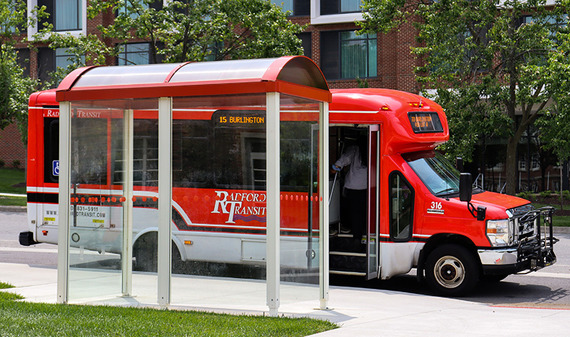
Virginia’s 40 public transit agencies transported a combined total of nearly 137.5 million trips over calendar year 2024! That is an increase of 21.6 million from statewide ridership in 2023 - an 18.6% increase. 2024 was the highest ridership year statewide since 2019.
Note: September 2024’s edition of Data Stories reported on Fiscal Year 2024 ridership (so July 2023 to June 2024). This edition of Data Stories looks at the entire calendar year. Expect a report on ridership for Fiscal Year 25 (July 1, 2024 to June 30th, 2025) this September!
|
|
Statewide Calendar Year Ridership
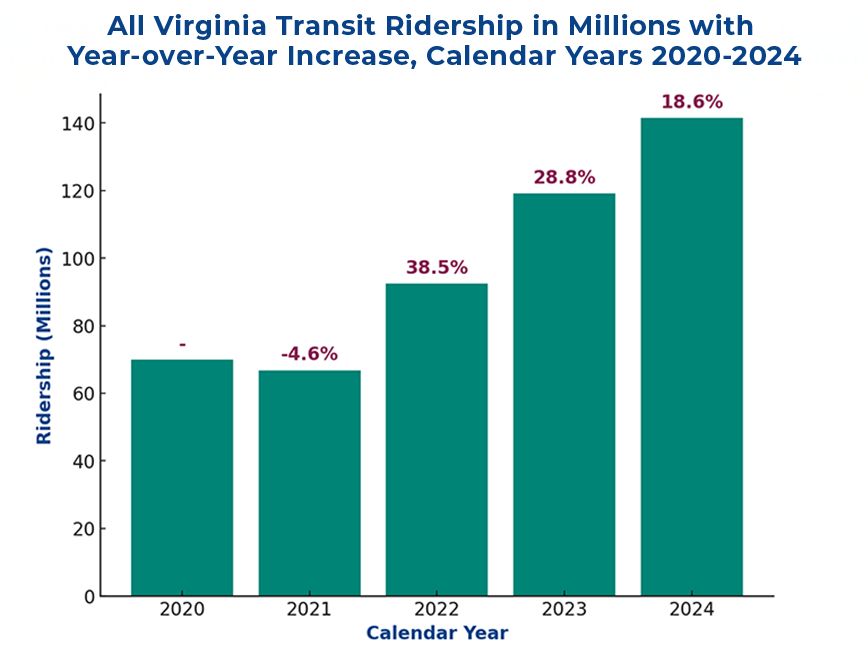
As stated in the introduction, Virginia’s 137.5 million trips was an 18.6% increase over 2023. Since the pandemic, Virginia’s transit ridership has recovered quickly, growing each of the last three calendar years. DRPT anticipates that ridership will increase once again in calendar year 2025.
To kick things off, a quick review of statewide ridership in recent years. The chart below visualizes Virginia’s cumulative statewide transit ridership from 2020 to 2024, as well as the annual change in ridership over the prior calendar year:
|
|
|
As ridership continues to increase, the rate of those increases (the percentage change year-over-year) have decreased, partially due to a larger denominator, but also because capacity restraints, such as the demand for new bus drivers often exceeding the supply of qualified drivers, persisted among many transit systems.

WMATA, the Washington Metropolitan Area Transit Authority, provides the largest proportion of Virginia’s public transit trips. WMATA’s large share of Virginia’s transit ridership means its trends can sometimes obscure the trends of the rest of Virginia’s transit community. The chart below visualizes Virginia’s statewide transit ridership, and its annual growth, with WMATA’s ridership removed for the past five calendar years:
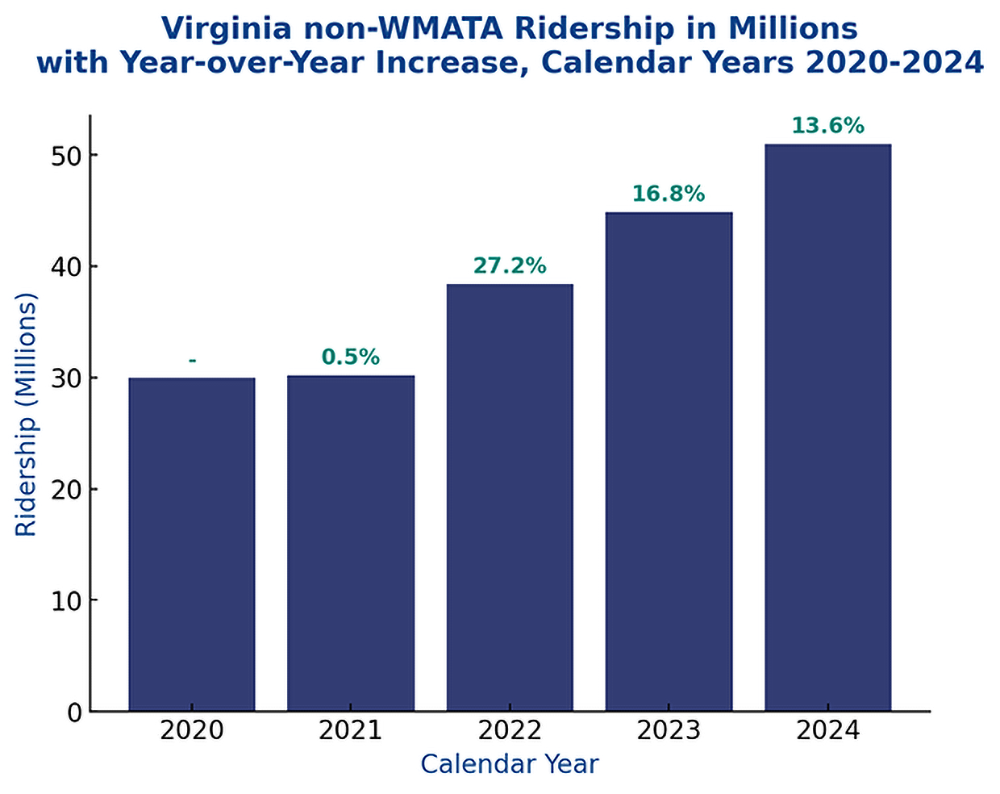
Separating WMATA from overall state ridership numbers tells us two things. First, non-WMATA ridership is recovering from a smaller pandemic-related decrease and began to recover quicker. 2021 non-WMATA ridership was greater (albeit slightly) than 2020 non-WMATA ridership despite a full calendar year of pandemic impacts in 2021. Second, WMATA’s ridership recovery started slower, but has come back with a roar.
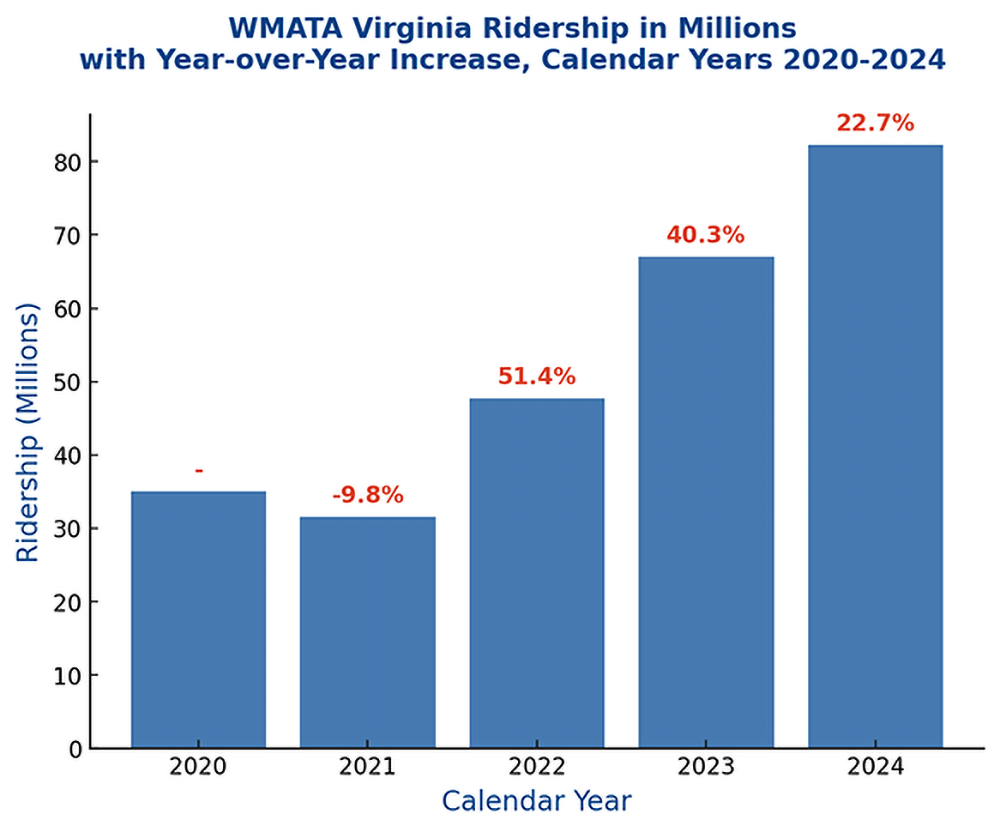
WMATA’s roaring ridership recovery is illustrated in the chart below, showing WMATA’s Virginia ridership form 2020-2024 and annual change percentage. As a note, DRPT only collects ridership from WMATA on trips that either began or ended in Virginia. That means many of WMATA’s trips systemwide – those only in Washington, D.C. or Maryland – are not included. WMATA’s total systemwide ridership is significantly higher.
|
|
The largest increases in ridership – both absolutely and proportionally
While Virginia’s statewide transit ridership has grown each of the past three years, some transit agencies have excelled in driving ridership increases. The two tables below chart the transit agencies with the highest ridership increases from2024, first as numeric increase, then as a percentage increase:
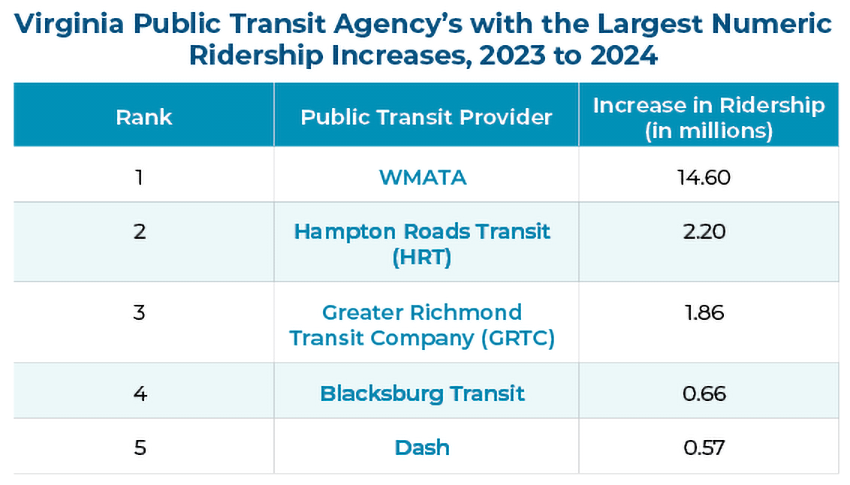  WMATA unsurprisingly saw the largest absolute (numeric) increase in ridership year-over-year as the largest provider of public transit in Virginia. Hampton Roads Transit saw the second largest absolute increase in ridership but, as the table below shows, the largest proportional increase in ridership:
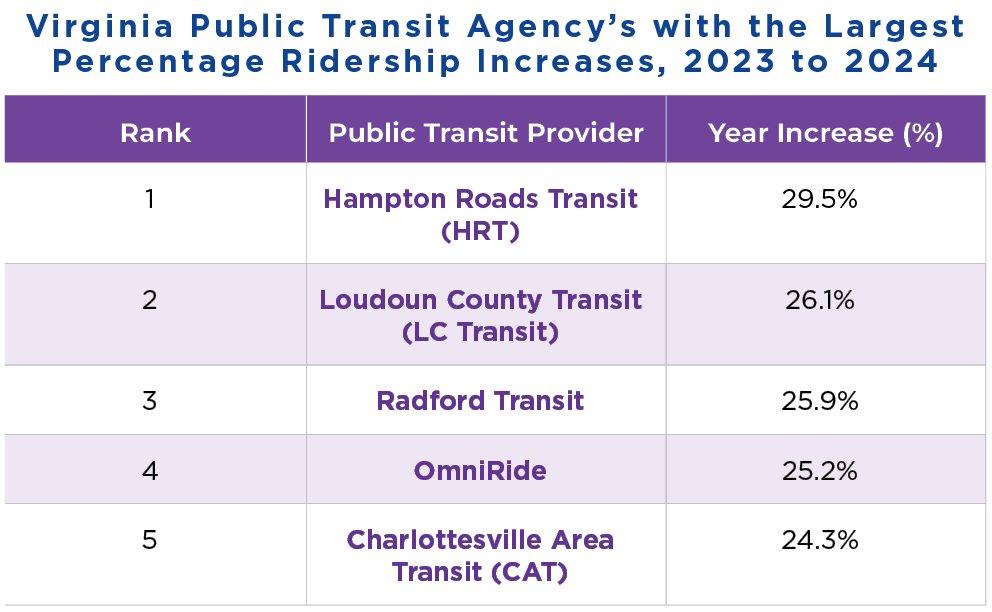 Hampton Roads Transit’s nearly 30% increase in ridership is not only the largest in Virginia, but the third largest increase within similar-sized transit agencies in the entire country. HRT led the way in Virginia for proportional ridership increases, leading the pack as the vast majority of Virginia’s transit providers saw annual increases in ridership as well.
Virginia’s biggest public transit agencies in 2024
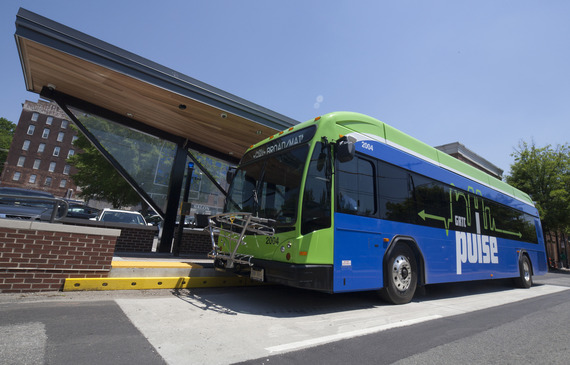 Based on the information already covered in this article, you may be able to guess which of Virginia’s public transit providers are the “biggest” in terms of ridership. Or, if you read the September 2024 Data Story that also looks into ridership, you probably have a good idea. The table below visualizes Virginia’s five largest transit agencies in terms of ridership:
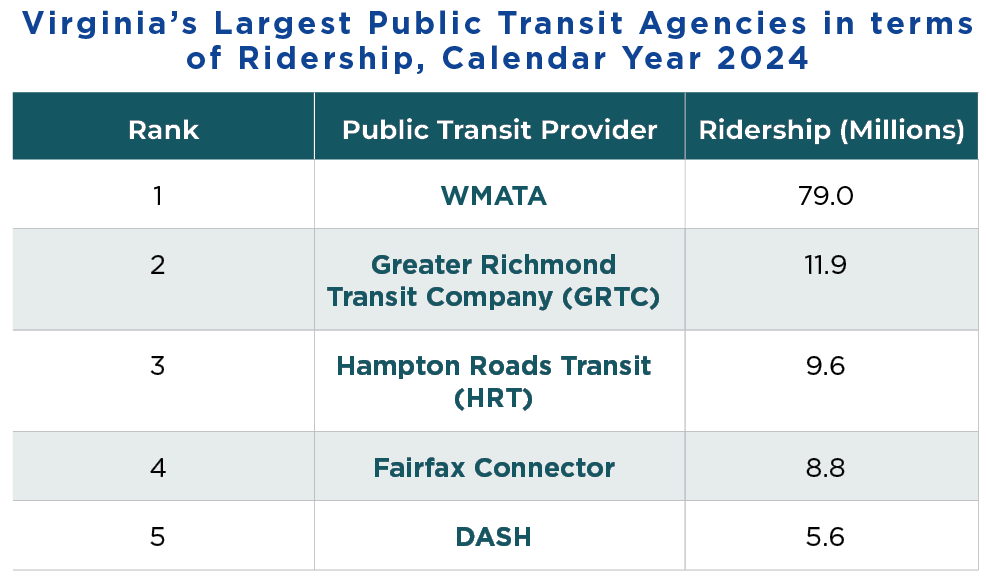
WMATA remains Virginia’s largest transit provider, the same place where it was at the end of fiscal year 2024. With its extensive subway network, large bus operations, and regional paratransit services across Virginia’s largest population center, it is no surprise they remain in first. GRTC, the Richmond region’s public transit provider, maintains its position as the second-largest transit agency in Virginia. Hampton Roads Transit, driven by its huge ridership increase as mentioned above, climbs one spot higher to 3rd, just shy of breaking the 10 million trips mark. Fairfax Connector, the local bus provider for Fairfax County, dropped to fourth, but its ridership remains strong and still grew. Alexandria’s fare-free transit service, DASH, maintains its position as Virginia’s 5th largest transit provider.
Virginia Transit Sets Sights Higher for 2025
DRPT’s strategic plan aims to increase the throughput of people on public transit, and sets a goal for statewide annual ridership. In 2024, DRPT’s strategic plan aimed for statewide ridership to meet 130 million trips. Not only did Virginia’s public transit community meet that goal, but it also exceeded it comfortably with 137.5 million trips. Those trips represent commutes to work, errands ran, families visited, and access to jobs, healthcare, and the surrounding community. These trips take cars off the road, save gas and reduce pollution, and help make Virginia the best place to live, work, and raise a family. DRPT anticipates that ridership successes will continue through 2025. To reflect these successes, DRPT has updated the ridership projection for 2025 to be 148.5 million trips, up from an original projection of 140 million.
|
|

DRPT’s mission is to connect and improve the quality of life for all Virginians with innovative transportation solutions. Our vision is a connected Commonwealth with an integrated multimodal network that serves every person, every business, and every need. DRPT’s Six-Year Improvement Program provides funding for rail and public transportation initiatives across the Commonwealth, enabling Virginia’s rail and public transportation network to thrive. Did someone forward this email to you? Sign up to get Data Stories directly in your inbox! Having trouble viewing this email? View it as a Web page.
Follow Us
|
|
|
|
|