Quality Quick Takes-November 2022
Professional learning for school leaders is essential to school improvement and student success. Leaders' professional growth opportunities are dynamic when training strengthens leadership skills, empowering leaders to mentor and guide staff and students. In addition, offerings may include specific topics such as creating data dialogues with actionable steps or developing deep knowledge on evidence-based educational strategies that leaders can then train and implement with school staff. Professional learning for leaders may also be job embedded opportunities, provided through coaching or mentoring which helps leaders set goals, mitigate daily challenges unique to their schools, receive much needed support and grow professionally. Research tells us what we already know: effective principals have a direct correlation to strong student achievement. We can all agree that the foundation of work in the field of education, our collective “why” if you will, is student success. Our investment and support of school leaders is a must if we are to break through barriers and achieve high levels of student success for all of our students.
Sometimes leader-focused professional learning can miss the mark due to time constraints, funding, offerings that lack varied approaches, or timely topics that match a leader's needs. Key elements for leaders to consider when choosing professional learning or planning for a division:
- Match data-informed needs to learning opportunities;
- Align school, division, and state priorities;
- Include meaningful applied learning experiences that are problem-based and context-specific;
- Provide mentors and/or coaches for support tailored to leaders’ needs;
- Dedicate time and funds for leadership professional learning;
- Focus professional learning on improving school wide instruction for all students;
- Create opportunities to participate in collaborative learning, such as networks of practicing principals, instructional rounds, or analyses of problems of practice;
- Build mechanisms for reflection, planning, and measurement of participant learning, future actions, and impact on student achievement.
School leaders who have ongoing growth opportunities will be knowledgeable and ready to lead more effectively tomorrow than they did today. Read on to register and view details of our virtual Principal Leadership Conference.
On a final note with the season of gratitude upon us, on behalf of the OSQ team, we thank you for your commitment to educational excellence and your service to students, staff, and your community.
Deanna Varljen, Specialist
Office of School Quality
- Correction-The opening message in the October Quality Quick Takes was written by Dr. Debra Lane.
Support for High-Quality Educational Environment
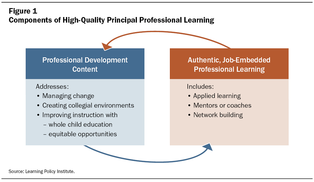
According to the research brief from the Learning Policy Institute Elementary School Principals’ Professional Learning: Current Status and Future Needs (Levin, S., Leung-Gagne’, M., Edgarton, A., Scott, C., 11/11/2020), research has found that high-quality professional learning opportunities for principals—including preparation programs, induction supports for early-career principals, ongoing training, one-on-one support through coaching and mentoring, and peer networks—can build leadership capacity. Such learning opportunities can develop principals’ competence in leading across their full range of responsibilities, empowering them to foster school environments in which adults and students thrive. Principals who have access to high-quality professional learning are typically more likely to remain in the profession. Additionally, teachers appear more likely to remain in schools led by principals who participate in these types of professional learning programs.
Figure 1 below summarizes these components of professional learning that research identifies as contributing to principal learning. Local policymakers and district leaders can play important roles in ensuring that principals have these types of professional learning opportunities to build their leadership capacities.
Promotion of Quality Leadership
Leaders across the Commonwealth work diligently to promote quality in their schools. Please take some time to recognize those leaders. The OSQ Team is happy to announce the names of school leaders who were recognized for their skills in monitoring for implementation and impact. You can view the list of individuals on this document.
Based upon this month's theme on the importance of professional learning for school leaders, please nominate a principal or division leader who has embodied this work as designated in the criteria below. Complete the nomination form by November 28, 2022, for consideration. The leader guides school improvement efforts by:
- Seeking opportunities for professional growth through a variety of resources;
- Regularly sharing leadership practices with peers;
- Using the knowledge gained from professional learning to improve their leadership practices.
Data Connections
The focus of Virginia's Comprehensive Needs Assessment (CNA) is to provide schools with a process to assist with the use of data in the identification of their strengths, areas for improvement, challenges, and successes as well as a mechanism to determine the potential root causes of those needs. All schools in Virginia are required to conduct a CNA, which provides the foundation to develop the Comprehensive School Improvement Plan (CSIP) (§22.1-253.13:6c of the Code of Virginia). This checklist is to support schools in the development of their CNA process and comprehensive school plan.
|