|
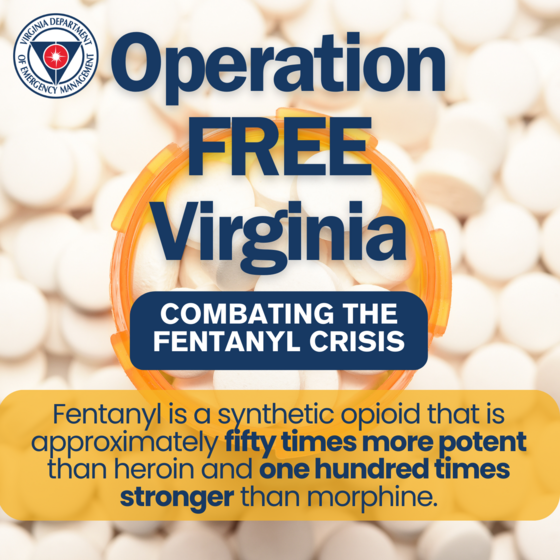
In May 2023, Governor Glenn Youngkin signed Executive Order 26 to defeat the fentanyl crisis in the Commonwealth of Virginia. Fentanyl is a synthetic opioid that is approximately fifty times more potent than heroin and one hundred times stronger than morphine.
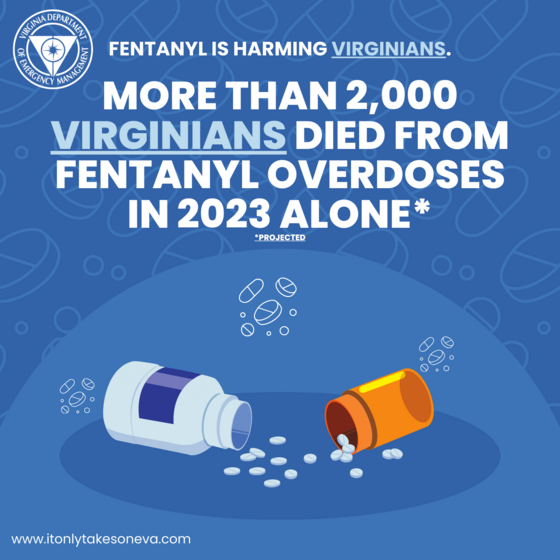
Fentanyl poisoning has devastated families and communities across the nation and in Virginia. The number of fentanyl overdose deaths in the Commonwealth has grown over 20-fold since 2013, with 1,951 Virginians killed by fentanyl in 2022. Since 2020, more Virginians have died from fatal drug overdoses than motor vehicle and gun-related deaths combined. Drug overdose is the leading cause of unnatural death in Virginia.
As part of Operation FREE Virginia (April 1 - May 1), VDEM is doing its part by educating and training our communities, local emergency managers and first responders. We are asking that you help us by sharing this email with your stakeholders, follow us on social media for the latest information concerning this crisis, and telling your co-workers, family, and friends about the dangers of fentanyl.
 First Lady Suzanne S. Youngkin and Attorney General Jason Miyares announced the launch of the Fentanyl Awareness Pilot Program at the Fralin Biomedical Research Institute in Roanoke, VA.
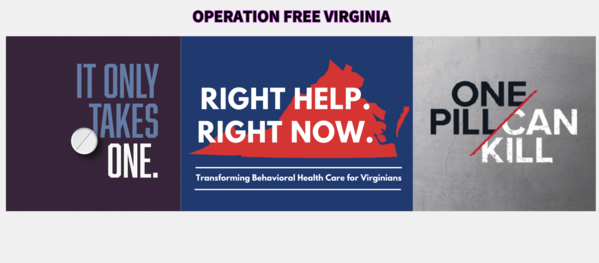
The first-of-its-kind, Virginia Department of Health awareness initiative is being implemented with support from the First Lady of Virginia and the Virginia Foundation for Healthy Youth (VFHY) in partnership with Attorney General Miyares’ ‘One Pill Can Kill’ campaign.
The campaign strives to warn parents and caregivers that “it only takes one.” One bad decision, one counterfeit pill can cost a life. Fentanyl poisoning has become the leading cause of unnatural death in Virginia with an average of five Virginians dying every day. Since 2019, deaths have more than doubled in the Roanoke region.
Click on graphic below for more information.
Preparedness starts with you, but it takes the collaboration of the whole community to achieve a culture of preparedness. Here at VDEM, we focus on how to support the whole community (localities, communities, first responders, families) with preparing for, responding to, recovering from, and mitigating the impacts of natural and man-made hazards. We use the National Incident Management System (NIMS) and Incident Command System (ICS) to assist us and our partners to prepare, respond, recover, and mitigate all events and incidents from hurricanes, flood, snow, hazardous materials, epidemic, and many others.
Fentanyl is considered a human made hazard and although a public health centric crisis, we can all have a role in stopping its spread and mitigating the impacts. Emergency Managers and their partners rely on staying current with training, trends, plans and policies to help keep communities prepared and resilient. Below are a few independent study classes that are available, free of charge, that any member of the community can take to have a better understanding of what you can do to be prepared, learn about NIMS and ICS. These classes are required training for all responders, (law enforcement, Fire, EMS, Emergency Managers, etc.) and are the basis for how we respond and operate. If you are interested in learning more you can go here . Fentanyl is hurting Virginia. Get Naloxone, help save a life (itonlytakesoneva.com) or our website
Independent Study (IS) Courses Recommended for All Levels
To take these classes you must have a FEMA Student ID- you can easily register for one here FEMA Student Identification (SID) System (dhs.gov)
WEEK 1 Courses
IS-100.C: Introduction to the Incident Command System, ICS 100
CEUs: 0.2
Course Length: 2 hours
Prerequisites: None
Course Overview
ICS 100, Introduction to the Incident Command System, introduces the Incident Command System (ICS) and provides the foundation for higher level ICS training. This course describes the history, features and principles, and organizational structure of the Incident Command System. It also explains the relationship between ICS and the National Incident Management System (NIMS). The Emergency Management Institute developed its ICS courses collaboratively with:
- National Wildfire Coordinating Group (NWCG)
- U.S. Department of Agriculture
- United States Fire Administration’s National Fire Programs Branch
Link to Course : FEMA - Emergency Management Institute (EMI) Course | IS-100.C: Introduction to the Incident Command System, ICS 100
IS-700.B: An Introduction to the National Incident Management System
CEUs: 0.4
Course Length: 3.5 hours
Prerequisites: None
Course Overview
This course provides an overview of the National Incident Management System (NIMS). The National Incident Management System defines the comprehensive approach guiding the whole community - all levels of government, nongovernmental organizations (NGO), and the private sector - to work together seamlessly to prevent, protect against, mitigate, respond to, and recover from the effects of incidents. The course provides learners with a basic understanding of NIMS concepts, principles, and components.
Link to Course: FEMA - Emergency Management Institute (EMI) Course | IS-700.B: An Introduction to the National Incident Management System
IS-908: Emergency Management for Senior Officials
CEUs: 0.1
Course Length: 1 hour
Prerequisites: None
Course Overview
The purpose of this course is to introduce senior officials to the important role they play in emergency management. The responsibility for preparing for, responding to, and recovering from incidents, both natural and manmade, begins at the local level – with individuals and public officials in the county, city, or town affected by the incident. This course presents:
- Simple steps official can take to become acquainted with their emergency management role, authorities, and team members.
- Video presentations sharing lessons learned from officials of the City of Baton Rouge, East Baton Rouge Parish, Louisiana.
Link to course: FEMA - Emergency Management Institute (EMI) Course | IS-908: Emergency Management for Senior Officials
IS-909: Community Preparedness: Implementing Simple Activities for Everyone
CEUs: 0.1
Course Length: 1 hour
Prerequisites: None
Course Overview
Community members are the key to our Nation’s preparedness and resilience. As such, we need to:
- Support the development of prepared, vigilant, and engaged communities.
- Foster strategic partnerships among:
- The private sector.
- Nongovernmental organizations.
- Foundations.
- Community-based organizations.
The purpose of this course is to present a model program for community preparedness. In addition, resources materials are available to help organizations conduct simple preparedness activities for everyone.
Link to Course: FEMA - Emergency Management Institute (EMI) Course | IS-909: Community Preparedness: Implementing Simple Activities for Everyone
IS36.A A preparedness for Childcare Providers
CEUs: 0.2
Course Length: 2 hour
Prerequisites: None
Course Overview
This course will provide childcare providers, in a variety of settings, with the information they need to identify, assess, and plan for hazards at their childcare site.
Link to Course: FEMA - Emergency Management Institute (EMI) Course | IS-36.A: Preparedness for Child Care Providers
|