|
This past March, the Department of Parks & Recreation conducted its second deer population aerial drone survey. Using thermal imaging, visual spectrum imagery, and GPS, program staff got an updated snapshot of the deer population in Arlington. A prior aerial survey from 2021 allows us to now analyze population change over time.
Key Findings
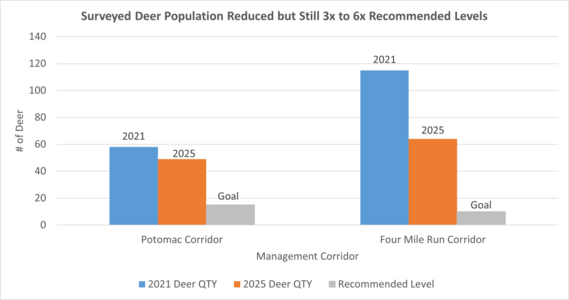
- Arlington's surveyed deer population declined 23% from 2021, but was still approximately 3x to 6x above recommended levels in key wildlife corridors that contain most County natural lands.
- The Potomac River Corridor's deer population was 3x higher than recommended levels for forest health and regeneration.
- The Four Mile Run Corridor's deer population was 6x higher than recommended levels for forest health and regeneration.
While the observed population has declined, ongoing deer monitoring and management remains necessary to restore forest health and protect biodiversity in County-owned natural land parks.
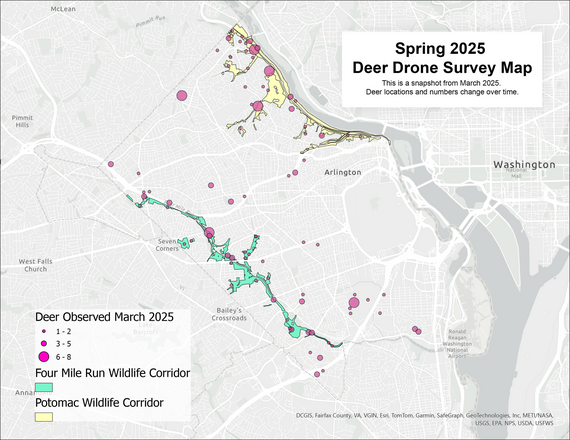
Below is a map of Arlington County with locations where deer were detected symbolized as circles of varying sizes to indicate quantities of deer observed.
This graph compares the deer population for both corridors in 2025 and 2021. The graph includes a grey bar that indicates the recommended population level for forest health and regeneration.
|
|
Frequently Asked Questions
Why did the observed deer population decrease from 2021 levels?
- Deer populations are increased by immigration and births and decreased by emigration and deaths by various causes. Staff does not have good data on how these different factors intersected to cause an overall decrease in the number of deer documented since 2021. Aerial surveys can also over or undercount deer, which can impact the number of deer they report. The contractor, methods, and technology employed for this survey were selected to minimize any potential inaccuracies.
Can we compare the 2021 and 2025 deer drone surveys?
- Yes. Both surveys were conducted by the same contractor using similar methods. The 2025 survey used improved thermal imaging cameras, which may have improved the accuracy of deer detection when compared to 2021.
Since the observed deer population decreased, do we still need to manage deer?
- Yes. Even though the overall observed population declined from 2021, our key wildlife corridors remain significantly above recommended population densities for forest health and regeneration. Ongoing monitoring and management remain necessary to understand our deer population and manage its impacts on our forest ecosystems.
Why are deer being measured by wildlife corridors instead of individual parks?
- Deer don't stay within park boundaries, they move across natural areas and neighborhoods. Wildlife corridors better reflect how deer move and allow for more effective population tracking and management.
What happens next?
- Staff will use this updated deer population data to inform deer management. Drone survey data will be complimented by annual field surveys to document deer impacts to native plants that will be conducted this summer and fall. If indicated by data, the program will reduce deer populations using professional sharpshooting in January/February 2026.
To learn more and access resources related to 2025 deer drone survey, visit the Deer Management Program webpage.
|
|
|
|